

Home Blog

How to Spot a Love Spell Scam Before You Send Money

0
How to Spot a Love Spell Scam Before You Send Money — human-centered editorial illustration

Quick Guide

Before paying, identify the provider, the concrete service and the maximum total cost. Pause when a seller guarantees another person’s love, creates fear or insists that more payments are necessary. Keep your records.

When you miss someone or hope that the relationship can be fixed, a reader who promises a reunion can feel intriguing. A love spell seller might seem to understand the pain behind your question before anybody else does.

Because of this, you need to make sure to slow down and check the offer carefully. No seller can guarantee another person’s love, return, or consent. A spiritual service should never turn your hope into an obligation to pay for something you can’t afford.

You can believe in things like spiritual connections, intuition, and rituals, but still ask regular consumer questions, such as:

  • Who is providing the service?
  • What will you receive?
  • What is the full price?

This guide looks at decisions before making a payment. Even though the examples in this guide are fictional, the information is a practical precaution rather than a way to certify someone’s supernatural ability.

Describing the Purchase So the Buyer Can Understand It

Before ever sending money, you should write down what you’re planning on buying without relying on the seller’s promises. If you’re buying a written ritual or a 30-minute reading that’s described in a service, this is a good place to start. You shouldn’t buy something that says, "My ex will return within 7 days," because this is something the seller cannot control.

If you can’t get a concrete deliverable, then ask for one. Is the offer a reading, a recording, or a written interpretation? The seller might keep elements of the spiritual tradition private, but that shouldn’t prevent a clear description of what you’re buying. You should still know what you’re paying for and what the fee covers.

The first step shows if the offer is understandable. A service that can’t be described without guaranteeing another person’s behavior needs more caution before you make any purchases.

Checking the Profile of the Account

A social media profile can look amazing without revealing who operates it. Look for:

  • A business name you can check.
  • Working contact details.
  • Clear terms and a process for raising problems.

Find out if the payment receipt matches the provider or if it has a different relationship that’s explained. An unfamiliar name doesn’t automatically mean fraud, but you need to understand what it means before you purchase anything.

Always be careful with accounts that contact you unexpectedly after you comment on a breakup, grief post, or a spiritual video. Personal details in your public activity can help strangers sound informed and know more about you.

Don’t just verify who they are on the links they send you but look up the business through independent sources and the platform’s own account tools. If the seller avoids identity questions by saying that trust is important to the ritual, think about whether that explanation works in your interest or prevents you from having trust.

Guarantees Should Look Like Red Flags

A promise to bring back a specific person disregards that person’s freedom to choose. Treat it as a warning sign, however confidently it is presented.

U.S. Postal Inspection Service guidance warns about romantic promises and increasing payments. The issue isn’t that you want love, but it is a seller presenting an uncontrollable result as a dependable purchase.

Also, be cautious if a reader gives you exact deadlines or success percentages without credible evidence or claims that every failed relationship can be fixed. Ask the reader what supports the claim and what they mean by success. Does a message from the person qualify as a reunion, even if reconciliation never comes? Can the deadline be moved indefinitely?

If every time you ask a question, the definition changes, the guarantee might give less protection than it seems to. Don’t confuse confident wording with measurable service commitments.

Read Reviews

Reviews help people understand whether appointments happen, whether the communication is clear, and whether billing matches what the site offers. They’re less useful as proof of a ritual and how it causes someone else’s behavior.

Always look for specific reviews instead of repeated phrases. Compare more than one review source if possible and pay attention if critical reviews get a practical response or if there’s a personal attack.

FTC advice on evaluating online reviews encourages looking beyond a single rating or source. A glowing collection on the seller’s own page is not the entire picture.

Don’t think that a screenshot of a happy message is independent evidence. You might not know who wrote it, what happened before the message, or whether the message actually represents a real experience. Use the reviews to ask better questions about the quality of the service and avoid treating them as a guarantee about your own relationship.

Asking for the Full Price

Some offers start with a small payment and introduce additional work afterward. A seller may claim that the ritual uncovered resistance, a rival’s influence, or a more serious blockage.

Before paying, ask if the quoted fee covers the entire service or if other purchases could be requested later. Ask specifically about materials, consultations, renewals, and charges for follow-up questions.

Set a personal maximum total before you ever do the reading, independent of whatever explanation may be offered later. A clear answer might be: “The fee includes one consultation and the written instructions. No additional purchase is required.” A vague response such as “We will see what the energy needs” leaves your potential cost open-ended.

You can decline an offer that cannot define its financial boundaries. A spiritual explanation shouldn’t be a reason to keep paying more money.

Recognizing Emotional Pressure

Urgency may be framed around a moon phase, an ex’s new relationship, or a claim that a spiritual window is closing.

The biggest question to ask is if you’re still free to think, compare terms, and consult someone else. A meaningful date does not justify threats, pressure, or concealment. Try saying: “I will not make this decision today. Please send the full terms in writing.”

A legitimate service may have a genuine booking deadline, but it should be able to explain that deadline without predicting punishment or disaster.

Pay attention if the seller responds by saying that there is danger or offering a sudden discount that is available only if you pay immediately. That behavior changes the focus away from evaluating the purchase and toward making you act under pressure.

Missing an offer is usually easier to manage than committing to paying money while feeling pressured. You do not need to buy time from someone who created the deadline.

Giving Too Much Information

A seller might ask for pictures, names, birthdays, or a description of your relationship. Look at each request separately instead of just thinking that a spiritual service has to have all the information.

Don’t send intimate images, passwords, documents, or another person’s private conversations just because the seller says they’re needed for a connection. Ask the reader why the information is needed, who’s going to see it, and how it’s stored. If you’re not comfortable with the answer, don’t send it.

A picture that feels emotionally important can also become information that you can’t get back once you share it. Use care with images that involve other people. You can talk about your own question without exposing a former partner’s address or medical history. It’s important to respect privacy when getting spiritual reflection.

Payment Processes Should Be Understood

Use the payment process that you understand. Keep records of the service that you agreed to. Don’t let the conversation rush you into a certain method just because a hard question comes up later.

If the seller asks for gift card codes, banking information, one-time verification codes, or wants access to your device, these are not normal requests for a reading or a ritual consultation.

If the merchant name or the amount is different from the agreement, resolve it before you send the payment. Don’t follow instructions that aren’t described in what you’re purchasing. No payment method guarantees that you’ll get your money back after a dispute, and the goal is to know the process and avoid giving more access than the transaction requires.

If something seems unclear, take a pause. A seller’s hurry does not make a confusing payment request safer or easier to reverse.

Understanding the Refund Language

A money-back-if-it-fails promise might feel reassuring, but the details matter.

  • What counts as failure?
  • When can you apply for a refund?
  • Is the refund returned to your payment method or issued as account credit?
  • Must you purchase additional rituals to qualify?
  • Can the seller exclude claims by blaming doubt, contact with your ex or an unrelated event?

An offer that makes success impossible to measure can make its refund policy hard to use. Ask for the terms before paying and save them. A later explanation should not silently replace the agreement you relied on.

Know that the refund policy needs evidence. A seller that offers reimbursement hasn’t shown an ability to control romantic outcomes. If the policy needs you to keep paying before you can qualify for a refund, consider whether this is working to protect you or is another step in the sales process.

Pre-Payment Reviews

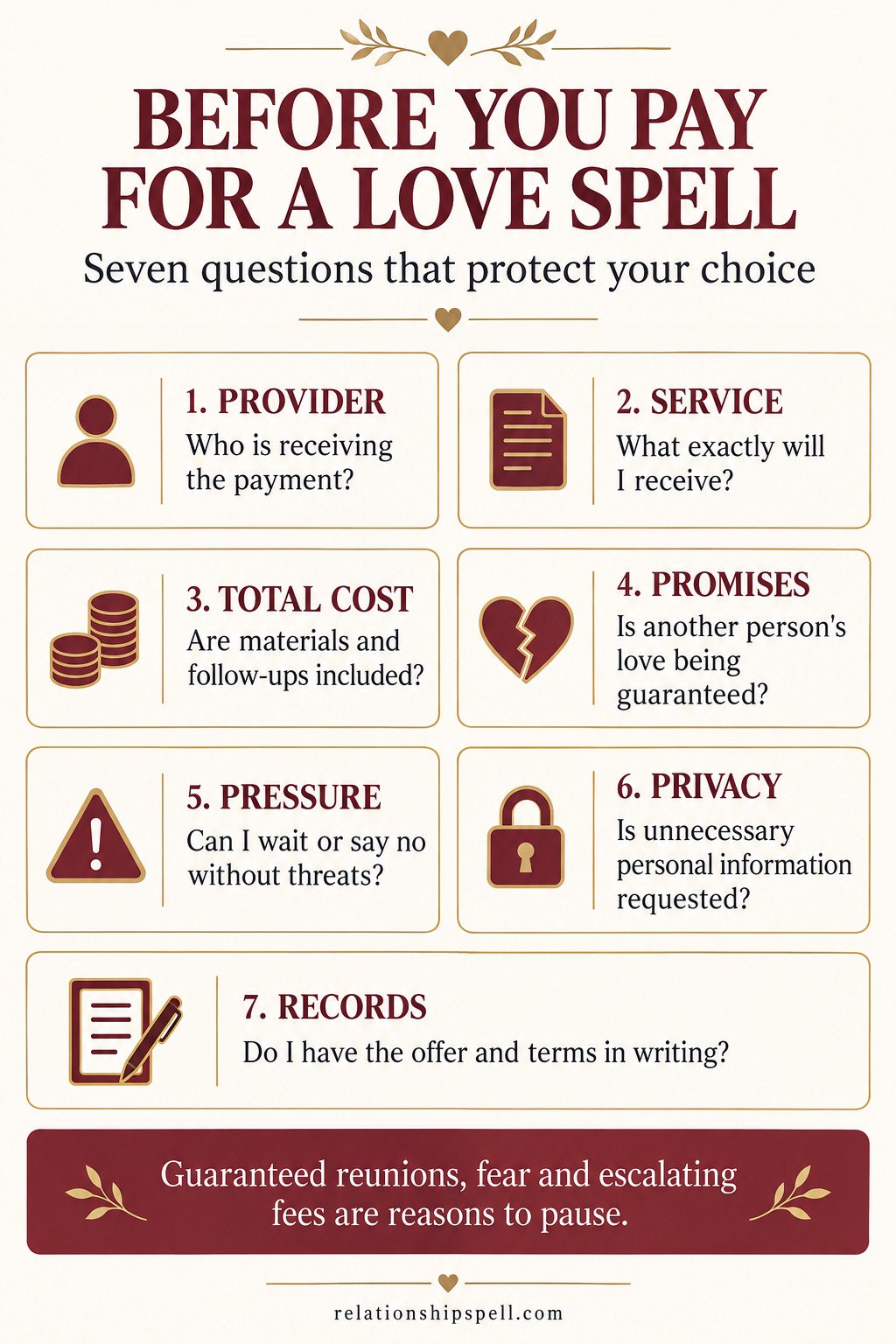
Before you send money, answer these questions:

  • Who is receiving the payment?
  • What concrete service will I receive?
  • What is the maximum total cost?
  • What outcome is being claimed, and can it be supported?
  • What happens if I decline more work?
  • What information am I being asked to share?
  • Can I discuss the purchase with someone I trust?

You may not be able to verify every claim, but unresolved questions about identity, cost or pressure are reasons to pause—not reasons to lower your standards. Give yourself time before you complete the review and before paying. If the answers change during that time, look at the new offer instead of just assuming the original offer still applies.

This checklist is an editorial tool, and it can’t certify the provider, but it can make an emotionally charged purchase easier to look at.
A Fictional Example of Stopping Before the Payment

Imagine that Daniel gets a message from someone claiming that his ex still loves him but that an outside influence is keeping them apart. The seller offers to perform a ritual for a low starting price.

Daniel asks what the payment includes and how much the ritual will cost altogether. The seller explains that the first payment only starts the work but won’t give him a final price. When Daniel says that he wants a day to think about it, the seller warns him that if he waits, his ex could become permanently unavailable.

At this point, Daniel notices several warning signs. The seller is making claims about another person’s feelings that can’t really be proven, won’t tell him how much he could end up paying, and is using fear to pressure him into making a quick decision.

Daniel doesn’t have to argue about whether rituals or spiritual practices can be meaningful. He decides not to pay and saves the messages in case the seller keeps contacting him.

Walking away doesn’t mean that Daniel has to give up the spiritual beliefs or practices that are important to him. It just means that he recognized a situation that made him uncomfortable and decided to protect himself and his money.

What If You Already Paid?

Do not send another payment because the seller claims your earlier spending will otherwise be wasted. Pause the transaction and gather your records, including the advertised offer, terms, messages, receipts, the payment receipt, and any other information. Then contact your payment provider promptly and explain the situation accurately. Do not describe a payment you knowingly made as unauthorized.

FTC guidance for people who were scammed explains possible next steps for different payment methods. It does not guarantee reimbursement. Then take time to report the account to the platform. If identity information was exposed or the threats keep happening, then get advice from authorities.

Don’t tell every recovery step to the seller. You don’t need their permission to ask a bank or platform about your refund options. If someone new offers guaranteed recovery for an upfront fee, verify this carefully instead of accepting another urgent promise.

Declining a Purchase Does Not Erase Longing

For a reflective practice that does not promise control over someone else, see our consent-based love rituals.

Even after you decline an offer, you might still want to get your relationship back. Recognizing a transaction that is concerning doesn’t mean it removes your longing. Consider a private action that doesn’t depend on the seller or your ex, such as writing an unsent letter, talking to a friend, or figuring out the kind of relationship you want in the future.

If dream interpretation is something that’s important to you, write down your dream as an experience instead of proof that you’re going to get back to your ex. Ask what this shows about your hopes, not what kind of payment you would have to make.

Set a boundary about looking at love spell offers. Repeated exposure might keep the purchasing decision active when you would be better off focusing on something else. Your wish for a connection does deserve care, but it doesn’t have to become a project with an unlimited budget.

Check the offer before sending money

1. Service

What will actually be delivered, apart from a promised romantic outcome?

2. Cost

What is the full price, including renewals, materials and follow-ups?

3. Freedom

Can I decline, wait or ask someone else without threats or guilt?

Key Takeaways

  • A confident romantic promise is not evidence that a seller can deliver it.
  • A free consultation can still introduce pressure and upsells.
  • Protect private images, messages and verification codes.
  • If you already paid, contact your payment provider promptly; refunds are not guaranteed.

Related Reading

Frequently Asked Questions

1. Are all paid love rituals scams?

No. A fee alone does not establish fraud. Evaluate the deliverable, evidence, terms and pressure tactics.

2. What is the clearest warning sign?

A guarantee that payment will make a particular person love, return or obey deserves serious caution.

3. Is a free consultation risk-free?

No. It can lead to upsells, pressure or unnecessary requests for private information.

4. Can reviews prove a spell works?

Reviews may describe service and billing, but they do not establish that a ritual caused another person’s behavior.

5. What should the price include?

Ask about consultations, materials, follow-ups, recurring charges and whether any later purchase is required.

6. What if a seller claims to discover a blockage?

Do not treat an unverifiable explanation as an obligation to pay more. Pause and reassess the entire offer.

7. Should I pay to meet a spiritual deadline?

A claimed spiritual deadline is not a reason to abandon ordinary checks or accept threats.

8. What information should I avoid sharing?

Avoid passwords, verification codes, intimate images, identification documents and other people’s private messages unless a legitimate necessity is clearly established.

9. What if the seller knows details about me?

Some details may come from public activity or prior disclosures. Knowledge of details does not validate every claim.

10. Do refund promises guarantee protection?

No. Read eligibility, deadlines, refund form and exclusions. Recovery can depend on the facts and payment method.

11. Should I use gift cards for payment?

Requests for gift-card codes are a major warning sign. Do not send codes to a seller making romantic promises.

12. What if I already paid?

Save the offer, terms, messages and receipts, and promptly ask your payment provider about options. Describe events accurately.

13. Can a recovery service guarantee my money back?

Be wary of unsolicited promises of guaranteed recovery for an upfront fee. Independently verify any assistance.

14. Can I choose a self-focused ritual instead?

You can use a reflective practice about your own intentions without promising control over another person.

15. Do I need to justify walking away?

No. Unclear terms, pressure or discomfort are sufficient reasons to decline a purchase.

Consent-Based Love Rituals: A Safe Spiritual Guide

0
Consent-Based Love Rituals: A Safe Spiritual Guide — human-centered editorial illustration

Quick Guide

Focus on your own intentions and respectful actions. In shared rituals, ask about the specific activity and make stopping easy. No ritual, dream or symbol overrides a person’s refusal or creates consent.

A love ritual can be as easy as writing an intention, choosing a meaningful object, or making time for a conversation. Those who believe in spiritual energy might use a ritual to show devotion, hope, or openness to a connection.

Consent-based love rituals make sure that another person’s freedom is respected. They focus on your own choices or on an activity that everyone is allowed to agree to instead of promising to make someone love you, come back to you, or obey you.

This guide treats rituals as spiritual or reflective practices, not as ways to control another person’s feelings. These exercises are suggestions and aren’t historical reconstructions or proven treatments.

You can be hopeful about love but still respect uncertainty. A useful ritual connects reflection with respectful action in daily life.

Start With What is Yours

Your attention, intentions, communication, and boundaries are yours, and another person’s feelings, decisions, and availability are not yours to decide. Knowing the difference can guide the wording of your ritual, such as “help me to welcome mutual love,” which leaves a person free to make their own decisions, instead of saying “make this person love me no matter what,” which doesn’t.

The issue isn’t if the second intention will work or not, but it’s about the attitude and behaviors it encourages, which is treating someone’s refusal as a problem that you have to overcome or change.

At the beginning, the intention should make you feel comfortable explaining it to the person involved. If it doesn’t, find out if it relies on possession, secrecy, or out-of-control expectations.

You can change your intention without losing emotional truth so that you can do it with honesty and self-respect.

Consent Can Change

Agreeing to date someone isn’t agreeing to a ritual, and agreeing to a ritual doesn’t mean you agree to touch, recording, pictures, or a lifelong commitment with someone.

Consent-based practices should look at the actual activity, such as lighting a candle to talk about hope. You should always ask if the person involved is open to the ritual.

Consent means a freely chosen, specific agreement to the activity. It can be withdrawn. Applying this principle to spiritual rituals is the ethical approach used in this guide.

Either person is allowed to change their mind, and the ritual should be easy to stop without guilting someone else. If your partner doesn’t want a spiritual version, you can decide if a simple conversation can feel meaningful. You don’t have to have the same beliefs to have shared participation.

Private Intentions Don’t Create Permission

You might privately wish that someone would reflect on a relationship, and this doesn’t create permission to message them repeatedly, visit them at their house, or to try to get on a blocked account.

A dream, card, or ritual impression doesn’t substitute for the person’s actual response, but if they have asked you for no contact, respect that. You can direct a ritual toward your own actions, and you need to make sure that you set intentions for yourself and not someone else.

After a breakup, for example, you might want to put an unsent letter in a drawer and then look at it again later. This acknowledges longing without you trying to obligate another person. The difference matters because spiritual meanings can feel urgent, and you can give that urgency a place of reflection instead of taking some kind of action.

Ritual One: Make Room for Mutual Love

This ritual focuses on thinking about the kind of relationship you want and what you can bring to it.

Find a quiet place and grab a piece of paper. If you like using symbolic objects during your rituals, you can place one nearby, but you don’t need to buy anything special.

Write down three qualities that are important to you in a relationship, such as honesty, warmth, and reliability. Under each one, write something that you’re willing to give and something that you hope to receive.

For example, under the word honesty you might write, “I will be honest about my intentions,” and “I want someone who tells me when their plans change.” This can help you think about what those qualities would actually look like in a relationship.

Finish by picking one small action that you can take. You might honestly update your dating profile, walk away from an interaction that feels disrespectful, or spend more time with people who treat you well.

Keep the paper somewhere so that you can look at it again. The purpose isn’t to guarantee that you’ll find a partner. Instead, it’s a simple way to think about what you want from a healthy and mutual relationship.

Ritual Two: Have a Relationship Check-In Together

This ritual is for two people who both want to participate.

Pick a comfortable place and decide how much time you’d like to spend on the ritual. Before getting started, talk about any subjects that either person would rather not discuss. You can pick a symbolic object together or keep things simple with something like two cups of tea.

Take turns finishing two sentences: “Something I appreciated recently was…” and “Something I would like us to talk about is…” Give each other time to listen before responding.

Afterward, pick one small thing that you both feel comfortable doing. This might be having a phone-free meal, communicating plans more clearly, or asking before sharing pictures of each other.

Don’t use the ritual to pressure someone into making a promise that they’re not comfortable making. Sometimes the most helpful thing that comes from the ritual might be realizing that you need more time or that there’s something you should talk about later.

At the end, ask each other if you’d like to do the ritual again sometime. Both people should always have the choice to participate.

Ritual Three: Let Go of an Expectation Without Letting Go of Love

Sometimes you aren’t trying to attract a new relationship. You might simply want to stop putting so much of your time and energy into hoping for one particular outcome.

Start by writing down what you hoped would happen. Then think about the difference between what you hoped for and what you can actually control. For example, you could write, “I wanted us to get back together, but I can’t make that decision for both of us.”

Next, write down something that you want to take with you from the experience. This could be something that you learned about communication, a memory that means something to you, or something that you learned about yourself. Finish by writing down one boundary that could help you move forward.

You can fold the paper and keep it somewhere, put it in your journal, or recycle it when you’re finished. You don’t have to burn it or do anything dramatic with it.

This ritual isn’t meant to make sadness suddenly disappear. Instead, it gives you a way to work through some of your feelings while also focusing on something that you can do for yourself.

You can repeat the ritual whenever it feels helpful, but there’s no schedule that you have to follow. If you decide that you don’t want to do it again, that’s completely okay too.

Physical Safety Is Important

A ritual doesn’t need to have oil, smoke, flames, ingestible mixtures, or objects put on someone’s body. A paper-based practice can have the same intention without adding these things.

If you use candles, make sure that you are using fire precautions and don’t leave the flame unattended. The U.S. Fire Administration’s candle guidance recommends stable holders, separation from combustible objects and extinguishing candles when you leave the room. A flameless candle is a simpler option.

Don’t put things in a person’s food, drink, bath, or their belongings without them agreeing to it. Consent is still necessary when you regard a substance as purely symbolic. Never make health claims about herbs or oils that are used in a ritual. Products can carry their own risks and shouldn’t be assumed safe just because they are natural.

A simple practice need not feel less meaningful, but its meaning can come from the attention you bring instead of just how complex the materials are.

Respect Photos, Messages, and Personal Belongings

Using a photograph might seem like a natural part of a love ritual, but it’s important to think about where the picture came from and how you plan to use it.

Just because someone posted a picture publicly doesn’t mean that you have permission to share a ritual involving them or make it seem like they participated. Private messages should also stay private, especially when another person hasn’t agreed to have them shared with a psychic or used as part of a paid reading.

Instead, you can use something symbolic that represents your own intention. This might be a stone that represents stability, a blank card for new possibilities, or even a piece of paper with a word like “mutual” written on it.

If you and your partner decide to use a photo together, talk about keeping the ritual private or sharing it before posting anything online. Both people should be comfortable with what’s being shared.

The same thing applies to personal belongings. If you’ve borrowed something from another person, return it like you normally would. A love ritual isn’t a reason to take, hide, damage, or keep something that belongs to someone else.

Dreams Are Not Consent

If you believe that dreams have spiritual insight, a dream about someone might feel encouraging, but it doesn’t mean what is going on in someone’s waking life.

Write down the dream before you interpret it, and write down what happened, what you felt, what questions you have, and what your concerns are. A dream of a reunion can invite you to pay attention to longing, but it doesn’t prove that your ex wants contact or that your current partner is agreeing to a ritual.

Ask yourself, “What would respectful action look like if I had not had this dream?” Use the answer to guide your own behavior, without treating the dream as permission to contact someone.

This kind of approach leaves room for personal meaning without giving the symbol authority over someone else’s boundaries.

Pay Attention to Control

Before paying for a ritual, use our love-spell scam checklist to examine the provider, promised service and full price.

A psychic might offer supportive ritual designs but be cautious about guaranteed reunions, obedience, obsession, or the removal of a romantic rival. Those promised outcomes depend on another person’s choices. A seller shouldn’t present them as results that can be purchased.

The U.S. Postal Inspection Service’s psychic-scam warning describes costly promises involving love and other desired outcomes. These warning signs do not establish that any particular practitioner is dishonest.

Ask what you’re buying, such as a ritual, a consultation, materials, or claimed results. A clear activity is easier to evaluate than an unverifiable guarantee. If the psychic says refusal will hurt the relationship or that more payments are needed to prevent consequences, step away. Your wish for love should not become a reason to spend beyond your limits.

Hesitating About Spiritual Rituals

If someone hesitates, give that response space. Find out what makes them feel uncomfortable instead of trying to talk the person into participating. They might not like the spiritual language, might worry about being recorded, or prefer not to talk about sensitive issues in a ritual setting. These are useful differences.

You can give alternatives without pressure, such as taking a walk, a written exchange, or a regular conversation. The answer might still be no. Avoid saying that a loving partner would agree or that the refusal shows negative energy. This is unethical.

Shared meaning can develop through differences, and one person might see the activity spiritually, but the other sees it as a reflection. If both understand and accept what they are doing, they can participate on that basis. If either person is uncomfortable, change or stop the activity.

An Example of Changing a Love Intention

Imagine someone named Elise who wants to perform a love ritual because she hopes that her ex will come back. The relationship has ended, and her former partner has made it clear that they need some space.

At first, Elise makes her intention, “Bring them back.” After thinking about it, she realizes that getting back together isn’t something that she can decide on her own.

Instead, she changes her intention to “Help me make room for love that’s freely shared and help me respect the space that’s been requested.” As part of her ritual, Elise writes a letter that she doesn’t send and decides to stop checking her ex’s social media for a while. She also makes plans to spend an evening with a friend.

Changing the intention doesn’t mean that Elise suddenly stops missing the relationship. It simply gives her a way to work through those feelings while still respecting the other person’s choices. That’s what a consent-based love ritual is about.

Pay Attention to Rituals and Actions

After performing a ritual, think about anything that you did differently afterward. Maybe you communicated more clearly, respected someone’s answer, or realized something that you need in a relationship.

These things can tell you more than looking at every coincidence as proof that your ritual worked. For example, getting a message afterward doesn’t necessarily mean that the ritual caused it, and not getting one doesn’t mean that you did anything wrong.

If you enjoy journaling, you can write down what happens and how you feel along the way. Just remember that not everything that happens afterward has to be connected to the ritual.

If you notice that the practice is making you spend more time thinking about how to control another person’s choices, it might be a good idea to change your intention or take a break. A love ritual shouldn’t make your entire life revolve around getting one particular outcome.

You can always try something different without thinking that you failed spiritually. The purpose is to give yourself a meaningful way to reflect on your feelings and choices, not to perform everything perfectly.

From intention to respectful action

1. Choose your focus

Name a quality you can practice, such as honesty or accepting an answer.

2. Check agreement

Ask before involving anyone’s body, belongings, private messages or photos.

3. Act and reflect

Take one practical step. Treat coincidences as events, not proof of control.

Key Takeaways

  • Personal meaning does not establish supernatural effects.
  • Consent is specific and can change at any time.
  • Respect no-contact requests, including after dreams or readings.
  • Paper, conversation and flameless objects can avoid unnecessary ritual hazards.

Related Reading

Frequently Asked Questions

1. What is a consent-based love ritual?

It is a reflective spiritual practice focused on your choices or an activity everyone freely agrees to, rather than controlling another person.

2. Can a ritual guarantee love?

No reliable guarantee can be made that a ritual will change someone else’s feelings or choices.

3. May I perform a private ritual?

Yes, keep it focused on your own feelings and actions without involving another person’s body, belongings or private information without permission.

4. Does a dream count as consent?

No. Dreams may have personal meaning, but they do not communicate another person’s agreement.

5. Do both partners need the same beliefs?

No. Both should understand and freely agree to what they are doing, even if they understand its meaning differently.

6. Can someone stop halfway through?

Yes. Make stopping easy and do not use guilt, fear or spiritual claims to pressure them.

7. What if my ex asked for no contact?

Respect that request. A ritual is not permission to message, visit or bypass a block.

8. Are candles necessary?

No. Use a flameless candle, symbolic object or simple conversation if you prefer.

9. Can I add herbs to someone’s drink?

Do not add substances to another person’s food or drink without informed agreement. Natural substances can also carry health risks.

10. May I use a public photo?

Public availability does not mean the person agreed to participate or to have a ritual involving them publicized. A neutral symbol avoids that issue.

11. What intention works after rejection?

Choose something within your control, such as respecting the answer and making room for mutually wanted relationships.

12. Do I need to buy supplies?

No. Paper, a familiar object or a conversation can be enough for a personal reflective practice.

13. How should I evaluate a ritual?

Notice whether it helps you communicate honestly and respect boundaries, rather than treating coincidences as proof.

14. What are seller red flags?

Guaranteed reunions, promises of obedience and escalating payments to prevent harm are reasons to step back.

15. When should I pause?

Pause if the practice increases fixation, spending or attempts to control someone. Seek trusted support if distress is affecting everyday life.

The Art of a Loving Relationship: 16 Essential Skills

0
Adult couple building a bridge-shaped puzzle together at a table

Loving relationships are not sustained by chemistry alone. They depend on learnable skills: recognizing emotions, listening, asking clearly, regulating conflict, repairing harm and protecting each person’s dignity. The goal is not perfect harmony; it is a safer, more honest way to handle inevitable differences.

Skills never excuse abuse: Communication techniques are not a cure for intimidation, coercive control, stalking or violence. When one partner is afraid to disagree or leave, prioritize confidential individual safety support rather than joint exercises.

Quick Guide

  • Notice: Name the emotion beneath the first reaction.
  • Check: Ask what your partner meant before assuming intent.
  • Listen: Reflect the message before defending your position.
  • Request: State a concrete need without attacking character.
  • Repair: Acknowledge impact, change behavior and reconnect.

16 Essential Relationship Skills

  1. Name the feeling beneath anger or defensiveness.
  2. Check assumptions before assigning bad intent.
  3. Listen without planning a rebuttal.
  4. Reflect back what you heard.
  5. Focus on the problem instead of winning.
  6. Take a timed pause when overwhelmed.
  7. Return at the promised time.
  8. Ask directly for reassurance, time, affection or help.
  9. Describe behavior instead of attacking character.
  10. Tolerate ordinary disappointment without retaliation.
  11. Accept imperfection while keeping firm safety boundaries.
  12. Apologize for impact without adding “but.”
  13. Make a specific repair plan.
  14. Stay curious about a partner who changes over time.
  15. Balance outside support with direct conversation.
  16. Practice appreciation and affection outside crises.

A Better Conflict Sentence

Use: “When [specific event] happened, I felt [emotion] because [meaning]. Could we [concrete request]?” This is not magic, but it gives the other person something understandable to respond to.

Emotional Safety and Repair

Emotional safety means difficult truths can be shared without humiliation, threats or later weaponization. Explore ways to build emotional safety in marriage and compare them with this guide to rebuilding closeness after emotional distance.

A repair includes naming the behavior, recognizing its effect, asking what would help, and changing the pattern. Forgiveness cannot be demanded, and reconciliation is not always the healthiest outcome.

When to Ask for Help

A licensed couples therapist can help with recurring cycles, grief, intimacy, parenting or trust repair. Individual support may be better when there is active addiction, untreated trauma, fear or abuse.

Key Takeaways

  • Relationship health depends on skills, not the absence of emotion.
  • Check assumptions and listen before defending.
  • A timeout needs a clear return time.
  • Good apologies include accountability and behavioral change.
  • Safety and consent outrank preserving the relationship.

Frequently Asked Questions

Can relationship skills be learned?

Yes. Practice, feedback and sometimes professional support can improve them.

What is active listening?

Giving attention, reflecting meaning and checking whether you understood.

How long should a conflict break last?

Long enough to regulate, with an agreed time to return—often 20 minutes or more.

What is a soft start-up?

Raising a concern without contempt, blame or character attacks.

How do I ask for a need?

Name the specific need and a realistic action your partner can choose.

What makes an apology sincere?

Specific accountability, recognition of impact, repair and changed behavior.

Should every conflict be solved immediately?

No. Some need regulation, information or time, but avoid indefinite avoidance.

Is forgiveness required?

No. It cannot be forced and does not require reconciliation.

When can couples therapy help?

When both partners can participate safely and want help with patterns or repair.

When is joint counseling unsafe?

When intimidation, coercive control, stalking or violence prevents honest participation.

Emotional Safety in Marriage: 15 Ways to Build Stronger Intimacy

0
Married couple having a calm, respectful conversation on a sofa

Two people can love each other and still stop feeling safe enough to be honest. Stress, unresolved hurt, criticism, defensiveness and withdrawal can gradually turn ordinary conversations into something both partners brace for. Emotional safety in marriage is the sense that you can share a need, mistake, fear or hope without being mocked, punished, controlled or abandoned for having it.

Safety does not mean constant agreement, perfect communication or avoiding conflict. It means disagreements remain respectful and repair is possible. Research on couples also suggests that communication and relationship satisfaction influence one another in complex ways; communication skills matter, but they are not a single cure for every marital problem. This guide turns that nuance into 15 practical habits.

Important safety distinction: The practices below are for relationships in which both people can participate freely. If there is intimidation, stalking, threats, sexual coercion, financial control or physical harm, a joint “communication exercise” may be unsafe. Prioritize confidential, individual support and a personalized safety plan. In the United States, the National Domestic Violence Hotline explains warning signs and offers live help; elsewhere, contact a trusted local domestic-abuse service or emergency services if danger is immediate.

Quick Guide

  • Start with one small pattern: choose listening, gentler openings or repair—not all 15 habits at once.
  • Use a shared signal: agree on a word that means “pause, regulate and return,” not “this conversation is over forever.”
  • Make requests specific: “Could we talk for 15 minutes after dinner?” is easier to answer than “You never care.”
  • Track behavior, not promises: trust grows from repeated respect and follow-through.
  • Bring in help when stuck: a licensed couples therapist can support entrenched conflict when joint work is safe.

The Emotional-Safety Loop

During a difficult conversation, use this four-part loop. It is deliberately simple enough to remember when emotions run high.

15 Ways to Build Emotional Safety and Stronger Intimacy

  1. Listen before defending yourself

    Give your partner enough room to finish the thought. Put down the phone, avoid interruptions and summarize what you heard: “You felt alone when I changed the plan without checking.” Understanding is not the same as accepting every accusation; it simply ensures you respond to the real concern.

  2. Validate the emotion, even when you disagree

    Validation says a feeling is understandable from the other person’s perspective. Try: “I can see why that landed painfully,” or “It makes sense that you were worried.” You can validate an emotion while still discussing different memories, interpretations or solutions.

  3. Reconnect after conflict

    Healthy couples are not conflict-free; they learn to return. A repair might be a sincere apology, a gentle touch if welcome, corrected information or a promise to revisit the issue at a named time. If distance has already become the norm, this guide to rebuilding closeness with a spouse offers additional starting points.

  4. Begin hard conversations gently

    A harsh opening often invites a harsh defense. Describe one event, name your feeling and ask for a change: “When the bill was late, I felt anxious. Could we set a reminder together?” Avoid global labels such as “selfish,” “lazy” or “always.”

  5. Create small daily connection rituals

    Intimacy is usually built in ordinary minutes: a device-free check-in, a morning hug, an evening walk or ten minutes talking after the children are asleep. Choose a ritual that fits your real schedule rather than an idealized routine neither person can sustain.

  6. Express specific appreciation

    General praise is pleasant; specific recognition is credible. “Thank you for calling the repair company when you were busy” tells your partner exactly what you noticed. Appreciation should not be used to erase a legitimate concern, but it can keep the relationship from becoming a running list of faults.

  7. Slow down when either person is flooded

    When your heart is racing and your thoughts narrow, pause. Agree in advance that a break includes a return time—perhaps 20 minutes or later that evening. Use the interval to regulate, not to rehearse a more damaging argument or punish the other person with silence.

  8. Take responsibility without adding a “but”

    Accountability is concrete: “I interrupted and raised my voice. That was not respectful. I’m sorry.” An explanation can come later if useful. A clean acknowledgment lowers the pressure on your partner to prove that harm occurred.

  9. Practice empathy before problem-solving

    Ask whether your partner wants comfort, ideas or practical help. Many conflicts intensify because one person offers solutions while the other is asking to feel less alone. Empathy can be as simple as staying present and saying, “That sounds exhausting.”

  10. Remove shame and humiliation from conflict

    Name-calling, mockery, public embarrassment, threats and weaponizing a disclosed insecurity are incompatible with emotional safety. Set a clear boundary: discuss the behavior and impact, not the other person’s worth. If contempt is habitual, professional support may be more useful than another home communication tip.

  11. Protect what is shared in vulnerability

    When your partner reveals fear, grief, insecurity or a past wound, treat it as entrusted information. Do not repeat it for entertainment or bring it back as ammunition. Ask before sharing private relationship details with relatives or friends.

  12. Stay curious about the person beside you

    Long relationships can create the illusion that partners already know everything about one another. Ask current questions: “What has felt heavy lately?” “When did you feel close to me this week?” “What support would actually help?” Listen for an answer that may have changed.

  13. Make physical affection consensual

    Hugs, hand-holding and sitting close can communicate warmth, but affection only supports safety when it is welcome. Ask when unsure, accept “not now” without retaliation and do not use touch to bypass an unresolved conversation.

  14. Build trust through consistency

    Grand gestures cannot substitute for reliability. Follow through on small promises, tell the truth about mistakes and make your behavior predictable in a good way. For readers who include spiritual practice in married life, this balanced discussion of whether love spells can help save a marriage emphasizes that ritual cannot replace mutual consent, communication or action.

  15. Expect mutual effort—not perfect symmetry

    Both partners shape the relationship, although their contributions will not look identical every day. One may have less capacity during illness, grief or caregiving. The key question is whether both people show good faith over time and can discuss an imbalance without fear.

What Emotional Safety Is—and Is Not

Emotional safety can look like It does not require
Speaking honestly with respect Agreeing on every fact or preference
Taking a pause and returning Enduring yelling or accepting silent punishment
Validating a feeling Approving harmful behavior
Making and repairing mistakes Perfection or instant forgiveness
Freely chosen affection and vulnerability Access to a partner’s body, phone or private thoughts on demand

When Self-Help Is Not Enough

Consider a licensed marriage and family therapist, psychologist or other qualified couples clinician when the same conflict repeats without repair, resentment is entrenched, an affair or major breach has occurred, or mental health and substance-use concerns are affecting the relationship. Research on emotionally difficult conversations highlights the value of perceived responsiveness and emotional safety, while longitudinal couples research cautions that communication and satisfaction have a reciprocal, complicated relationship (emotional safety research; communication and marital satisfaction research).

Couples counseling is not automatically appropriate when one partner is abusive or coercively controlling. In that situation, seek confidential individual guidance from an abuse-informed professional who can help assess safety.

Key Takeaways

  • Emotional safety means honesty without humiliation, coercion or retaliation—not the absence of disagreement.
  • Small, repeated experiences of listening, accountability and repair build more trust than a single grand gesture.
  • Validation acknowledges a feeling; it does not force agreement.
  • Pauses work best when both partners know when the conversation will resume.
  • Affection and vulnerability must remain voluntary.
  • Abuse requires safety-focused support, not shared blame or ordinary couples exercises.

Frequently Asked Questions

What is emotional safety in marriage?

It is the felt sense that you can express emotions, needs, boundaries and mistakes without expecting humiliation, coercion, threats or retaliation. It includes respect during disagreement and a realistic path to repair.

Can a marriage have love but lack emotional safety?

Yes. Affection can coexist with defensiveness, avoidance or harmful conflict habits. Love is meaningful, but safety also depends on behavior, boundaries, accountability and consistency.

Does validating my spouse mean agreeing with them?

No. Validation recognizes that an emotion makes sense from their perspective. You can acknowledge the feeling while disagreeing about facts, interpretations or the best solution.

How can we rebuild emotional safety after an argument?

Regulate first, return at the agreed time, summarize each person’s concern, own specific behavior, apologize where appropriate and agree on one concrete change. Repeated follow-through matters more than one perfect conversation.

How long does rebuilding trust take?

There is no universal timeline. It depends on the severity and repetition of the breach, the injured partner’s needs, accountability and consistent changed behavior. Pressure to “move on” can slow repair.

Are time-outs healthy during marital conflict?

They can be. A healthy pause is communicated, used to regulate and paired with a specific return time. Disappearing, threatening abandonment or using silence to punish is different.

Can physical affection improve emotional safety?

Welcome affection may support connection, but it must be consensual. Touch should not be demanded, used to end a conversation prematurely or treated as proof that a conflict is resolved.

When should we consider couples therapy?

Consider it when conflict cycles repeat, repair attempts fail, distance is persistent or a major breach is hard to navigate. Choose a licensed, qualified clinician and confirm that joint work is safe for both partners.

Is couples therapy recommended when there is abuse?

Not automatically. Joint sessions can create additional risk when there is intimidation or coercive control. Confidential, abuse-informed individual support and safety planning should come first.

What is one habit we can start today?

Try a ten-minute, device-free check-in. Each person answers: “How are you feeling, what do you need, and what is one thing you appreciated today?” Listen without fixing unless advice is requested.

Why You Don’t Feel Close to Your Husband Anymore

0
Couple sitting apart on a sofa and looking away from each other

Feeling emotionally distant from your husband can be unsettling because love and closeness are not exactly the same thing. You may still care deeply about him, value the marriage, and want it to work while also feeling lonely, unseen, or disconnected inside the relationship.

For many couples, that distance does not arrive in one dramatic moment. It grows through stress, missed conversations, unresolved resentment, exhaustion, distraction, changing roles, and small opportunities for connection that are repeatedly lost.

Quick Guide
Distance is a pattern, not automatically an ending
Notice:
when connection started changing
Name:
what you miss and what you need
Rebuild:
through small repeated moments

You Can Love Someone and Still Feel Emotionally Lonely

Love can remain while emotional intimacy weakens. Closeness also needs attention, responsiveness, curiosity, affection, vulnerability, and the feeling that your inner world matters to your partner. When those behaviors become less frequent, a marriage can become functional without feeling emotionally connected.

You might still cooperate on bills, parenting, chores, and schedules while realizing that most conversations are logistical. That shift can make spouses feel more like roommates than partners.

Responsive Infographic

How Emotional Distance Builds — and How Connection Returns

Distance can grow

Stress → missed bids → surface-level talk → withdrawal → loneliness

Reconnection can start

Notice → ask → listen → respond → repeat

Repair requires mutual willingness. Safety, respect, and accountability matter more than preserving a relationship at any cost.

Emotional Distance Usually Builds Slowly

Busy seasons make disconnection easy to miss. Work, parenting, financial pressure, health concerns, caregiving, household responsibilities, and digital distraction can use up the energy that once went toward conversation and affection. None of those pressures means the marriage is doomed, but they can change how much emotional attention remains available.

One missed conversation is rarely decisive. The problem is repetition: one person reaches out, the other is distracted; affection becomes less spontaneous; difficult topics get postponed; resentment is never fully resolved; and eventually both people stop expecting much emotional response.

Routine Is Not the Enemy

Stable routines can create security. The issue begins when routine replaces curiosity. Couples may stop asking what the other person is thinking, worrying about, hoping for, or struggling with. The relationship becomes efficient but less emotionally alive.

Try replacing automatic questions with specific ones: “What has been weighing on you this week?” “What felt good lately?” “Is there anything you wish I understood better?” A better question does not guarantee a deep answer, but it creates a different opening.

Small Bids for Connection Matter

People regularly make small attempts to connect: sharing a funny story, reaching for a hand, asking about the day, showing a photo, suggesting a walk, or mentioning a worry. These moments can carry an unspoken message: notice me, respond to me, be with me.

When those bids are often met with distraction, criticism, silence, or indifference, vulnerability tends to decrease. When they are met with interest and warmth, emotional trust can gradually strengthen.

Signs You May Be Growing Emotionally Apart

  • Most conversations are about logistics.
  • You stop sharing good news or worries with each other first.
  • Affection feels rare, awkward, or automatic.
  • You feel lonely even while spending time together.
  • Conflict becomes more defensive or disappears into silence.
  • You assume the other person will not understand, so you stop trying.
  • You invest most of your emotional energy outside the marriage.

One sign on its own does not define a marriage. Look at the pattern, how long it has lasted, and whether both people are willing to talk about it.

Resentment Can Block Closeness

Unresolved hurt often makes emotional openness feel unsafe. If one partner feels repeatedly dismissed, criticized, overburdened, betrayed, or taken for granted, simply scheduling more date nights may not address the real problem. Repair may require a direct conversation about the underlying injury, meaningful accountability, and changed behavior.

Physical Affection May Change Too

For many couples, emotional and physical intimacy influence each other. Feeling rejected or resentful can reduce desire for affection, while less affection can increase emotional distance. The goal is not to pressure either partner into physical closeness. It is to understand the cycle and talk openly about what helps both people feel safe and connected.

How to Begin Reconnecting

Start smaller than “fix the marriage.” Choose one repeatable behavior. Have ten minutes without phones after dinner. Take a short walk together. Offer a real greeting when one person comes home. Ask one meaningful question and listen without immediately solving the problem.

Specific appreciation also matters. Instead of a general “thanks,” name the behavior: “I noticed you handled that stressful call today; I appreciated it.” Small positive interactions do not erase serious problems, but they can change the emotional climate when a relationship is basically safe and both people are participating.

Use Clearer Language About What You Miss

“You never care about me” is likely to trigger defense. A more useful opening is specific: “I miss feeling like we talk about more than schedules. I want us to feel closer, and I’d like to start having time each week where we actually check in.” This does not guarantee agreement, but it gives the conversation something concrete to work with.

For a related perspective on long-term repair, see Can Love Spells Help Save a Marriage? Spiritual Guide, which also emphasizes mutual effort, trust, and communication rather than guaranteed outcomes.

When Couples Counseling Can Help

Qualified couples counseling can be useful when the same arguments repeat, resentment feels stuck, communication shuts down, or both partners want to reconnect but do not know how. Individual support may also help if one partner needs a private place to clarify boundaries, needs, or decisions.

When Reconnection Is Not the Only Goal

Emotional distance is different from coercion, intimidation, threats, violence, chronic contempt, or abuse. In an unsafe relationship, the priority is safety and appropriate professional or community support—not trying harder to create intimacy. Reconnection only works when respect and basic safety are present.

Related reading

Key Takeaways
  • You can still love your husband while feeling emotionally disconnected.
  • Distance often grows through repeated small misses rather than one event.
  • Curiosity, responsiveness, appreciation, and repair rebuild intimacy over time.
  • Both partners need to participate; one person cannot carry the entire repair process.
  • Safety and respect come before preserving closeness.

Frequently Asked Questions

1. Why don’t I feel close to my husband anymore?

Common contributors include stress, routine, unresolved hurt, missed attempts at connection, reduced affection, exhaustion, and less emotionally meaningful conversation.

2. Can I still love my husband and feel disconnected?

Yes. Love and emotional closeness overlap, but closeness also needs ongoing attention and responsiveness.

3. Does emotional distance mean my marriage is over?

No. Some couples reconnect when both partners recognize the distance and consistently work on repair.

4. Why do we feel more like roommates?

Relationships can become heavily focused on schedules, chores, parenting, and logistics while emotional curiosity and affection receive less attention.

5. Can stress make spouses feel distant?

Yes. Chronic stress can reduce patience, attention, empathy, and energy for connection.

6. What are bids for connection?

They are small attempts to gain a partner’s attention or closeness, such as sharing a thought, asking a question, reaching for affection, or suggesting time together.

7. How can I tell my husband I feel lonely?

Use specific, non-accusatory language about your experience and what you would like to change.

8. Can resentment cause emotional distance?

Yes. Unresolved hurt can make openness and affection feel unsafe or unrewarding.

9. Why has physical affection decreased?

Emotional tension, stress, resentment, health factors, changing desire, and relationship patterns can all affect affection and intimacy.

10. What is one small way to reconnect?

Create a short daily ritual without distractions, such as a walk, ten-minute check-in, or intentional greeting.

11. Should I plan more date nights?

Date nights can help, but they work best when deeper issues such as resentment, disrespect, or avoidance are also addressed.

12. How long does rebuilding closeness take?

There is no universal timeline. Consistency and mutual effort matter more than a fixed number of days or weeks.

13. What if I am the only one trying?

One person can improve their own communication and boundaries, but lasting relationship repair requires participation from both partners.

14. When should we consider couples counseling?

Consider it when recurring conflict, emotional withdrawal, resentment, or communication problems are difficult to resolve together.

15. What if the relationship feels unsafe?

Prioritize safety and appropriate professional or community support. Emotional reconnection should not be pursued at the expense of personal safety.

How Often Should You Perform a Love Spell? A Clear Guide

13
Woman walking along a lakeside boardwalk with evenly spaced posts

After performing a love spell, it is natural to wonder whether doing it again will make the intention stronger. The uploaded draft correctly notes that traditions differ and that there is no universal rule for how often a ritual must be repeated.

The most useful distinction is between timing and frequency. “How long will results take?” asks about an outcome. “How often should I perform the ritual?” asks whether repetition is adding meaning or simply responding to uncertainty. This guide focuses on the second question.

There is no universal spiritual countdown. Repetition is most grounded when it has a clear purpose, not when it is driven by fear that you must keep doing more.

There Is No Standard Repetition Schedule

Different traditions may use one-time rituals, multi-day practices, moon-based ceremonies, anniversary traditions, or recurring self-reflection. Because these practices are not one standardized system, a fixed “every seven days” or “once a month” rule should not be presented as universal.

Instead, ask what the repetition is meant to accomplish.

When Repetition May Have a Clear Purpose

  • A recurring gratitude or self-love practice is part of your routine.
  • A couple chooses an anniversary or monthly harmony ritual together.
  • Your original intention has changed after reflection.
  • You are marking a meaningful personal transition.
  • A tradition you follow specifically uses a repeated ceremonial structure.

In these cases, repetition is part of the meaning of the practice rather than an attempt to force faster results.

When It May Be Better to Wait

The uploaded draft highlights anxiety, constant checking, and desperation as reasons to pause. That is useful guidance because repetition can become a way to manage uncertainty instead of reflect on it.

  • You are repeating the ritual because you are afraid it “didn’t take.”
  • You check messages, social media, or signs constantly.
  • You keep changing rituals after only a short time.
  • You are spending more money than you planned.
  • You are ignoring a clear boundary or lack of interest.
  • Your sleep, work, friendships, or daily routine are being disrupted.

Frequency Depends on the Type of Practice

Practice How repetition is often framed Grounded consideration
Attraction ritual Often performed once or at meaningful intervals Stay socially open instead of waiting passively
Self-love practice May be repeated regularly Focus remains on your own well-being
Reconciliation ritual Often given space between attempts Mutual communication matters more than frequency
Harmony ritual May become a couple tradition Both partners should want to participate
Healing ritual Can be revisited during recovery Should support rather than replace real coping
Commitment ritual Often tied to milestones Celebrate commitment that already exists

Self-Love Practices Are a Useful Exception

Journaling, meditation, gratitude, affirmations, and quiet reflection can be repeated frequently because they focus on your own thoughts and habits. A five-minute daily gratitude practice is different from repeatedly targeting one relationship because you are anxious about the outcome.

Moon Phases Can Be a Rhythm, Not a Requirement

The draft describes new, waxing, full, and waning moon associations. Many believers enjoy those symbols. You can use them as a calendar for reflection without treating them as a rule that requires another ritual.

  • New moon: beginnings and intentions.
  • Waxing moon: growth and development.
  • Full moon: celebration or reflection.
  • Waning moon: release and letting go.

The meaning varies by tradition. A moon phase does not prove that repeating a spell is necessary.

Do Not Confuse Frequency With Result Timing

Repeating a ritual more often does not create a reliable timetable for another person’s feelings or behavior. If your main concern is how long to wait for change, use observable relationship information rather than the number of ceremonies performed.

See How to Tell If Your Love Spell Is Actually Working for a grounded way to distinguish symbolic signs from real relationship signals.

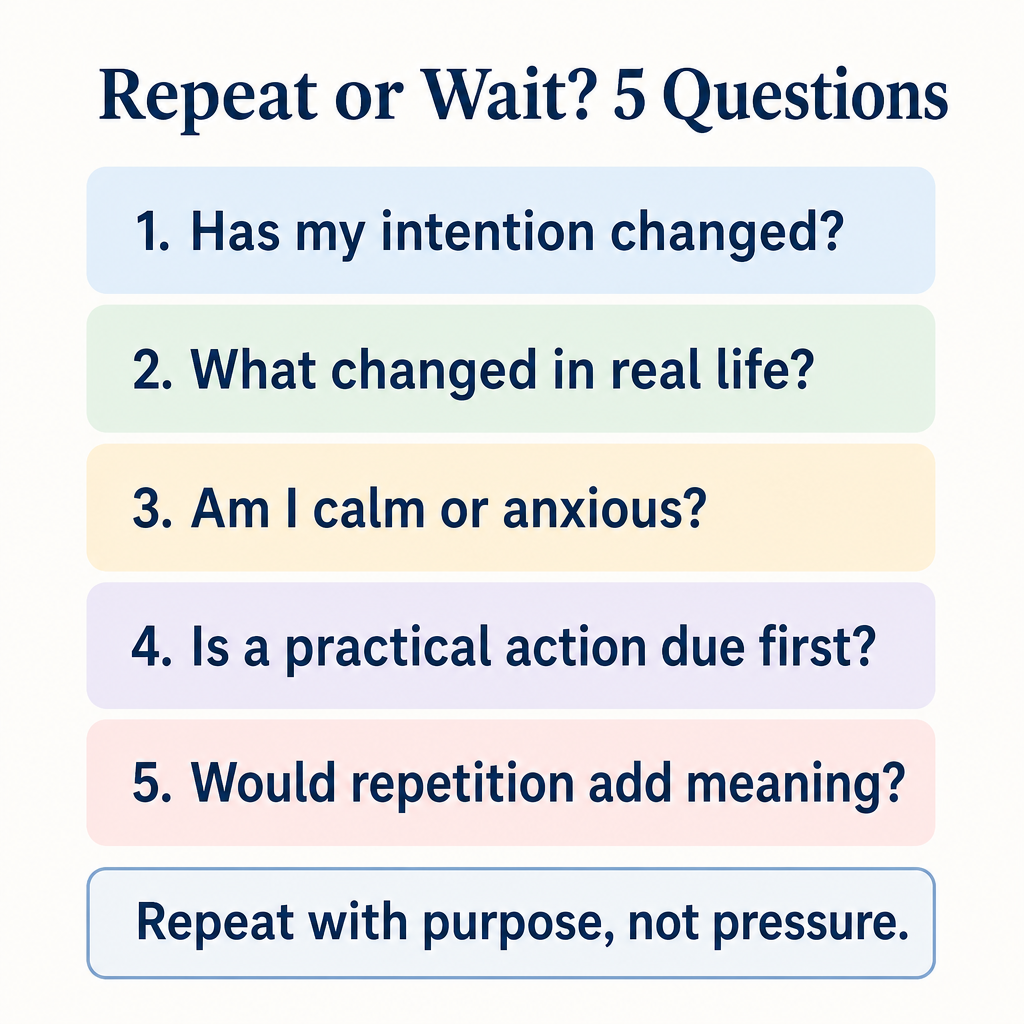
Use a Reflection Check Before Repeating

  1. What was my original intention?
  2. Has that intention changed?
  3. What has changed in real life since the last ritual?
  4. Am I calm enough to accept more than one possible outcome?
  5. Would another ritual add meaning, or am I trying to reduce anxiety?
  6. Is there a practical action I should take first?

Repeat or Wait? Five Questions infographic

Practical Actions Between Rituals

The time between rituals is not empty time. It is where the real-life part of the intention happens.

  • Maintain friendships and hobbies.
  • Communicate directly when appropriate.
  • Respect silence or a request for space.
  • Meet new people if you are seeking new love.
  • Work on recurring relationship patterns.
  • Keep your financial limits.
  • Notice whether the practice is making you calmer or more anxious.

What If the Original Ritual Seems Not to Work?

Repetition is not the only option. You can reconsider the intention, decide that the situation is unchanged, or choose a different direction. Sometimes the healthiest next step is to stop pursuing the original outcome.

Why Didn’t My Love Spell Work? Causes and Next Steps offers a fuller troubleshooting framework.

Can Repeating a Spell Backfire?

There is no need to assume supernatural punishment because you repeated a ritual. The more practical concern is whether repetition increases obsession, fear, spending, boundary violations, or disappointment.

If you are worried about “backfire,” see Can Love Spells Backfire?.

How Success Factors Connect to Frequency

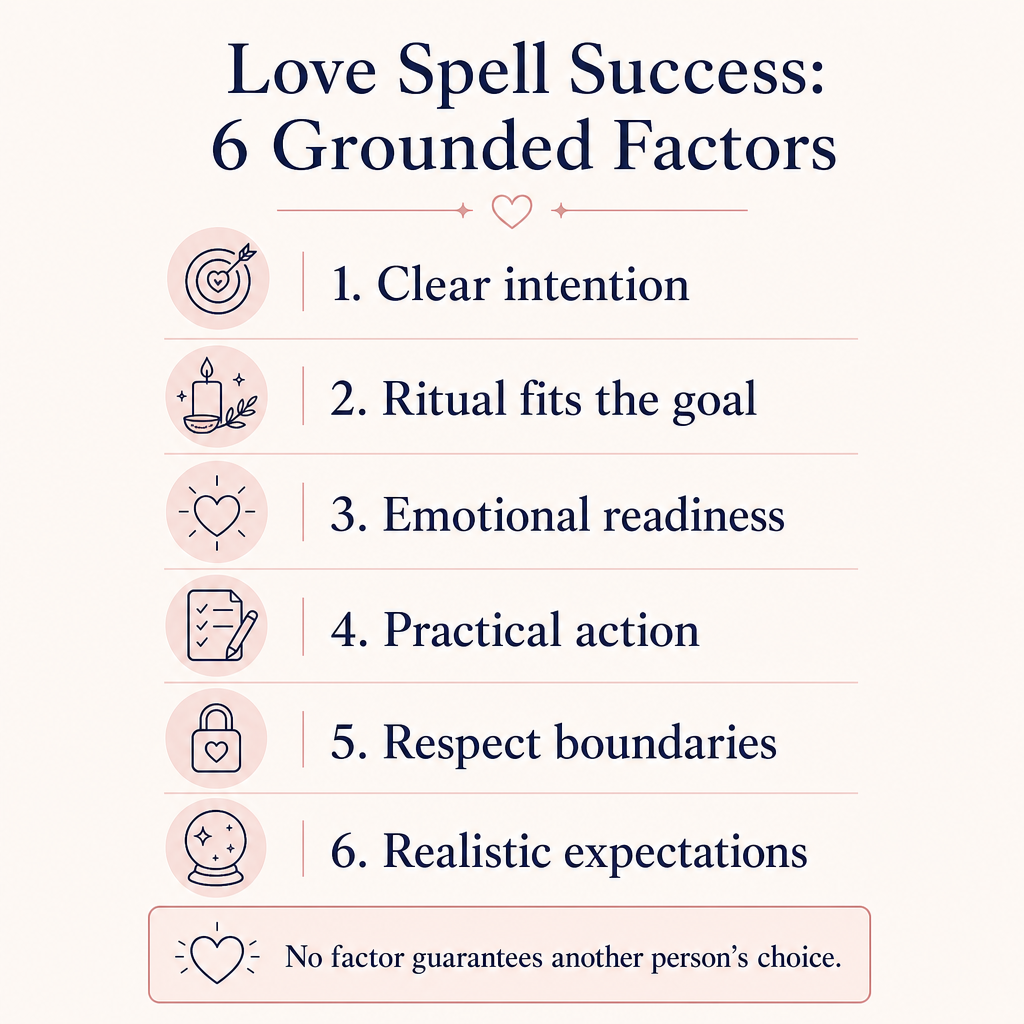
Clear intention, emotional readiness, practical action, and realistic expectations matter more to a grounded practice than the raw number of rituals. The new guide Love Spell Success Factors explains those factors in detail.

Do Not Let a Practitioner Create Forced Repetition

Be cautious if someone says you must immediately buy another ritual, pay to remove a new curse, or keep purchasing services or something bad will happen. Fear-based escalation is a warning sign. You can stop at any time.

Frequently Asked Questions

1. Can I perform the same love spell every day?

Some traditions include repeated practices, but repeating the same ritual every day out of anxiety can make it harder to judge the situation clearly. Many believers prefer to give one intention space.

2. Is there a required waiting period between love spells?

No universal waiting period applies across traditions. The more useful question is whether anything has changed in your intention, emotional state, or real-life circumstances.

3. Should I repeat a spell if nothing happens right away?

Not automatically. A lack of immediate change may simply mean the situation is unchanged. Reflection and practical action are usually more informative than immediate repetition.

4. Do moon phases determine when I should repeat a spell?

Some traditions use moon phases symbolically, while others do not. A moon phase can provide ritual structure, but it does not guarantee a result.

5. Are self-love practices different from other love spells?

Yes. Practices such as journaling, meditation, gratitude, and affirmations may be used regularly because they focus on your own reflection rather than changing another person.

6. Can couples repeat harmony rituals?

Couples may choose recurring gratitude, anniversary, or reflection rituals when both people enjoy them. Their value comes from shared meaning and real relationship effort.

7. How do I know I am repeating a ritual from anxiety?

Warning signs include checking constantly for proof, feeling unable to stop, spending more than planned, neglecting daily life, or repeating the ritual mainly because you fear something bad will happen.

8. Can repeating a spell make it stronger?

There is no reliable evidence that frequency alone makes a ritual more effective. Repetition can add personal meaning, but more ceremonies do not guarantee a stronger relationship outcome.

9. Should I change to a different spell if the first one does not work?

Changing rituals repeatedly can turn into chasing an outcome. First review the original goal, real-world evidence, and whether another type of practice would actually fit better.

10. How often can I use a healing ritual?

Healing practices can be repeated when they remain calming and useful, but they should support rather than replace ordinary coping, supportive relationships, or professional help when needed.

11. Should I wait for a specific sign before repeating a spell?

No sign can reliably tell you that a ritual must be repeated. Dreams, numbers, and coincidences can be meaningful personally but should not create pressure to perform another ritual.

12. What should I do between love spells?

Continue normal life: maintain friendships, work on communication, meet people, care for your well-being, and notice whether your real-life circumstances are changing.

13. Can I stop a ritual practice whenever I want?

Yes. You do not owe a ritual, practitioner, or spiritual routine continued participation. You can stop, change direction, or take a break whenever the practice no longer feels useful.

14. What if someone tells me I must pay for repeated rituals?

Be cautious of fear-based pressure, guaranteed claims, escalating fees, or statements that something bad will happen unless you keep paying. Those are warning signs, not proof that more rituals are necessary.

15. What is a good rule for deciding whether to repeat?

Repeat only when the practice still has a clear purpose, you feel emotionally grounded, it respects everyone involved, and you are not using repetition to avoid real-life information or action.

Final Thoughts: Repeat With Purpose, Not Pressure

How often you perform a love spell does not need to be decided by a fixed schedule. Some practices are one-time rituals, some are repeated symbolically, and self-reflection practices may be used regularly.

A useful rule is to repeat only when the practice still has a clear purpose and you feel grounded. If repetition is being driven by fear, constant checking, money pressure, or a refusal to accept real-life information, waiting or stopping is the healthier choice.

Love Spell Success Factors: What May Influence Results

10
Woman walking through a terraced garden with several steps ahead

People often ask what makes one love spell feel more successful than another. The uploaded draft emphasizes intention, emotional readiness, ritual choice, timing, patience, spiritual preparation, and personal growth. Those themes can be useful when they are presented as parts of a spiritual practice rather than as guarantees that another person will change.

A grounded way to think about love spell success factors is to separate what you can control from what you cannot. You can choose your intention, prepare thoughtfully, reflect on your emotions, act respectfully, and make practical relationship decisions. You cannot guarantee another person’s feelings, consent, timing, or future choices.

A useful spiritual practice should help you become clearer and more intentional. It should not require you to ignore evidence, boundaries, or another person’s freedom to choose.

1. Start With a Clear Intention

The draft correctly places intention at the center of the ritual. Before choosing tools or timing, define the goal in plain language. Are you hoping to meet someone compatible, heal after a breakup, repair communication, celebrate an existing relationship, or strengthen self-confidence?

Clear goals reduce the temptation to keep changing rituals whenever you feel anxious. If you are unsure what kind of spell fits your situation, see Choosing the Right Love Spell for Your Heart’s Intent.

2. Match the Ritual to the Real Goal

Different love-spell traditions use different categories, and those categories are more useful when they describe a goal rather than promise a result.

Goal Common spiritual framing Grounded real-life focus
New love Attraction ritual Meet people, define compatibility, stay open
Healing Self-love or release ritual Closure, boundaries, emotional recovery
Reconnection Reconciliation ritual Mutual willingness, honest communication
Existing relationship Harmony ritual Trust, listening, shared effort
Long-term bond Commitment ritual Reliability, shared goals, consent

3. Emotional Readiness Matters

The uploaded article links emotional state with spiritual focus. A practical interpretation is simple: intense jealousy, panic, grief, or desperation can make decisions harder. If the ritual is becoming a way to avoid a painful reality, reflection may be more useful than another ceremony.

  • Can you accept an outcome you did not choose?
  • Are you respecting the other person’s boundaries?
  • Are you using the ritual to avoid a needed conversation?
  • Are you putting normal life on hold while waiting?
  • Would healing be more useful than pursuit right now?

4. Belief Can Support Meaning, Not Certainty

Faith or belief can make a ritual feel personally meaningful. It can also help someone focus on values such as gratitude, patience, or hope. But belief should not be presented as proof that a ritual can alter another person’s private thoughts.

For a broader discussion of what believers mean when they say a spell “works,” see Do Love Spells Really Work? A Balanced Spiritual Guide.

5. Preparation Helps You Slow Down

A calm setting, a written intention, a few minutes of reflection, or a simple symbolic object can make a ritual easier to approach thoughtfully. Preparation does not need to be elaborate. Expensive supplies, rare ingredients, or dramatic ceremonies do not establish greater effectiveness.

Preparation is most useful when it helps you ask better questions and avoid impulsive choices.

6. Timing Can Be Symbolic Without Becoming a Deadline

Some traditions use moon phases or meaningful dates as a rhythm for spiritual work. That can give a ritual structure. It should not be confused with a reliable timetable for relationship outcomes.

If you find yourself repeating rituals because nothing happened on a certain schedule, the more useful question may be whether anything has actually changed in your life or relationship.

7. Practical Action Is a Major Success Factor

Spiritual intention is easier to evaluate when it is paired with ordinary action. If your goal is new love, make space to meet people. If your goal is reconciliation, look at whether communication is mutual. If your goal is harmony, work on the behavior that causes conflict.

  • Communicate clearly.
  • Keep promises.
  • Respect space and consent.
  • Meet new people when seeking new love.
  • Apologize when you caused harm.
  • Set boundaries when needed.
  • Continue your own goals and friendships.

8. Free Will Sets the Limit

No success framework should treat another person as an outcome to obtain. A clear no, a request for space, blocking contact, or consistent disinterest should be respected even if a dream, tarot reading, coincidence, or ritual feels meaningful.

This is especially important because spiritual language can otherwise make it easy to reinterpret boundaries. Mutual choice is a stronger foundation for love than any sign.

9. Repetition Is Not the Same as Progress

The draft warns against repeating spells out of doubt or desperation. That is a useful distinction. Repetition may have ceremonial meaning in some traditions, but it is not a substitute for reflection.

The companion guide How Often Should You Perform a Love Spell? explains how to decide whether another ritual adds meaning or simply repeats anxiety.

10. Use Better Measures of Progress

Instead of asking only whether one exact event happened, look at several kinds of change.

More grounded indicator Less reliable by itself
Mutual, consistent communication One unexpected message
Changed behavior over time A single coincidence
Clear consent and interest A dream or intuitive feeling
Greater emotional balance Constantly checking for signs
Healthy practical action Buying more ritual supplies

Love Spell Success: 6 Grounded Factors infographic

11. Personal Growth Can Be a Positive Outcome

The uploaded article repeatedly returns to growth, gratitude, and self-awareness. Those are useful outcomes because they do not depend on controlling another person. A ritual may help you recognize that you need closure, stronger boundaries, more confidence, or a different kind of relationship.

If an outcome is very different from what you expected, Can Love Spells Backfire? offers a grounded way to think about unexpected results without treating them as supernatural punishment.

12. Watch for Pressure and Guaranteed Claims

One factor that should never be mistaken for spiritual success is spending more money. Be cautious when someone promises guaranteed love, claims that only they can fix the situation, creates fear about a curse, or pressures you to keep purchasing additional services.

A trustworthy spiritual service should leave room for uncertainty, choice, questions, and clear pricing.

13. What If Nothing Changes?

Sometimes the most accurate answer is that the situation has not changed. That does not require you to invent a hidden explanation. You can reassess the goal, your practical options, and whether continuing the same approach is helping you.

For a troubleshooting framework, see Why Didn’t My Love Spell Work? Causes and Next Steps.

Frequently Asked Questions

1. What is the most important love spell success factor?

Many believers place clear intention near the top of the list. A clear intention can make a ritual more focused, but it does not guarantee a particular relationship outcome.

2. Does belief make a love spell work?

Belief can make a spiritual practice feel more meaningful and can support focus or reflection. It is not proof that a ritual can control another person’s feelings.

3. Is emotional readiness important?

Yes. If you are acting from panic, jealousy, grief, or desperation, it may be harder to make calm decisions. Many people prefer to begin with healing or self-reflection.

4. Does choosing the right type of spell matter?

It can matter within a spiritual practice because attraction, healing, reconciliation, harmony, and commitment rituals have different goals. Matching the ritual to the goal can make the practice clearer.

5. Do expensive ingredients improve results?

There is no reliable evidence that price makes a ritual more effective. Many practitioners consider simple, meaningful tools enough for reflection and intention-setting.

6. Does moon timing determine whether a spell succeeds?

Some traditions attach symbolic meaning to moon phases, while others do not. Lunar timing can provide structure for a ritual, but it should not be treated as a guarantee.

7. Can repeating a spell make it stronger?

Repeating a ritual may be meaningful in some traditions, but repeating it from anxiety can create more worry. Reflection and patience are often more useful than constant repetition.

8. How does free will affect love spell expectations?

Any healthy relationship still depends on mutual choice. A spiritual practice should not be used to reinterpret a clear no, a request for space, or another person’s boundaries.

9. What practical actions support a love-focused intention?

Examples include improving communication, meeting new people, repairing your own behavior, respecting boundaries, following through on commitments, and staying socially engaged.

10. Are dreams and coincidences signs of success?

They can feel meaningful to a believer, but they are subjective. Consistent communication, mutual effort, and changed behavior are stronger relationship signals.

11. Can personal growth count as a positive result?

Yes. Greater confidence, closure, emotional balance, or clearer relationship standards can be valuable outcomes even when the original romantic outcome does not happen.

12. What can interfere with a healthy spiritual practice?

Constant checking, desperation, unrealistic promises, pressure to spend money, ignoring boundaries, and neglecting real-life action can all make the experience less grounded.

13. How long should I give a love spell before judging it?

There is no universal deadline. It is better to avoid putting your life on hold and to judge progress by real changes in your own behavior and relationships.

14. Should I work with a professional spell practitioner?

That is a personal choice. If you do, look for transparent pricing, realistic language, respect for boundaries, and no fear-based pressure or guaranteed outcomes.

15. What is the best way to define success?

A grounded definition of success asks whether the practice helped you become clearer, calmer, more respectful, and more open to a healthy relationship rather than whether it forced one exact outcome.

Final Thoughts: What Really Supports a Positive Practice?

Love spell success factors are most useful when they keep expectations grounded. Clear intention, emotional readiness, a ritual that fits the goal, patience, reflection, practical action, and respect for free will can all improve the quality of the experience.

None of those factors can guarantee a particular person’s love. What they can do is help you approach relationships with more clarity, better boundaries, and a stronger understanding of what healthy mutual connection requires.

Dreaming of Your Soulmate Before You Meet: Meaning

13
Mature man reflecting after a vivid soulmate dream at dawn

Dreaming of Your Soulmate Before You Meet: Meaning

Some dreams feel ordinary and disappear within minutes of waking. Others stay with you because the emotions feel unusually vivid. You may remember feeling safe beside someone you do not recognize, hearing an unfamiliar voice that feels comforting, or waking with the strong impression that the person mattered.

People who believe in spiritual or psychic dream interpretation sometimes wonder whether this means they have dreamed about a soulmate before meeting them. The supplied guide frames these dreams more carefully: they may symbolize hope, emotional readiness, intuition, healing, or the qualities you want in a meaningful relationship rather than proving that you literally met a future partner in a dream.

A grounded starting point: a dream can feel spiritually important without being a reliable prediction. The most useful question is often not “Who was that person?” but “What did this dream reveal about the kind of love, safety, or connection I am ready to build?”

Can You Dream About a Soulmate Before Meeting?

There is no reliable method for confirming that an unknown person in a dream is someone you will later meet. Spiritual traditions may interpret a vivid stranger as a soulmate, guide, symbolic companion, or intuitive image. Psychological interpretations may view the same dream as a reflection of emotional needs, memory, imagination, attachment, and expectations about future relationships.

These views do not have to cancel each other out. You can value the spiritual meaning of a dream while still recognizing that the identity of a future partner cannot be verified from dream content alone.

Research on sleep and dreaming supports a more modest claim: sleep is involved in emotional and memory processing, and emotionally meaningful material can appear in dreams. Reviews indexed by PubMed discuss links between dreaming and emotional processing, while the NIH Common Fund describes sleep as an active period in which memories are reorganized and consolidated. This research does not establish prophetic soulmate dreams, but it helps explain why a dream about love can feel vivid and personally important.

What a Soulmate Dream May Symbolize

Emotional Readiness

You may be becoming more open to trust, companionship, and healthy vulnerability after a period of healing.

Relationship Values

The unknown person may symbolize qualities you now value more deeply, such as patience, honesty, emotional safety, and mutual respect.

A New Chapter

The dream may appear while you are releasing an old relationship pattern, rebuilding confidence, or becoming more hopeful about love.

Your Future Self

Some spiritual interpretations treat the mysterious figure as a reflection of the person you are becoming rather than a literal future partner.

Why the Feeling Can Be Stronger Than the Face

Many people remember the emotional tone of a vivid dream more clearly than physical details. The face may be incomplete, the setting may change, or the conversation may be impossible to recall, while the feeling of being understood remains.

This is one reason the source article emphasizes the emotional message over identifying the person. Ask whether the dream made you feel accepted, calm, inspired, protected, hopeful, or ready to love again. Those emotions can tell you more about your current inner life than an attempt to reconstruct a stranger’s appearance.

Common Soulmate Dream Scenarios

Dreaming About an Unknown Soulmate

An unfamiliar person who feels deeply familiar may symbolize hope, emotional readiness, trust, or the qualities you want in a future relationship. It does not confirm that the same face will appear in waking life.

Talking to Your Soulmate in a Dream

A calm conversation can represent your desire for honest communication and being truly heard. The important clue may be whether the exchange felt respectful, easy, and emotionally safe.

Falling in Love Before You Meet

Falling in love with an unknown person can symbolize your heart becoming more open after disappointment or heartbreak. It may reflect renewed optimism rather than predict a specific romance.

Your Soulmate Protecting You

Protection imagery often points toward emotional safety and boundaries. Spiritually, it may remind you that secure love begins with feeling safe enough to be yourself.

Missing a Soulmate You Have Never Met

This can reflect longing for companionship, closeness, or a sense of being known. It does not necessarily mean a missing person exists somewhere waiting for you.

Seeing the Same Unknown Person Repeatedly

Recurring dreams deserve attention because the pattern itself may be meaningful. Track what changes: the setting, your emotions, the conversation, and the ending. The repeated figure may mirror your own growth over time.

Hearing Them Call Your Name

This can symbolize self-awareness or an inner part of you asking for attention. Rather than assuming a future partner is calling, consider what part of your emotional life wants to be acknowledged.

Traveling Together

Travel imagery often represents movement through life. A peaceful trip with an unknown companion can symbolize confidence about the direction you are heading and openness to sharing that journey someday.

Dancing Together

Dancing can symbolize harmony, reciprocity, timing, and trust. An effortless dance may reflect the kind of balanced partnership you value.

Watching the Person Walk Away

A departure may feel sad, but it can symbolize patience, changing expectations, or the need to continue living fully rather than waiting for a predicted relationship.

When a Soulmate Dream Becomes Unhelpful

A meaningful dream should not make you abandon real-life judgment. Be cautious if you start:

  • Waiting for an imagined person instead of engaging with real relationships.
  • Rejecting compatible people because they do not resemble the dream.
  • Treating every coincidence as confirmation.
  • Ignoring someone’s boundaries because they “feel destined.”
  • Putting your life on hold while waiting for a prediction to happen.
  • Using the dream to avoid healing from a previous relationship.

The same principle applies to spiritual love work more generally: meaningful belief should not replace consent, evidence, communication, or ordinary relationship judgment. Our guide to love spell myths versus facts explores that distinction in more detail.

Soulmate Dreams and Free Will

Even if you believe a dream can carry intuitive or spiritual meaning, another person’s choices remain their own. A dream does not create consent, prove compatibility, or make a relationship inevitable.

If a real person later reminds you of someone from a dream, let the actual relationship provide the evidence. Are they interested? Do they communicate honestly? Do your values align? Do you feel safe and respected? Those questions matter more than resemblance to dream imagery.

This is also why our guide on whether love spells can make someone love you centers mutual choice rather than control.

Soulmate Dream Reflection: 5 Questions

How to Reflect on the Dream

  1. Write it down quickly. Record the setting, people, symbols, colors, dialogue, and emotional tone before details fade.
  2. Focus on feelings first. Ask what you felt rather than trying to identify the person.
  3. Notice relationship qualities. Was the dream centered on trust, communication, adventure, security, affection, or acceptance?
  4. Look for current-life context. Consider recent healing, dating experiences, endings, hopes, or changes in your priorities.
  5. Track recurring patterns. A dream journal can reveal themes without forcing one interpretation.
  6. Stay open, not attached. Let the dream inspire you without requiring life to reproduce it exactly.

Dream Journal Questions That Help

  • What emotion stayed with me after waking?
  • What made the unknown person feel important?
  • Did I feel safe, respected, heard, or understood?
  • What qualities did the dream relationship have?
  • What was happening in my waking life before the dream?
  • Am I healing from something or preparing for a new chapter?
  • Did the dream encourage action, patience, or self-reflection?

If you are exploring love intentionally, compare those answers with the practical questions in our guide to choosing a love-focused spiritual practice by intention.

Could the “Soulmate” Be Your Future Self?

One of the strongest ideas in the supplied article is that the mysterious person may not represent someone else at all. They could symbolize qualities you are growing into: calmness, self-respect, compassion, emotional honesty, courage, or the ability to love without fear.

This interpretation shifts the dream from prediction to development. Instead of asking when a soulmate will arrive, ask what the dream invites you to practice now. That can make the experience valuable even if no matching person ever appears.

What to Do After a Powerful Soulmate Dream

Use the dream as inspiration rather than a deadline. Keep meeting people naturally, maintain healthy boundaries, develop the qualities you want in a partner, and allow real relationships to reveal themselves through consistent behavior.

If manifestation practices are meaningful to you, keep them focused on the qualities of a healthy relationship instead of one exact face or identity. Our article on manifesting love in your life can be read alongside this dream guide with that more open-ended approach.

Frequently Asked Questions

1. Can you really dream about your soulmate before meeting them?

Some spiritual traditions believe this is possible, while psychological interpretations may see the dream as symbolic. There is no reliable way to verify that an unknown dream figure is a future partner.

2. Why did the person feel so familiar?

Dreams can create a strong sense of familiarity even when physical details are unclear. Spiritually, people may interpret this as connection; psychologically, it can reflect emotion, memory, expectation, and attachment themes.

3. What if I never saw the person’s face?

That is common. The emotional tone may be more important than physical details, especially when the dream centers safety, acceptance, or companionship.

4. Does a soulmate dream guarantee I will meet that person?

No. A meaningful dream is not a guarantee about a future relationship or a specific individual.

5. Should I try to find the person from my dream?

Usually it is healthier to stay open to real relationships rather than search for a stranger who matches dream imagery.

6. Why do I keep dreaming about the same unknown person?

Recurring dreams may signal an unresolved theme or an idea your mind keeps revisiting. Track how the dream changes and what is happening in your waking life.

7. Can a soulmate dream be intuition?

If intuition is part of your spiritual beliefs, you may experience the dream that way. It is still wise to treat it as personal guidance rather than proof about another person’s identity or intentions.

8. What does it mean if I fall in love in the dream?

It may symbolize emotional openness, hope, healing, or readiness for commitment rather than predict a literal romance.

9. What if the dream person protects me?

Protection imagery can symbolize emotional security, boundaries, and the desire for a relationship where you feel safe.

10. What if the soulmate walks away?

This may represent timing, acceptance, fear of loss, or the need to keep living rather than waiting for one predicted outcome.

11. Are vivid soulmate dreams more spiritual than ordinary dreams?

Vividness alone does not prove a spiritual origin. Emotionally intense dreams can feel unusually real because dreaming and sleep are closely connected with emotional and memory processing.

12. Can a dream reveal what kind of partner I need?

It can be useful for reflection. The qualities you notice in the dream—such as honesty, calmness, humor, or respect—may reveal what matters to you now.

13. Should I keep a dream journal?

Yes, if it helps you reflect without becoming obsessive. Record details and patterns, then compare them with real-life experiences and emotional changes.

14. Could the soulmate actually represent me?

Yes. One symbolic interpretation is that the unknown person represents qualities you are developing in yourself or the future version of you that feels more secure and loving.

15. What is the healthiest way to use a soulmate dream?

Let it encourage hope, self-awareness, and growth while keeping expectations flexible. Real relationships should still be evaluated through mutual interest, respect, communication, and consistent behavior.

Final Thoughts

Dreaming of a soulmate before you meet can be emotionally powerful without needing to function as a prediction. The stranger may symbolize a future possibility, the qualities you hope to find in love, a period of emotional healing, or the person you are becoming.

The most balanced approach is to honor the dream’s meaning while staying grounded in waking life. Keep growing, stay open to real connection, and let actual relationships show you who is compatible through mutual choice and consistent care.

Why Didn’t My Love Spell Work? Causes and Next Steps

12
Woman reflecting quietly in a modern art museum atrium

When someone says, “My love spell didn’t work,” they may mean several different things: a specific person did not return, communication did not improve, no obvious sign appeared, or the hoped-for change did not happen by a self-imposed deadline. Those are different problems and should not all be diagnosed the same way.

Use this as a troubleshooting guide, not a promise: spiritual rituals do not provide verified control over another person’s feelings. Start with observable facts, then decide what the experience means within your own beliefs.

This article is intentionally more practical than our older piece on why a love spell might not work. Instead of listing spiritual explanations, it gives you a structured review of intention, evidence, timing, consent, and next steps.

Step 1: Define What “Didn’t Work” Means

Write the expected result in one sentence. Then ask whether it is something you can actually observe.

Observable
“We have not spoken in six weeks.”
Interpretive
“The energy feels blocked.”
Observable
“They said they do not want to reconnect.”
Interpretive
“A dream says they secretly want me.”

Observable behavior should carry more weight than symbolic interpretation when deciding what to do next.

Step 2: Check Whether the Goal Required Someone Else to Change

If success depended on one specific person developing feelings, returning, apologizing, or committing, the goal depended on another person’s free will. No ritual can guarantee those choices.

Our guide on whether a love spell can make someone love you explains why mutual choice is a healthier standard than control.

Step 3: Revisit the Original Intention

The supplied draft emphasizes asking what you truly want and whether the intention came from love or loneliness. That is useful troubleshooting. Sometimes the original goal was too narrow:

  • “Bring this ex back” may actually mean “I want emotional security.”
  • “Make them text me” may mean “I need clarity about where I stand.”
  • “Find my soulmate immediately” may mean “I am tired of feeling alone.”
  • “Fix my relationship” may mean “I want us to communicate without fighting.”

Once the real need is clear, a different spiritual practice—or a practical action—may fit better.

Step 4: Check the Match Between Goal and Ritual

Different ritual categories are associated with different intentions. Attraction is not the same as reconciliation; healing is not the same as commitment. If you chose a ritual because it was called “powerful” rather than because it matched the goal, the practice may have been poorly aligned.

Use our guide to choosing the right love spell to compare intention categories.

Step 5: Stop Using a Deadline as Proof

If the only reason you believe the spell failed is that seven days, 21 days, or one moon cycle passed, the problem may be the deadline itself. There is no verified universal timetable for a spiritual ritual to change a relationship.

That does not mean you should wait forever. Practical decisions still need practical time limits. If someone has clearly said no, waiting longer is not a reason to ignore that boundary.

Step 6: Look for Real-World Follow-Through

A ritual about new love cannot create social opportunities if you never meet anyone. A harmony ritual cannot repair communication if neither partner talks honestly. A self-love practice has limited value if you continue accepting the same harmful boundaries.

Ask what action supports the intention:

  • Meet people and accept appropriate social opportunities.
  • Communicate once, clearly and respectfully.
  • Apologize when you are responsible for harm.
  • Give space when someone asks for it.
  • Use counseling when relationship problems need structured support.
  • Change habits that repeatedly damage your relationships.

Love Spell Troubleshooting: Five Questions

Infographic with five questions to troubleshoot a love spell
Start troubleshooting with observable behavior, mutuality, ritual fit, and the practical action that supports the goal.

Step 7: Check for Over-Interpretation

Repeated numbers, songs, dreams, chance meetings, or social-media activity may feel personally meaningful. They are not reliable evidence that another person’s feelings have changed. Our myths vs. facts guide explains why patterns should not be treated as proof.

For a stronger progress standard, see how to tell if a love spell is actually working, which emphasizes consistent communication, mutual effort, and changed behavior.

Step 8: Check Your Emotional State

If you are more anxious, obsessed, fearful, or financially stressed than before the ritual, stop adding more spiritual work. Give yourself distance. A ritual should not become a cycle in which every disappointing result requires another payment, another reading, or another sign.

Step 9: Decide Whether the Relationship Itself Is Healthy

Sometimes the most important answer is not about the ritual. Ask:

  • Is interest mutual?
  • Do we communicate respectfully?
  • Are boundaries honored?
  • Is there trust?
  • Do our goals fit?
  • Do I feel emotionally and physically safe?

If the relationship fails these basic tests, “making the spell work” is probably the wrong problem to solve.

Step 10: Choose the Next Step

  1. Clarify: rewrite the intention around what you actually need.
  2. Act: take one practical step that supports the goal.
  3. Wait: if no decision is needed immediately, stop checking constantly.
  4. Accept: respect clear boundaries and outcomes.
  5. Redirect: choose healing, self-love, or a new goal if the original path is no longer healthy.

What Not to Do

  • Do not keep paying someone who claims one more ritual will guarantee success.
  • Do not treat fear about curses or “blocked energy” as proof you need an expensive upgrade.
  • Do not contact someone repeatedly because you believe signs override their boundaries.
  • Do not ignore work, sleep, finances, friends, or daily life while waiting.
  • Do not use spiritual practice instead of urgent safety, medical, legal, or mental-health support.

Frequently Asked Questions

1. Why didn’t my love spell work right away?

There is no verified universal timeline. Start by checking the actual goal and observable changes.

2. Did I choose the wrong spell?

Possibly. Different rituals are associated with different goals, so intention and ritual type should match.

3. Should I repeat the spell?

Not automatically. First review whether repetition would add clarity or simply increase anxiety.

4. Does no contact mean the spell failed?

No contact is an observable fact. Respect it rather than assuming hidden spiritual meaning.

5. Can emotional healing be the outcome?

Yes. Healing and clarity can be meaningful personal outcomes even when a relationship does not change.

6. What if my ex says no?

Respect the answer. A ritual should not be used to override a clear boundary.

7. Are dreams signs that something is changing?

Dreams may be personally meaningful, but they do not prove another person’s feelings have changed.

8. What if I keep seeing repeating numbers?

You can note them if they matter to you, but do not use them as evidence of consent or relationship progress.

9. Can I make a spell stronger with more ingredients?

More ingredients do not prove greater effectiveness.

10. Does paying more improve the result?

No. Price is not evidence that a ritual will produce a specific outcome.

11. What practical actions should I take?

Choose actions that fit the goal: communicate respectfully, meet people, set boundaries, apologize, seek counseling, or focus on healing.

12. How long should I wait?

There is no spiritual deadline. Use practical judgment and do not wait indefinitely for someone who has clearly declined.

13. Should I change my intention?

Yes, if reflection shows that your original goal no longer fits your needs or values.

14. What if I feel worse after the ritual?

Pause the practice and focus on your well-being. Seek support if anxiety or fixation is interfering with daily life.

15. Can a failed spell still teach me something?

Yes. It may help clarify what you want, what boundaries matter, and what kind of relationship is healthier for you.

Final Thoughts

“Why didn’t my love spell work?” becomes easier to answer when you stop treating every disappointment as a mysterious spiritual failure. Define the expected result, look at observable behavior, respect free will, review the intention, and identify the practical action that belongs beside the ritual.

For believers, spiritual practice can still offer reflection and meaning. But the clearest next step usually comes from combining that reflection with reality: what the other person has communicated, how the relationship functions, and what choices support your long-term well-being.

Can Love Spells Help Save a Marriage? Spiritual Guide

8
Mature couple reconnecting in a quiet sunroom

Marriage can go through seasons of closeness, stress, resentment, exhaustion, and renewal. The supplied draft frames marriage-focused love spells as spiritual rituals that may help couples pause, reconnect with shared intentions, and focus on communication, gratitude, healing, and commitment. That is a more realistic use of ritual than treating it as an instant repair for every marital problem.

Key point: a love spell cannot replace mutual effort, consent, communication, or professional support when a marriage is in serious distress. For believers, ritual can be a symbolic companion to the work both spouses are willing to do.

This article focuses on what marriage-centered spiritual practice can and cannot reasonably support, and how to tell whether the relationship itself has a foundation worth rebuilding.

Can Love Spells Save a Marriage?

A spiritual ritual cannot guarantee that a marriage will continue. It also cannot make one spouse communicate, forgive, stay faithful, or remain in a relationship against their wishes. What it can do for some believers is create a structured moment to reflect on the marriage and renew intentions such as patience, appreciation, honesty, and shared commitment.

That perspective fits with our guide on whether love spells are permanent: lasting relationships depend on what partners continue doing after the ritual.

When a Marriage Ritual May Be Meaningful

Emotional distance
Both partners still care but daily routines have reduced closeness.
Communication strain
Conversations have become reactive, defensive, or infrequent.
Life transitions
Work changes, parenting, caregiving, moving, or grief have created stress.
Renewal
The marriage is stable and the couple wants to mark an anniversary or new chapter.

In these situations, a harmony, gratitude, or commitment ritual can serve as a reminder to make time for the relationship. The value comes from what the couple chooses to do with that reminder.

When a Spell Is Not the Main Issue

Some marriage problems require direct action rather than more ritual. If there is ongoing dishonesty, coercive control, repeated betrayal, threats, violence, stalking, financial abuse, or one partner has clearly chosen to leave, the priority should be safety, boundaries, and appropriate support. A spiritual practice should never be used to pressure someone to remain in an unsafe relationship.

Similarly, if only one spouse wants to repair the marriage, a ritual cannot create mutual commitment. The healthiest intention may shift from “save this marriage at any cost” to “help me act with clarity, dignity, and wisdom.”

Marriage Harmony Spells vs. Attraction Spells

Marriage harmony rituals are different from attraction-focused work. Attraction spells are commonly associated with welcoming romantic possibilities. Marriage rituals are usually centered on an existing bond and themes such as:

  • Listening without interrupting.
  • Restoring appreciation.
  • Rebuilding trust through consistent behavior.
  • Making time for affection and shared experiences.
  • Forgiving where forgiveness is appropriate.
  • Creating realistic shared goals.

For couples working through past hurt, our article on reconciliation and healing offers a related perspective.

Mutual Intention Matters More Than the Ritual

A marriage-focused ceremony is most meaningful when both spouses understand what they are trying to improve. Before starting, each person can answer three questions separately:

  1. What do I appreciate about this relationship?
  2. What needs to change for me to feel safer, closer, or more respected?
  3. What am I personally willing to do differently?

Compare the answers afterward. The conversation is often more valuable than any object used in the ritual.

A Practical Marriage Renewal Check-In

Infographic checklist for rebuilding a marriage
Marriage renewal depends on mutual willingness, communication, safe boundaries, consistent effort, and shared goals.

Five Areas to Work on Alongside Spiritual Practice

1. Communication

Use specific language instead of global criticism. “I miss having dinner together” creates a different conversation than “you never care about us.”

2. Trust

Trust grows through repeated behavior. Promises matter less than what each partner consistently does.

3. Quality Time

Regular, distraction-free time can help couples remember that the marriage is more than logistics and responsibilities.

4. Appreciation

Small acknowledgments can soften emotional distance. Gratitude rituals are meaningful because they deliberately direct attention toward what is still working.

5. Shared Goals

Couples often reconnect when they begin planning something together: a family goal, financial milestone, trip, home project, or personal dream they support in each other.

Simple Spiritual Practices for Couples

Not every ritual needs candles or elaborate tools. Couples may choose a shared gratitude list, a quiet meditation, an anniversary intention letter, a walk where each person names what they value about the relationship, or a small commitment ceremony. If candles are used, basic fire safety still matters.

For long-term relationships, using spiritual practice to strengthen love is most useful when it supports rather than replaces everyday relationship care.

What Progress Actually Looks Like

Do not judge progress by one romantic gesture or one unusually calm day. Look for patterns over time:

  • Arguments become less hostile.
  • Both partners initiate conversations.
  • Promises are followed by action.
  • Affection feels voluntary rather than forced.
  • Trust slowly improves.
  • Both people take responsibility for their part.
  • The home feels emotionally safer.

Those changes are much stronger evidence of relationship improvement than dreams, repeating numbers, or other symbolic signs.

When to Consider Counseling or Other Support

If the same conflict repeats without resolution, communication breaks down completely, trust has been seriously damaged, or the couple is considering separation, qualified relationship counseling may provide a structured way to work through the issues. Spiritual practice can coexist with counseling if both partners find it meaningful, but it should not replace professional help when deeper support is needed.

Frequently Asked Questions

1. Can a love spell guarantee that my marriage will survive?

No. A ritual cannot guarantee another person’s decisions or the future of a marriage.

2. Can married couples perform a ritual together?

Yes. Many couples find shared intention-setting more meaningful than one partner doing the ritual alone.

3. What type of spell fits an existing marriage?

Harmony, gratitude, healing, and commitment rituals are more relevant than attraction rituals.

4. Can a spell repair broken trust?

Trust is rebuilt through honesty, accountability, and consistent behavior. A ritual may symbolize that intention but cannot replace it.

5. What if only one spouse wants to save the marriage?

One person can change their own behavior, but mutual commitment cannot be forced.

6. Can spiritual practice improve communication?

It may create a calmer setting for reflection, but better communication still requires listening and honest conversation.

7. Should couples use anniversary rituals?

They can be a meaningful way to review progress, express gratitude, and set new shared intentions.

8. Are candles necessary?

No. Journaling, prayer, meditation, gratitude, and conversation can all be used without ritual tools.

9. What if we keep having the same argument?

Look for the underlying need or pattern rather than repeating the same surface debate. Counseling may help if the cycle continues.

10. Can a ritual make a spouse faithful?

No ritual can guarantee fidelity. Faithfulness depends on personal choices, boundaries, and agreements.

11. Can reconciliation work after a serious conflict?

Sometimes, if both partners genuinely want to repair the relationship and are willing to change behavior.

12. Should I use a spell if my partner wants to leave?

You can use personal reflection for your own clarity, but another person’s decision and boundaries should be respected.

13. Can gratitude help a marriage?

Regular appreciation can support emotional connection when it is sincere and combined with respectful behavior.

14. When is a marriage too unsafe to focus on spiritual repair?

If there are threats, violence, coercive control, stalking, or other abuse, prioritize safety and qualified support.

15. What is the healthiest intention for a marriage ritual?

Focus on mutual respect, honest communication, healing, shared effort, and the best healthy outcome for both people.

Final Thoughts

A marriage-focused love spell is best understood as a symbolic ritual, not a rescue mechanism. It can help believers create a moment to remember why they chose each other, identify what needs attention, and recommit to healthier habits.

The strongest foundation is still mutual effort. If both partners are willing to listen, repair trust, show appreciation, and make practical changes, a spiritual ritual may become a meaningful part of that process. If mutual commitment is missing, the wiser goal may be clarity rather than control.