

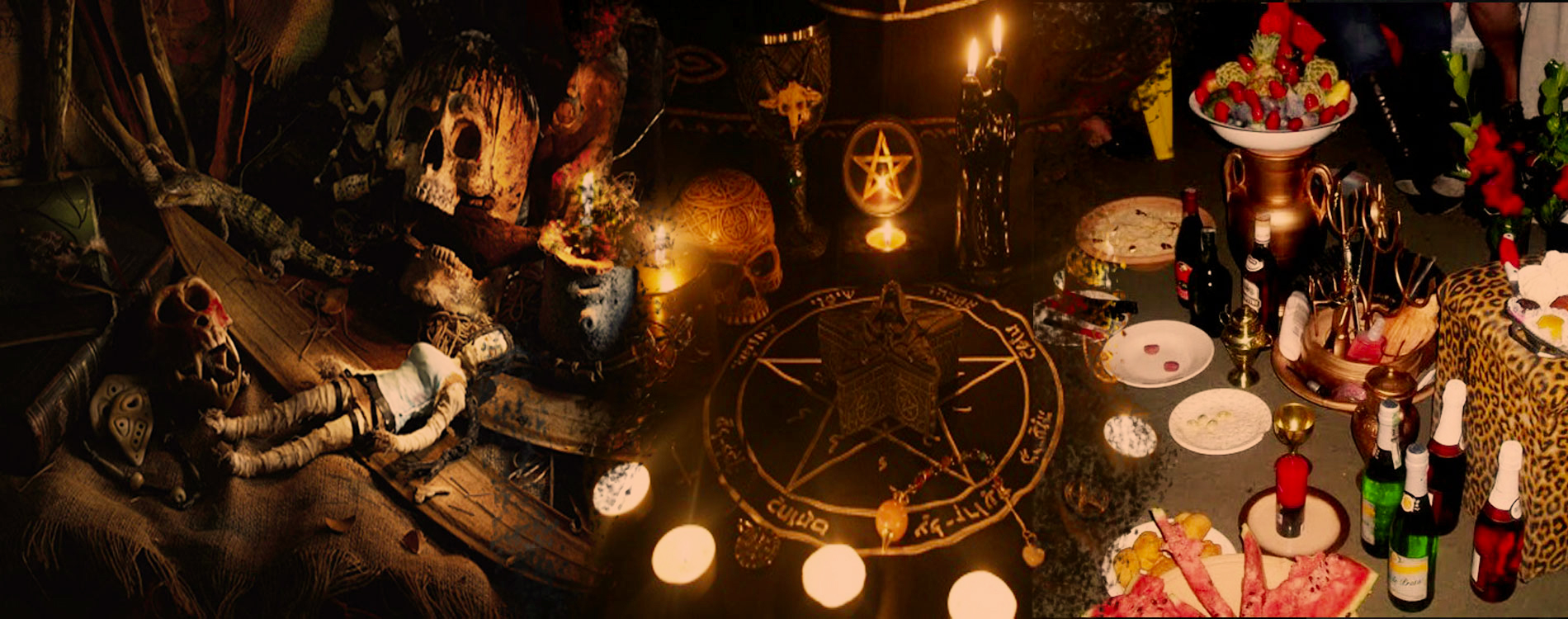
You may have met the words black magic in a story, a spiritual discussion or a message claiming someone has put a curse on you. Those situations call for different questions. A dramatic label can hide the details you actually need: what is being claimed, what can be checked and what choice remains yours.
This guide explains the term, gives a careful way to read historical accounts and helps you assess a present-day claim without dismissing a person’s beliefs or accepting a frightening promise as fact.
A useful starting definition
Black magic is commonly used for magic regarded as harmful, coercive or forbidden. It is a judgment about a practice as much as a description of one. A person may use the label for a curse, another for a rule-breaking ritual, and a novelist for an invented source of power.
There is no single rulebook behind all those uses. Before asking whether black magic is good, bad or powerful, ask what the speaker means. An account of a belief, a personal experience and an advertisement for a guaranteed outcome are different kinds of information.
1. A belief or tradition
Learn who holds the belief, how they describe it and what it means in their own setting.
2. A reported event
Separate what happened from the explanation someone gives for it. Timing alone does not establish a cause.
3. A promise for sale
Ask what service is actually offered, what it costs and what is being guaranteed about someone else’s life.
Why history needs a specific context
A sentence such as “people have always used black magic” tells you little about the people, the practice or the source. Historical study becomes more useful when it names a place, period and community. A ritual object can document what someone valued or feared without proving the result attributed to it.
Labels can also come from outsiders. In a Harvard discussion of Hoodoo and ancestral religion, religion scholar Yvonne Chireau places African American conjure in the history of enslavement, protection, resistance and community life. She explains how hostile descriptions shaped its reception. That specific history should not be flattened into a universal story of evil spells.
Hoodoo, Haitian Vodou and other traditions are not interchangeable names for a single system. Images of dolls, curses or secret ceremonies cannot stand in for a whole community’s beliefs. When exploring a tradition, look for its own accounts alongside careful historical scholarship; leave out sweeping claims about what all its members do.
Black, white and gray: look beyond the colors
Some practitioners use these categories to talk about intentions, boundaries or permitted methods. Others find them unhelpful. The labels do not tell you whether an action respects another person’s decision or whether a seller can support a promise.
Consider the practical difference between privately marking the end of a relationship and trying to make an unwilling person return. Calling either action “positive” does not remove the question of consent. Our guide to black-magic love claims and personal choices looks at that relationship question in more detail.
What counts as evidence?
A story may accurately describe someone’s experience while leaving its cause uncertain. A couple separating after a ritual, for example, does not establish that the ritual made them separate. You would need to consider their decisions and other events rather than treating the sequence as proof.
Testimonials, a confident prediction and a seller’s own success percentage do not resolve that problem. Ask whether the claimed outcome is clearly defined, whether independent evidence supports it and whether less extraordinary explanations have been considered. “You must believe harder” is not a way to check a claim.
Scientific words need scientific evidence
In physics, terms such as energy and matter have specific meanings. NASA explains dark matter through astronomical observations and its gravitational effects. The word dark does not connect that subject to magical power. References to particles, dimensions or percentages do not demonstrate that a ritual can alter matter or another person’s choices.
A three-question check you can use today
Write down the claim before deciding what to do with it. Keep the answers in ordinary language:
- What can I actually observe? Record a message, event or action without adding an explanation you cannot check.
- What is being inferred or promised? Identify the leap from an observation to a supposed curse, hidden cause or guaranteed future result.
- What practical step fits the real problem? Choose something within your control, such as asking a question, keeping records or getting appropriate support.
An example: a curse-removal message
Observation: a stranger sends a message saying you must pay today.
Unverified claim: the stranger says a hidden curse will harm your relationship unless you buy a service.
A useful next step: keep the message, pause the payment and ask someone independent to help you assess it. The message establishes that a demand was made; it does not establish that a curse exists.
If you are worried about a curse
Start with the problem you can describe. A threatening person, poor sleep, a difficult relationship and an unexplained symptom each need their own response. None becomes proof of a supernatural attack simply because it appears on an online list.
A spiritual interpretation does not have to prevent ordinary help. K. S. Jacob’s discussion of cultural beliefs and medical care describes the complexity of how people understand distress and seek treatment. If you have symptoms, seek an appropriate assessment and discuss your concerns; do not stop prescribed care because a seller claims a ritual will solve them.
If someone is threatening you, take the real-world threat seriously without accepting their supernatural explanation. Keep records, tell someone trustworthy and contact suitable local help. Use urgent local services if you face immediate danger.
Recognizing pressure around paid services
The Canadian Anti-Fraud Centre’s warning about psychic solicitation describes promises of good fortune and repeated demands for money to remove a curse. A frightened person can be drawn into paying again because the supposed problem is never independently checkable.
- Be cautious about a guaranteed reconciliation, separation, cure or deadline.
- Step away from demands for secrecy, urgency or another payment to prevent harm.
- Do not provide passwords, private photographs or someone else’s belongings as supposed proof or ingredients.
- Keep the written offer, full price, messages and payment records.
A refund policy or trial does not prove supernatural powers. For more detail, read how to spot a love-spell scam before paying.
Keep learning, and keep your choices
You can be interested in spiritual history without purchasing a ritual or accepting every claim. A useful next reading step is to choose one question, find a named source and note what it can actually establish. If the question is personal, identify one action you can take without directing someone else’s life.
For a relationship ending, our guide to breakup spell beliefs and boundaries separates your own decision from attempts to separate another couple. If you want a reflective practice for yourself, explore consent-based love rituals.
Frequently asked questions
1. What does black magic mean?
It usually refers to magic someone considers harmful, coercive or forbidden. The meaning depends on the speaker and setting. Ask which practice or claim is actually being discussed instead of assuming the label has one agreed definition.
2. Is black magic a single religion?
No. A broad label cannot describe the beliefs, history and practices of every community to which it has been applied. Learn how a particular tradition describes itself and avoid treating an outsider’s accusation as its definition.
3. Are black magic and white magic exact opposites?
Some practitioners use those categories to discuss intentions or rules, while others reject them. Neither color is a reliable test of consent, safety, honesty or a promised result. Examine the action itself.
4. Where did black magic begin?
There is no single origin story that accounts for every practice now given that name. A useful historical explanation identifies a particular place, period, community and source rather than combining unrelated traditions into one ancient system.
5. Does a historical ritual prove that a spell worked?
A record can show that a ritual was performed, valued or feared. That is different from demonstrating that it produced a supernatural effect. Both the historical context and the limits of the evidence matter.
6. Does dark matter explain spellcasting?
No demonstrated link follows from the shared word dark. Dark matter is an astrophysics concept studied through physical observations. Using its name does not establish that a ritual can move matter or control someone’s choices.
7. Are nightmares or bad luck signs of a curse?
They cannot identify a supernatural cause. Start with what is observable and seek appropriate ordinary help for the actual problem. Do not let a seller turn a general list of experiences into a diagnosis that requires repeated payments.
8. Should I stop medical care for a spiritual treatment?
Do not stop prescribed care or delay an assessment because someone claims a spell caused the problem. You can discuss personally meaningful beliefs with a qualified clinician while seeking help for the symptoms themselves.
9. Can a spell make someone return or love me?
There is no dependable basis for promising another person’s affection or agreement through a ritual. Respect their answer and any no-contact request. Focus a private symbolic practice on your own intentions and next step.
10. What if someone says I must pay to remove a curse?
Pause before paying, keep the messages and payment records, and seek independent advice. Threats, secrecy and escalating fees are reasons to step away. Contact an appropriate fraud-reporting or consumer-protection service if you suspect deception.
11. How can I study the topic respectfully?
Choose a specific tradition or historical question, read scholarship and the community’s own accounts, and note who wrote each source. Keep descriptions of belief separate from claims of proven effects. You do not need to perform a ritual or buy a service to learn.
12. Can I use a protective ritual for personal comfort?
A voluntary, harmless personal practice can have symbolic meaning for you. Keep it separate from promises of guaranteed protection and pair it with a practical action suited to the problem, such as documenting a threat or asking someone trustworthy for support.
While the article emphasizes the importance of choosing a trustworthy spellcaster, it could be enhanced by including some criteria or methods for verifying the credentials of such professionals.
Article provides an overview of black magic but lacks detailed evidence or references to support its claims. The mention of DNA-targeting spells is especially intriguing but raises questions about actual effectiveness.
The concept of curses passing through generations is fascinating yet concerning. It opens up a conversation about whether belief in these practices might psychologically influence one’s life experiences.
I agree with you, the article could benefit from more scientific or historical context. Understanding the cultural roots of these practices could provide a more balanced view.
The distinction between black and white magic appears to be primarily based on the intent and potential fallout of the spells cast. However, the argument could be made more nuanced by discussing the ethical implications of manipulating others through any form of magic.
Black magic spells seems to be presented as a very powerful but dangerous practice, requiring the intervention of a professional. The article mentions various uses of black magic, but it’s crucial to weigh the potential consequences seriously.
The claim that black magic spells can make someone fall in love with you or reverse life-long bad luck are quite extreme. It would be helpful to include some testimonials or case studies to validate these assertions.
Comments are closed.