

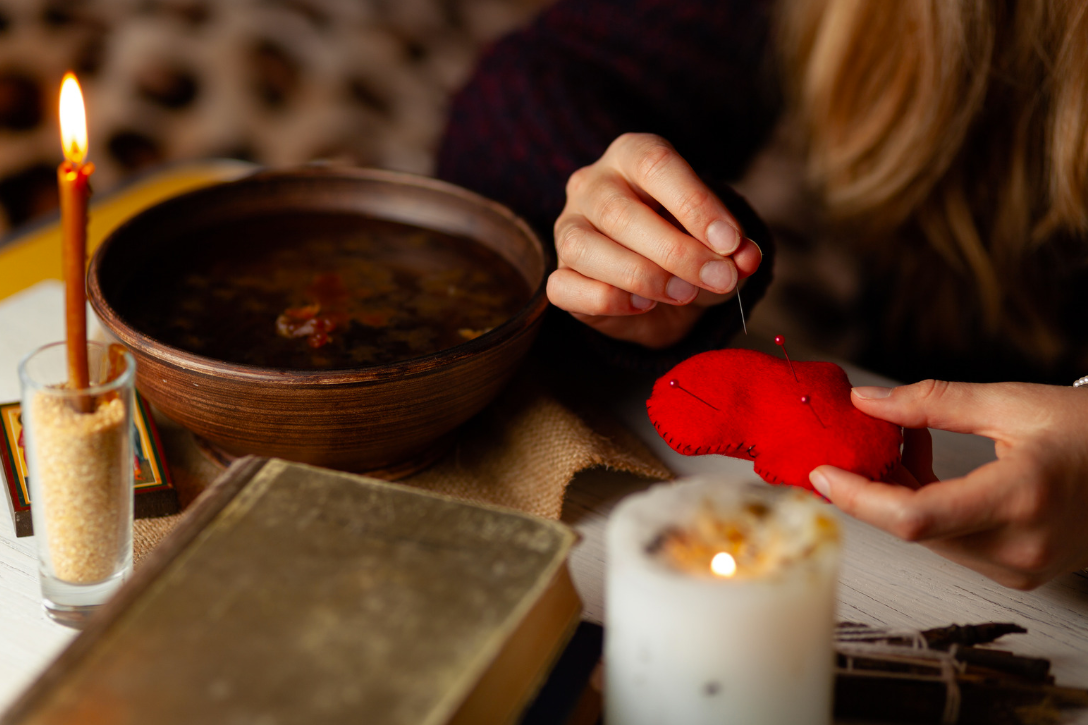
You have read a ritual, gathered a few things and reached the difficult question: what would it mean for this to work? Perhaps you want a sense of purpose, a way to mark a change or a moment to consider a decision. You may also be hoping for an outside event that no amount of preparation can guarantee.
Making magic work as a personal practice begins with separating those aims. You can learn a tradition, prepare thoughtfully and reflect on what you do. Those choices do not establish control over another person, a timetable or a supernatural outcome.
Separate Intention, Ritual and Outcome
An intention names a hope or purpose. A spell may give that intention a form through chosen words, actions or objects within a magical or spiritual practice. What those elements mean depends on the person and tradition; they are not a demonstrated mechanism that makes the universe deliver a request.
Keep the ritual, the practical action and the eventual outcome distinct. Writing a statement about a difficult conversation is something you do. Asking whether the other person is willing to talk is a separate action. Their response remains their choice. Confidence can be part of how you approach the situation, but doubt does not make you unworthy or explain every disappointment.
Define the Part You Can Evaluate
Before choosing a ritual, write down what you hope it will help you do. “Give myself time to consider a move” is different from “make the perfect home become available.” The first describes a process you can carry out. The second depends on circumstances beyond your practice.
You can notice whether you considered your options, respected a boundary or took a useful step. If a later event is welcome, you can appreciate it without deciding that the ritual must have caused it. If nothing changes, you do not need to invent a hidden success or a personal failure.
Learn the Context Before Adapting the Practice
Magical and spiritual practices do not share one rulebook. The Pagan Federation’s account of Witchcraft and Wicca, for example, describes several traditions within a particular religious context. A short online recipe cannot stand in for every community’s teachings.
Ask where a practice comes from, how its participants describe it and whether it involves knowledge or participation that has not been offered to you. You can make your own reflective exercise without presenting it as an inherited ceremony. A teacher’s clear explanation and willingness to answer questions tell you more than a claim to secret, unbeatable power.
Read the Instructions Before Buying Supplies
Read a proposed ritual all the way through while nothing is lit or prepared. Check what it asks you to handle, where it would happen, how it ends and what you would need to clean up. Decide whether the ordinary actions fit your home and the people who share it.
- Purpose: Can you explain why you want to do it?
- Permission: Does it involve another person, their belongings or shared space?
- Materials: Do you know what each substance is and how to handle it safely?
- Time: Can you remain present for the entire activity?
- Ending: Can you stop and put everything away without difficulty?
A dramatic instruction is not a reason to take an avoidable risk. You can decline a practice, choose a simpler one or ask a knowledgeable teacher about an alternative. No rare ingredient is necessary merely to sit quietly and reflect.
Keep Symbolic Choices Separate From Practical Requirements
A colour, an object or a lunar phase may have a meaning within a chosen tradition. That does not make it a demonstrated measure of power. Nor does an accidental change prove that you have created danger or ruined your chances.
Practical requirements deserve a different kind of attention. Heat can burn a surface, smoke can affect a shared room and an unidentified plant can be unsuitable to handle or consume. Do not put oils, herbs or other substances into someone’s food, drink or personal items. A symbolic purpose does not replace permission or ordinary product instructions.
The U.S. Fire Administration’s candle guidance recommends stable holders and at least 12 inches, about 31 centimetres, of clearance from things that burn. Extinguish candles before leaving the room or sleeping. A flameless light avoids an open flame.
Plan a Setup You Can Manage
Choose the material you are considering and the limits of your space. The planner suggests a practical next step; it does not rate magical effectiveness.
Use a Journal to Observe, Not to Prove a Cause
A useful record can be short. Note the purpose, what you actually did, anything that made the process awkward and what practical action belongs next to it. Later, add what happened without rewriting the original expectation to fit the result.
Include unchanged situations and alternative explanations. A journal may help you see a habit, a preference or a reason to try a different approach. It cannot separate every influence on an outside event, so a sequence of entries is not proof that a ritual caused it.
For example, a person might use a reflective practice before applying for a course. They can record whether it helped them organize their questions and submit the application. An acceptance or rejection still depends on the course’s requirements and decisions; it is not a verdict on the person’s spiritual worth.
Doubt and Difficult Feelings Do Not Make You at Fault
You do not have to feel perfectly positive to deserve care or to make a sensible choice. Being disappointed, uncertain or sad does not establish that you blocked the universe or caused someone else to act a certain way.
If you feel overwhelmed, pause the practice. You can return another day, change the format or stop. When questions about words and thoughts become worrying, our everyday spells guide offers a gentler way to think about intention without treating every thought as a spell.
Repetition and Spending Are Choices, Not Proof of Progress
Repeating a ceremony may have meaning within a tradition. Repeating it because someone says one more payment will finally fix everything is a different situation. Ask what has changed, what the next service includes and whether you can freely decline it.
You do not need to keep buying supplies to explain a disappointing result. A promise of guaranteed love or a threat that stopping will bring harm deserves a pause, not an urgent purchase. Read our guide to spotting love spell scams before making a pressured payment.
Give Practical Decisions Their Own Timetable
A spiritual practice does not decide when a bill is due, when an application closes or whether someone welcomes contact. Use the actual circumstances to choose your next step. Do not postpone needed help or keep pursuing a person who has declined because you have been told a result will arrive eventually.
For relationship questions, the guide to interpreting love-spell progress focuses on mutual communication and observable behaviour. For a general practice, a useful review asks: did I learn something, act with care and remain free to choose what happens next?
Frequently Asked Questions
1. Can I make a spell produce a guaranteed result?
No ritual can guarantee another person’s choices or a particular outside event. You can assess how you prepared, what you learned and which practical actions you took without claiming that you controlled the outcome.
2. Does using the wrong ingredient mean something bad will happen?
A substitution does not, by itself, establish a supernatural danger. What matters practically is whether a material is safe to handle and appropriate for the setting. Do not use an unknown substance merely to match a recipe.
3. Do all magical traditions follow the same rules?
No. Traditions have different religious contexts, customs and meanings. Ask how a practice is understood by the people who use it, and distinguish your own adaptation from a teaching you have not received.
4. Must I practise at the full Moon?
Some practitioners give lunar phases symbolic importance, while others do not. A phase of the Moon is not a verified guarantee of effectiveness or a reason to ignore ordinary safety and scheduling needs.
5. Will doubt or an unhappy mood ruin a ritual?
Doubt or sadness does not show that you caused a bad outcome. You can postpone a practice when you feel overwhelmed, but you do not have to maintain perfect positivity or blame yourself for another person’s decisions.
6. How long should I wait for a result?
There is no established universal waiting period. Keep practical decisions tied to real circumstances, and do not suspend your life or ignore a clear refusal while waiting for an imagined deadline.
7. Does a ritual journal prove that magic worked?
No. A journal can record what you did, how you felt and what happened later. It cannot isolate the cause of an event. Include ordinary explanations, unchanged outcomes and things you did not predict.
8. Do I need to pay for stronger materials or a teacher?
You do not need a purchase to begin personal reflection. If you choose a paid class or service, ask what it includes and what it costs. Avoid guaranteed outcomes, threats and pressure to buy repeated upgrades.
9. Should a candle burn all the way down?
No. Extinguish it before leaving the room or going to sleep. Use a stable holder away from anything that can burn, or choose a flameless light. A ritual instruction does not override fire precautions.
10. Can I change a ritual that does not fit my home?
Yes. You can choose a practice without flame, smoke or special substances, or decline it entirely. If you follow a particular tradition, ask a knowledgeable teacher about appropriate alternatives rather than claiming any change is traditional.
11. Should I repeat a ritual until I get the outcome I want?
Not automatically. First consider whether the practice remains useful and freely chosen. Repeating it does not establish greater effectiveness, and stopping is reasonable when it increases fear, fixation or pressure.
12. Can I involve someone else in my practice?
Ask before including them, using their belongings or sharing their private information. Respect their answer and the limits of shared space. A personal intention does not create permission to control someone else’s choices.
Magic is indeed a complex field. It’s interesting how ancient traditions like Voodoo and Ying-Yang play a role in it. Proper materials and the right mindset seems crucial.
While the article provide essential info on materials and mindset, a look into modern day practices would be more relevant for today’s readers. The historical context is enriching nonetheless.
The focus on proper materials and emotional state is paramount. It’s a reminder that magic isn’t just about the rituals but also about the practitioner’s inner state and intentions.
Waiting for the spell to work can be frustrating. Patience is as important as the energy we put into a spell. Also, the emphasis on moon phases is noteworthy.
Moon phases definitely affect spell effectiveness. Its often overlooked but plays a crucial role in many traditions.
Many people underestimate the power of lunar cycles in magic. Ancient cultures have always valued the moon’s influence.
The article touches on a broad aspect of magic and its elements like candles and oils. However, it lack a deep dive into regional practices which could have been insightful.
I agree, Anne. More details on region-specific practices would have been beneficial. The general overview is helpful but lacks depth in cultural contexts.