Home Blog Page 2

Can Love Spells Backfire? A Balanced Spiritual Guide

10
Woman reflecting on an unexpected relationship outcome on a coastal path

Stories about love spells “backfiring” can sound dramatic: a relationship supposedly gets worse, the wrong person appears, or the spellcaster feels that spiritual work has somehow turned against them. The uploaded draft takes a calmer view, treating unexpected outcomes as opportunities for clarity, healing, and growth rather than automatic supernatural punishment. That distinction is worth keeping.

Grounded view: there is no reliable evidence that a ritual can cause supernatural retaliation. What people call a “backfire” is often better understood as disappointment, unintended consequences, emotional fixation, poor boundaries, or a relationship developing differently than hoped.

For believers, a ritual can still carry personal or spiritual meaning. The safest approach is to separate that meaning from claims of guaranteed control over another person. That same free-will principle is central to our guide on whether love spells can make someone love you.

What Does “Backfire” Actually Mean?

Different practitioners use the word differently. Some mean a spell appears to produce the opposite result. Others use it for any outcome that feels disappointing or emotionally difficult. In everyday terms, “backfire” may describe situations such as:

  • Becoming more preoccupied with one person instead of feeling calmer.
  • Ignoring clear signs that interest is not mutual.
  • Spending money repeatedly because someone promises a stronger ritual.
  • Feeling disappointed when a hoped-for reunion does not happen.
  • Discovering that the relationship itself was not healthy.
  • Realizing that healing or moving on is the better outcome.

Those experiences can be real and important without requiring a supernatural explanation.

Why Unexpected Outcomes Happen

1. The Goal Was Too Narrow

A ritual aimed at one exact person can make it easy to overlook the larger question: is this relationship mutual, respectful, and genuinely compatible? A broader intention such as “I want a loving relationship built on mutual choice” leaves room for a healthier outcome.

2. Expectations Became a Deadline

Spiritual practice does not provide a verified timetable for another person’s feelings or decisions. Treating a date, dream, or coincidence as a deadline can create anxiety. Our balanced guide to whether love spells work explains why guaranteed outcomes are not a sound standard.

3. The Ritual Replaced Real Communication

If a relationship needs a conversation, apology, boundary, or decision, ritual alone cannot substitute for that work. People can use spiritual practice as reflection, but mutual communication still matters.

4. Emotional Readiness Was Missing

The supplied article correctly emphasizes emotional readiness before starting love-focused spiritual work. Strong grief, anger, jealousy, or fear can make it harder to evaluate a situation clearly. In that case, self-love, healing, journaling, or simply taking time may be more constructive than repeating rituals.

Free Will Is the Most Important Boundary

A healthy relationship depends on two people choosing it. The supplied draft also makes free will a central principle, encouraging mutual attraction, communication, and compatible partnerships instead of control.

Healthier intention
Invite mutual love and compatible relationships.
Riskier intention
Make one specific person ignore their own wishes.
Healthier action
Communicate once, clearly and respectfully.
Riskier action
Repeated unwanted contact because “signs” say to continue.

If someone says no, asks for space, or ends contact, spiritual interpretation should never be used to override that boundary.

When a “Backfire” May Really Be Useful Information

Sometimes the result that feels wrong at first reveals something important. You may realize an ex is not interested in rebuilding the relationship, notice that you feel more peaceful when you stop pursuing them, or meet someone whose values fit you better. That does not prove a spiritual mechanism. It does show why outcomes should be evaluated by the health of the situation, not by whether a ritual produced one predetermined result.

This is also where our love spell myths vs. facts guide is useful: meaningful coincidences can feel personally significant, but they are not proof that another person’s intentions have changed.

Signs You Should Stop and Reassess

  • You are checking for signs constantly and feeling more anxious.
  • You are spending more money each time someone says the previous ritual was not strong enough.
  • You are being told a curse, blockage, or emergency requires immediate payment.
  • You are ignoring a person’s stated boundaries.
  • Your sleep, work, friendships, or daily routine are suffering.
  • You feel afraid that stopping the ritual will cause harm.
  • You are repeatedly casting spells instead of making a practical decision.

These are reasons to reduce pressure and regain perspective, regardless of spiritual belief.

A Better Response to an Unexpected Outcome

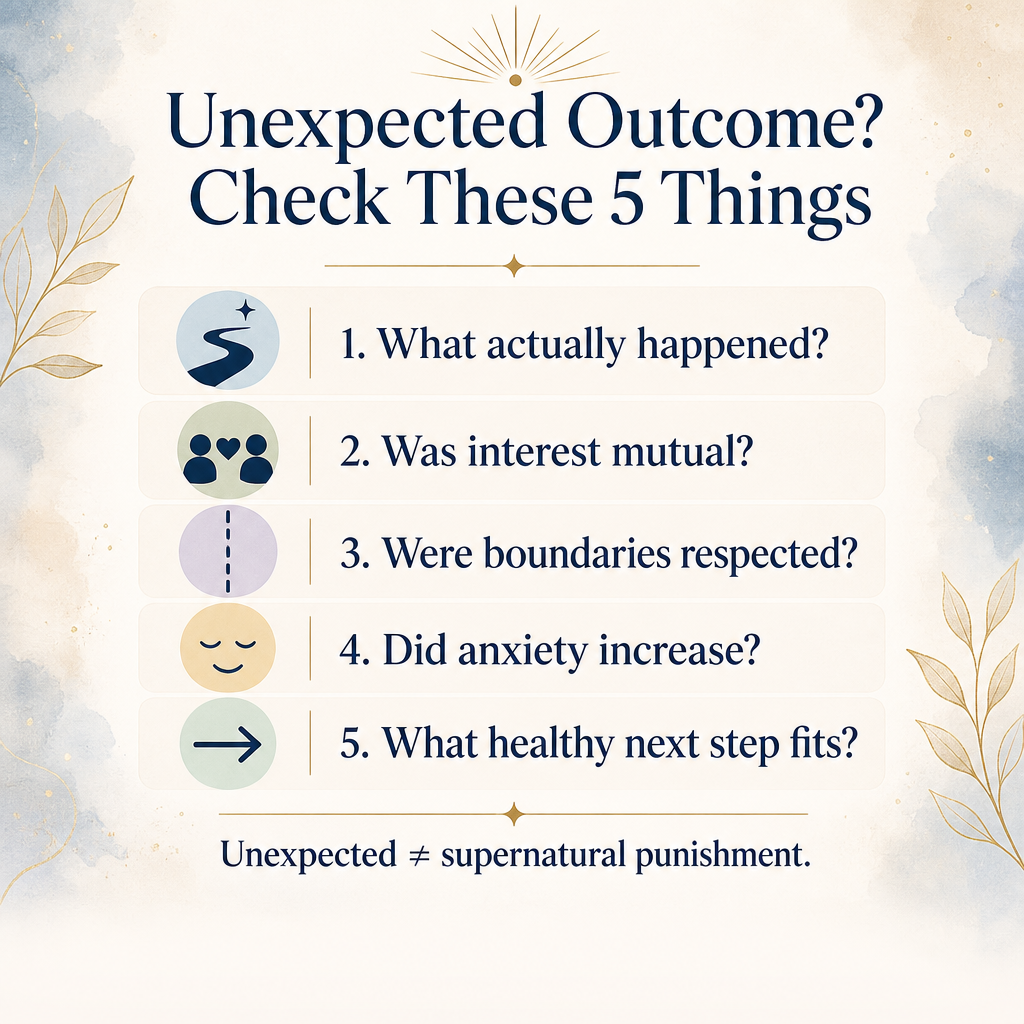
Infographic for evaluating an unexpected love spell outcome
Unexpected outcomes are easier to assess when you separate observable facts from spiritual interpretation.

  1. Name what actually happened. Separate observable facts from interpretations.
  2. Check consent and boundaries. Is the other person willingly participating?
  3. Review the original intention. Was it about mutual love or control?
  4. Look at your well-being. Are you calmer and clearer, or more fearful?
  5. Choose a practical next step. Communicate, give space, seek support, or move on.

How to Reduce the Risk of Harm

Use rituals as a reflective spiritual practice rather than a guarantee. Keep candle and herb use physically safe. Avoid coercive promises. Do not treat symbolic signs as consent. Set a spending limit before hiring anyone. And if a relationship involves threats, stalking, coercion, or abuse, prioritize personal safety and qualified support rather than a ritual.

For a related troubleshooting perspective, see why a love spell might not work.

Redefining Success

The uploaded draft suggests that inner peace, emotional healing, confidence, stronger self-respect, and healthier relationships can be meaningful outcomes. That is a much more useful standard than asking whether another person behaved exactly as expected.

For believers, a ritual may help create a pause for reflection. The strongest real-world measure is what happens next: whether you respect boundaries, communicate clearly, make safer choices, and move toward relationships based on mutual interest.

Frequently Asked Questions

1. Can a love spell really backfire?

There is no reliable evidence of supernatural retaliation. People may use “backfire” to describe disappointment, emotional fixation, poor boundaries, or an unexpected outcome.

2. Can a positive intention still lead to disappointment?

Yes. A positive intention cannot guarantee another person’s feelings, timing, or decisions.

3. Does an ex not returning mean the ritual failed?

Not necessarily in a personal or spiritual sense. It may simply mean reconciliation is not mutual or that moving forward is healthier.

4. Can repeating a ritual make things worse?

Repeated rituals can increase anxiety or fixation if they become a substitute for acceptance and practical action.

5. Should I target a specific person?

A broader intention centered on mutual, compatible love better respects free will than trying to control one person’s choices.

6. Are dreams proof that a spell is working?

No. Dreams can feel meaningful, but they do not prove another person’s intentions have changed.

7. What if I receive an unexpected message?

Treat it as normal communication first. Look at the person’s words and behavior instead of assuming a supernatural cause.

8. Can emotional healing count as a positive outcome?

Yes. Healing, confidence, and clarity can be valuable outcomes regardless of what happens romantically.

9. Should I be afraid to stop a love spell?

No one should pressure you with claims that stopping will cause harm. Fear-based pressure is a reason to step away.

10. Can a practitioner guarantee there will be no backfire?

No one can guarantee another person’s behavior or a supernatural result.

11. What is the safest intention?

Focus on mutual love, healthy communication, self-respect, healing, and compatible relationships.

12. When should I give someone space?

Whenever they ask for it, stop responding, decline contact, or make their boundaries clear.

13. Is disappointment a sign of bad energy?

Not necessarily. Disappointment is a normal emotional response when hopes and outcomes differ.

14. Can journaling help?

Yes. Writing down facts, feelings, and decisions can help separate observable changes from assumptions.

15. When should I seek outside support?

If the situation is affecting your safety, mental well-being, finances, or daily functioning, consider trusted personal or professional support.

Final Thoughts

Love spells do not need to be framed as dangerous supernatural forces to take unexpected outcomes seriously. The more useful questions are whether the practice is increasing clarity or anxiety, whether boundaries are being respected, and whether your choices support healthy relationships.

For believers, spiritual ritual can remain meaningful while still leaving room for uncertainty, free will, and practical judgment. An outcome that differs from your hope is not automatically punishment; sometimes it is simply information that helps you choose a healthier next step.

Love Spell Myths vs Facts: What Believers Should Know

10
Woman reflecting on love spell myths and facts in a botanical conservatory

Love-spell myths spread easily because love is emotional and because entertainment, advertising, folklore, and spiritual practice often get mixed together. The supplied draft had a useful myth-versus-fact format, but some of its “facts” were still belief claims presented too strongly.

This version uses a clearer standard: a “fact” should be something we can reasonably establish about practice, safety, consent, or evidence. Spiritual interpretations are labeled as beliefs rather than presented as proven mechanisms.

Important distinction: “Many practitioners believe this” is not the same statement as “this has been scientifically proven.” Both can be discussed, but they should not be confused.

Myth 1: Love Spells Always Work Instantly

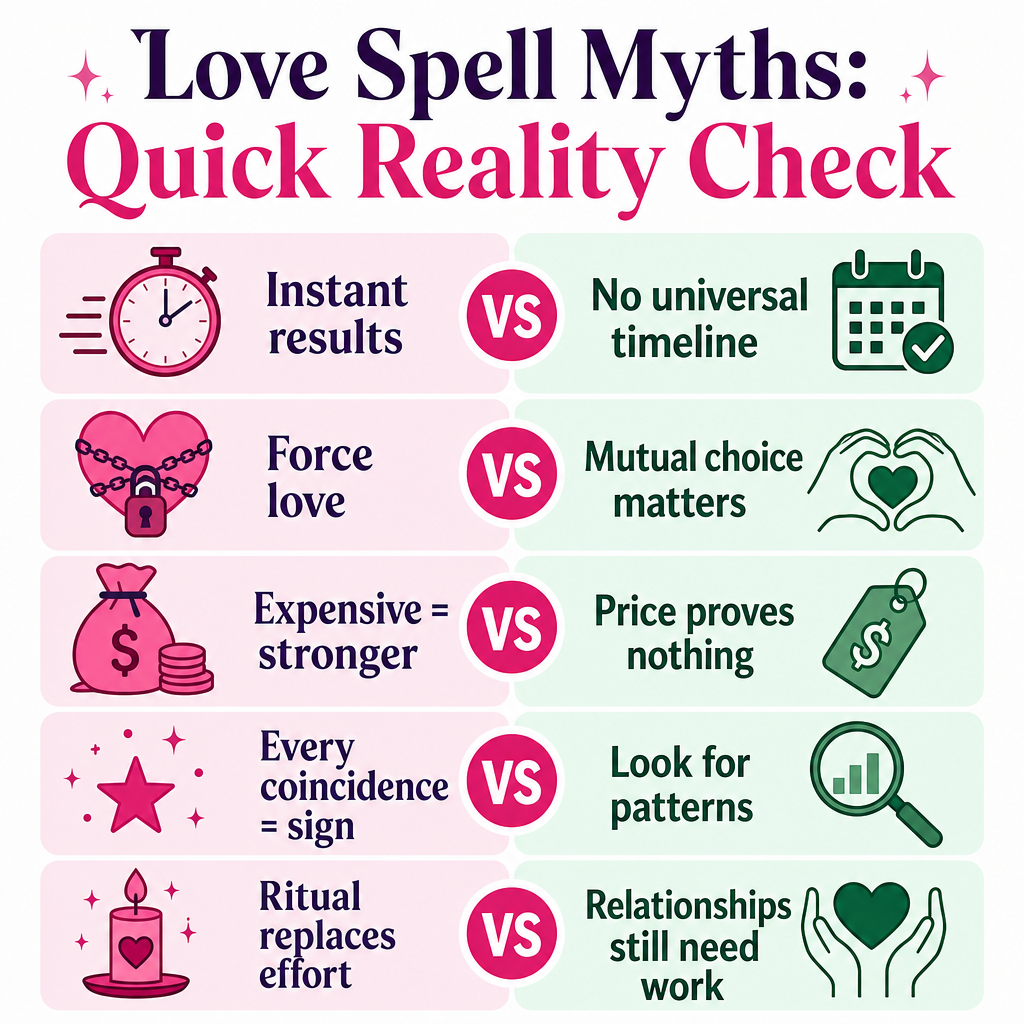
Reality: There is no verified universal timetable. Some believers report fast changes; others describe gradual experiences or no desired outcome at all. Healthy relationships usually develop through repeated interaction, trust, and mutual interest.

For the wider question of effectiveness, see Do Love Spells Really Work?.

Myth 2: A Spell Can Make Anyone Fall in Love

Reality: Genuine love involves another person’s choices. A modern consent-centered approach rejects using spirituality as a reason to override a refusal, pursue unwanted contact, or claim ownership over someone else’s feelings.

See Can Love Spells Make Someone Love You? for a deeper discussion.

Myth 3: More Expensive Means More Powerful

Reality: Price is not proof of effectiveness. Be especially cautious when someone claims a curse, blockage, or emergency that can only be fixed by paying more money immediately. For a broader checklist of factors that may make a spiritual practice more grounded, see Love Spell Success Factors.

Myth 4: Rare Ingredients Are Required

Reality: Many practitioners use simple symbolic tools such as a candle, paper, flowers, water, prayer, meditation, or journaling. Others use no physical tools. Ritual supplies should not be treated as inherently powerful objects that guarantee an outcome.

Love Spell Myths: Quick Reality Check infographic

Myth 5: Love Magic Is Only About Finding Romance

Reality: Modern love-focused practice may include self-love, emotional healing, relationship gratitude, reconciliation, commitment, or letting go. The common thread is the theme of love, not necessarily attracting a new partner.

Myth 6: Every Love Spell Has the Same Purpose

Reality: Attraction, reconciliation, self-love, commitment, harmony, and release are different intentions. The article Choosing the Right Love Spell for Your Heart’s Intent explains these distinctions.

Myth 7: Repeating Rituals Makes Results Happen Faster

Reality: There is no established evidence that repeating a ritual speeds up another person’s choices. Repetition can also turn into compulsive checking. If you keep restarting because you are afraid, it may be more helpful to pause and reassess the real-life situation. See How Often Should You Perform a Love Spell? for a dedicated repetition guide.

Myth 8: Fear and Desperation Create Stronger Magic

Reality: Many practitioners prefer calm intention. Practically, fear can narrow judgment and make people more vulnerable to scams, impulsive spending, or unhealthy relationship decisions.

Myth 9: Every Coincidence Is a Sign

Reality: Repeating numbers, dreams, songs, or chance meetings may feel meaningful, but one coincidence is not proof that a ritual caused an external event. Keep symbolic interpretation separate from evidence about another person’s behavior.

Myth 10: Psychic Readings and Love Spells Are the Same

Reality: They are usually treated as different practices. A reading is used for interpretation or guidance; a ritual is organized around an intention. Neither can replace an actual conversation with the person involved.

Myth 11: You Need a Secret Spiritual Gift

Reality: Many modern spiritual practices involve ordinary activities such as meditation, prayer, visualization, journaling, or symbolic ritual. Be cautious of claims that one practitioner alone has a secret power you must keep paying to access.

Myth 12: A Ritual Replaces Relationship Work

Reality: Communication, trust, accountability, boundaries, reliability, and mutual effort still matter. If those are missing, a ritual does not solve the underlying relationship problem.

For practical safety and preparation, see How to Make Spell Casting Safe.

Myth 13: Crystals and Candles Are Proven to Change Feelings

Reality: Crystals and candles have symbolic roles in many spiritual practices, but that is different from scientific evidence that they can alter another person’s emotions.

Myth 14: Reconciliation Can Be Guaranteed

Reality: Reunion requires both people to want it. Trust may need to be rebuilt, behavior may need to change, and sometimes the healthiest outcome is closure rather than reunion.

Myth 15: A Love Spell Makes a Relationship Permanent

Reality: No ritual removes the need for ongoing care. The article Are Love Spells Permanent? looks at lasting relationships in more detail.

Frequently Asked Questions

1. Do love spells work instantly?

There is no reliable evidence of a universal instant effect. Believers may interpret changes in different ways, but relationship outcomes do not follow a verified ritual timetable.

2. Can a love spell force someone to love you?

A consent-centered approach says no spiritual practice should be used to justify overriding another person’s choice. Genuine relationships require mutual interest.

3. Are expensive spells more powerful?

Price is not evidence of effectiveness. Be cautious of anyone who uses fear, urgency, or escalating fees to promise guaranteed results.

4. Do I need rare ingredients?

No. Many spiritual practices use ordinary symbolic items or no physical tools at all. Meaning depends on the practitioner and tradition.

5. Are love spells only for romance?

No. Modern practitioners may use love-focused rituals for self-love, healing, family harmony, reconciliation, or gratitude.

6. Are all love spells the same?

No. Attraction, self-love, reconciliation, commitment, harmony, and release rituals have different intentions and cultural backgrounds.

7. Does repeating a spell make it work faster?

There is no established evidence that repetition accelerates an outcome. Repeating a ritual from anxiety can also make it harder to judge the real situation.

8. Does desperation make a spell stronger?

Many modern practitioners prefer calm, clear intention over desperation. From a practical perspective, high anxiety can make decision-making and boundary-setting more difficult.

9. Does every coincidence mean the spell is working?

No. Coincidences can feel meaningful, but one event is not proof of a supernatural cause.

10. Are psychic readings the same as love spells?

No. A reading is generally used for reflection or guidance, while a ritual is performed around an intention. Neither should replace direct communication or consent.

11. Do you need a special gift to perform a love ritual?

Many modern practices are simple forms of reflection, prayer, journaling, or symbolism. Claims that only one person has a secret power should be evaluated carefully.

12. Does a ritual replace relationship effort?

No. Trust, communication, reliability, boundaries, and mutual effort remain essential.

13. Are crystals or candles scientifically proven to change relationships?

No. Their use in love rituals is spiritual or symbolic. That is different from scientific evidence of changing another person’s feelings.

14. Can a spell guarantee reconciliation?

No. Reconciliation requires willingness from both people and often changed behavior, communication, and rebuilt trust.

15. What is the biggest myth to avoid?

The idea that a ritual gives control over another person’s emotions. A healthier spiritual framework centers on intention, reflection, and mutually chosen relationships.

Final Thoughts: Separating Myth, Belief, and Evidence

You do not have to dismiss spirituality in order to use careful language. A belief can be meaningful without being presented as proven science. A ritual can be personally important without giving anyone control over another person.

The most useful love-spell guidance keeps those boundaries clear: spiritual intention on one side, real-world consent and relationship evidence on the other.

Love Spell History: Traditions Across Cultures and Time

8
South Asian woman studying historical love-magic sources in an archive reading room

Love magic has a real documented history, but that history is more complex than the idea that every civilization practiced the same kind of “love spell.” The supplied draft covered many cultures in a broad sweep. This revised version narrows claims to what surviving evidence can support and separates documented history from modern spiritual inspiration.

Ancient and medieval sources show people using rituals, prayers, amulets, figurines, written formulas, herbs, perfumes, knots, and other symbolic tools for attraction, marriage, affection, fertility, reconciliation, or control. The meaning of those practices changed from place to place.

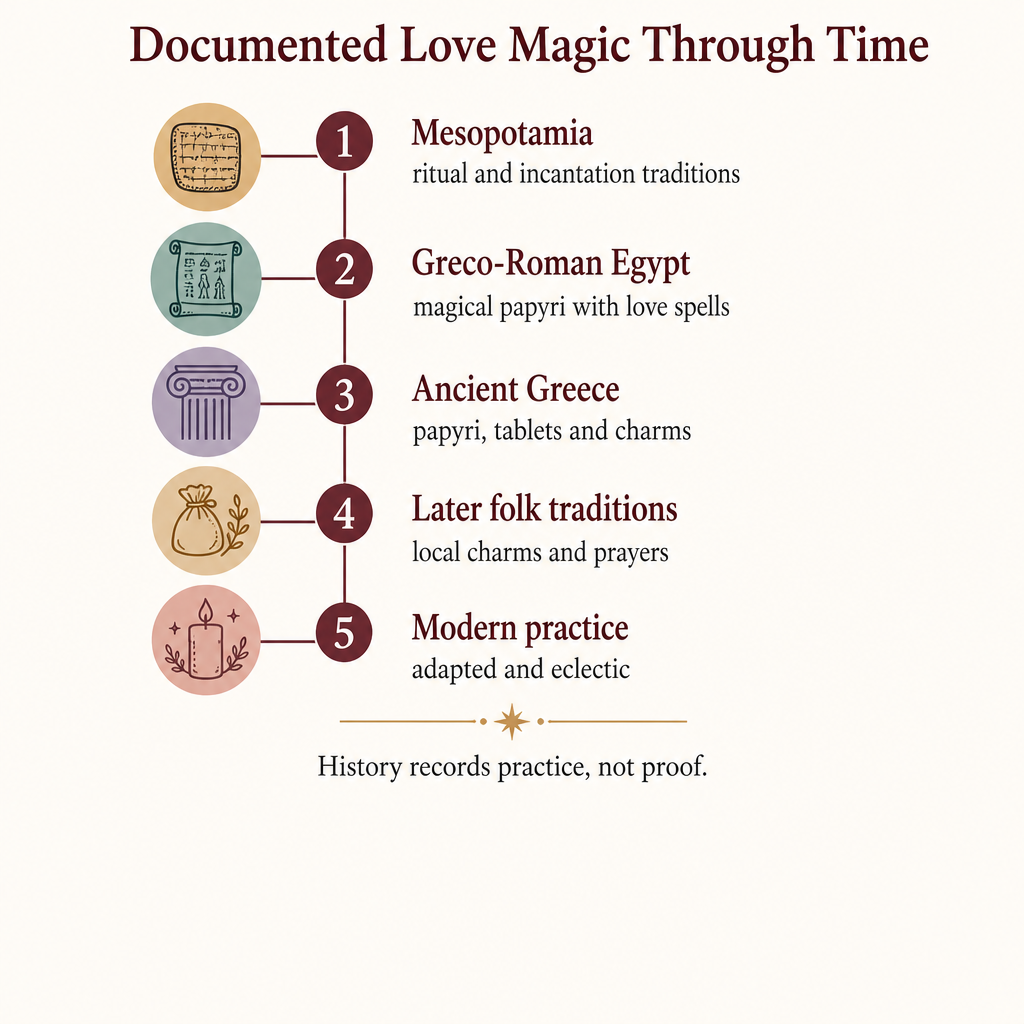
History is evidence of practice, not proof of supernatural results. A surviving spell tells us what people wrote, believed, or attempted—not whether the ritual caused the desired outcome.

What Counts as Evidence for Ancient Love Magic?

Historians rely on surviving objects and texts: papyri, tablets, inscriptions, figurines, amulets, recipe books, court records, religious texts, and literary references. For example, the British Museum’s London Magical Papyrus includes a catalogued love spell among many other ritual texts. The British Library also preserves Greek magical papyri containing love spells from Late Antique Egypt.

These sources are especially useful because they let us discuss a specific object, language, date, and context instead of making vague claims about an entire civilization.

Documented Love Magic Through Time infographic

Greco-Roman Egypt and the Magical Papyri

Some of the clearest surviving love-spell texts come from Egypt during the Greco-Roman and Late Antique periods. They may be written in Greek, Demotic Egyptian, or mixed linguistic traditions. They include attraction spells, binding rituals, love charms, and instructions involving objects or spoken formulas.

Many of these historical texts are coercive by modern standards. A modern consent-centered article should not romanticize that feature. Studying an ancient practice and recommending it are two different things.

Ancient Greek Love Magic

Greek evidence includes magical papyri, curse tablets, gemstones, figurines, and references in literature. Scholars distinguish different types of attraction and affection magic rather than treating “Greek love spells” as one uniform practice.

This is one place where the modern idea that ancient love magic was mainly about gentle harmony breaks down. Some historical spells explicitly attempted to compel or bind another person.

Mesopotamian Ritual Traditions

Mesopotamia preserves a large body of incantations and ritual literature. It is safer to say that magic and ritual were well documented there than to turn every marriage, fertility, or relationship custom into a “love spell.” The category itself is often a modern label applied to varied ancient practices.

Ancient Egypt Beyond the Simplified Story

Popular spiritual writing often says “Ancient Egyptians used love spells” without a date or source. A more accurate statement is that magical texts from Egypt, especially later periods with Greek and Demotic material, include love spells and related rituals. This distinction matters because Egyptian history spans thousands of years and many changing religious contexts.

For a site-specific companion piece, see What Are Egyptian Love Spells?.

Europe, Folk Practice, and Household Ritual

Across later European history, people used charms, prayers, herbs, written formulas, divination, and household customs connected with courtship, marriage, fertility, and affection. These practices varied by region and religious environment. It is better to discuss a particular folk custom than to claim there was one medieval European love-magic system.

Africa, Asia, and Indigenous Traditions: Avoiding Overgeneralization

The supplied draft treated Africa, India, China, Japan, and Indigenous cultures as large single traditions. That is too broad. Each region contains many religions, languages, ethnic groups, and local practices. Some have relationship blessings, marriage rituals, divination, ancestor traditions, shrine practices, charms, or folk magic, but they should be studied on their own terms.

A respectful history does not automatically relabel every relationship ceremony as a love spell.

How Modern Love Magic Developed

Modern witchcraft and eclectic spirituality often combine older folk practices with ceremonial magic, astrology, modern crystal culture, candle rituals, manifestation language, and internet-era interpretations. This means a modern ritual may be inspired by older symbols without being an unchanged ancient practice.

For the site’s wider background material, History of Magic provides another entry point, while Understanding Wicca covers one modern religious context that is often incorrectly treated as identical to all witchcraft.

Consent: A Major Difference Between Historical Study and Modern Practice

Historical love magic often reflects social values very different from modern relationship ethics. Some texts tried to compel desire, restrict a partner, or override resistance. A modern article can document that history without endorsing it.

Today, a safer framing focuses on self-love, openness to compatible partners, mutual reconciliation, relationship harmony, and personal reflection.

Frequently Asked Questions

1. How old is documented love magic?

Written evidence survives from antiquity, including magical papyri from Greco-Roman Egypt. This shows that love-related ritual texts are at least many centuries old, though practices and purposes differed widely.

2. Did ancient Egyptians use love spells?

Love spells appear in magical papyri from Egypt, especially from the Greco-Roman and Late Antique periods. It is more accurate to discuss specific surviving texts than to claim that all ancient Egyptians practiced the same rituals.

3. Did ancient Greeks practice love magic?

Yes, surviving Greek magical texts, curse tablets, amulets, and literary references document several forms of love magic. Some were coercive by modern standards.

4. Were ancient love spells always positive?

No. Historical evidence includes attraction, binding, compulsion, and other practices that would conflict with modern consent-centered ethics.

5. Did Mesopotamia have magic?

Mesopotamian sources preserve extensive ritual and incantation traditions. Claims about specific love rituals should be tied to documented texts rather than generalized from magic as a whole.

6. Were candles used in all ancient love rituals?

No. Depending on place and period, rituals could involve lamps, figurines, tablets, papyrus, amulets, incense, oils, knots, spoken formulas, or other materials.

7. Did every culture have love spells?

Many societies developed rituals around love, marriage, fertility, family, or attraction, but it is too broad to say that every culture had the same thing called a love spell.

8. What are the Greek Magical Papyri?

They are a modern scholarly name for a collection of magical texts, mainly from Greco-Roman Egypt, containing rituals for many purposes including love, protection, divination, and healing.

9. What is a love-binding spell in history?

Some ancient texts sought to bind, compel, attract, or restrain a desired person. These historical practices should be described accurately without presenting coercion as a model for modern relationships.

10. How did folk traditions change over time?

Rituals changed as religions, languages, trade, migration, family customs, and local beliefs changed. Modern practice often combines inherited traditions with newer eclectic spirituality.

11. Are modern love spells direct copies of ancient spells?

Usually not. Some modern practitioners borrow symbols or ideas from older material, but modern rituals are often simplified, adapted, or newly created.

12. Why is cultural context important?

A ritual can have a specific religious, ethnic, or historical meaning. Removing it from that context can lead to inaccurate claims or disrespectful borrowing.

13. Can historical sources prove magic works?

Historical sources can show that people practiced and believed in magic. They do not by themselves prove that a ritual caused the desired supernatural outcome.

14. Where can I see documented ancient love magic?

Major libraries, museums, and academic collections preserve magical papyri and related objects. The British Museum and British Library, for example, catalogue texts that explicitly include love spells.

15. What is the best way to study love-spell history?

Use museum catalogues, academic publications, primary-text translations, and scholarship that identifies the date, language, place, and cultural setting of each source.

Final Thoughts on the History of Love Spells

Love magic has a long and fascinating documentary record, especially in ancient Mediterranean material. But the strongest history is specific: it names the text, object, place, language, and period whenever possible.

That approach is more respectful to the cultures involved and more useful for readers than a single story claiming that all societies shared the same beliefs. Modern practitioners can be inspired by history while still recognizing how much spiritual practice has changed.

How to Tell If Your Love Spell Is Actually Working

10
Woman evaluating relationship changes with a flip phone and journal

After a love ritual, it is easy to start scanning daily life for proof: a dream, a repeating number, an unexpected message, or a sudden change in mood. The supplied draft usefully emphasized subtle progress, but it also mixed symbolic experiences with stronger claims about a spell “working.” This version separates those ideas.

For believers, signs can have spiritual meaning. But a sign is not the same as evidence that another person’s feelings were changed by a ritual. The most reliable relationship information still comes from observable behavior, direct communication, reciprocity, and consent.

Use two lenses: spiritual meaning can be personal; relationship evidence should be practical and observable.

Start With the Changes You Can Actually Observe

The earliest changes may be inside you. These are useful because you can evaluate them directly:

  • You feel less panicked about the relationship.
  • You are clearer about your standards and boundaries.
  • You communicate more calmly.
  • You stop chasing reassurance.
  • You become more willing to accept either reunion or a new direction.

These changes do not prove supernatural causation. They do show that the ritual or reflection process may be influencing how you approach the situation.

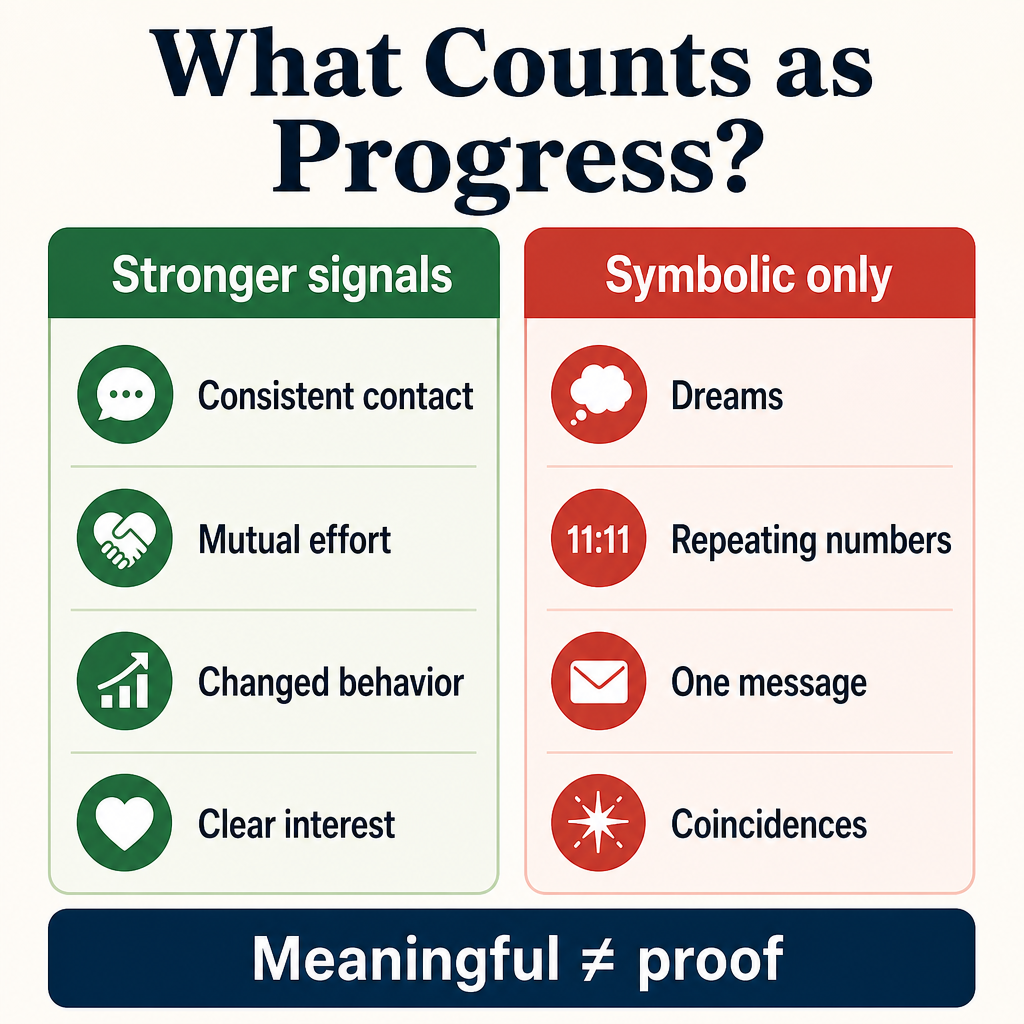
Stronger Relationship Signals

If you are evaluating an actual relationship, pay more attention to repeated behavior than isolated signs.

Potentially meaningful in a relationship Not enough by itself
Consistent, voluntary communication One unexpected text
Mutual plans and follow-through A dream about the person
An apology followed by changed behavior Seeing their name repeatedly
Clear expression of interest Repeating numbers
Respect for boundaries A tarot card pulled once

What Counts as Progress infographic

Dreams, Intuition, and Synchronicities

Dreams and coincidences are common parts of spiritual storytelling. They can help you reflect on your emotions, but they are subjective. If you keep a journal, record the event and also record alternative explanations instead of deciding immediately that it confirms one outcome. For a deeper look at emotionally vivid relationship dreams, see Dreaming of Your Soulmate Before You Meet: Meaning.

For broader context on whether spiritual rituals “work,” see Do Love Spells Really Work? A Balanced Spiritual Guide.

How to Avoid Turning Every Event Into a Sign

When we strongly want an outcome, it becomes easier to notice information that supports it. A simple way to reduce that problem is to decide in advance what would count as meaningful progress.

  1. Define your intention.
  2. List observable changes you would want in a healthy relationship.
  3. List outcomes that would tell you to move on.
  4. Review once a week rather than constantly.
  5. Give more weight to repeated behavior than symbolic events.

What If Nothing Seems to Be Changing?

No visible change does not require a new ritual. It may simply mean the situation is unchanged. If communication is absent, interest is not mutual, or the same conflict continues, that information matters.

You may also find useful context in Why a Love Spell Might Not Work, which explores the gap between expectation and real-life circumstances.

When a “Sign” Should Never Override a Boundary

A dream, card reading, coincidence, or intuitive feeling should never be used to reinterpret a clear refusal. If someone says no, asks for space, blocks contact, or communicates disinterest, respect that boundary.

The article Can Love Spells Make Someone Love You? explains why mutual choice is central to a healthy interpretation of attraction work.

Progress Can Mean a Different Outcome

Sometimes the clearest progress is realizing that you no longer need the original outcome. You may feel more ready to date someone new, more able to release an unhealthy connection, or more confident about having a difficult conversation.

That is compatible with a spiritual practice centered on growth rather than control. It also connects with the broader question of whether intentions endure over time, explored in Are Love Spells Permanent?.

Frequently Asked Questions

1. What is the first sign a love spell is working?

Believers often describe internal changes first, such as feeling calmer, more confident, or clearer about what they want. These experiences can be meaningful without proving that a ritual caused an external event.

2. Does a text message prove the spell worked?

No. A message can be welcome, but one contact does not establish cause. Look for consistent, reciprocal communication and respectful behavior.

3. Are dreams proof of a working love spell?

Dreams can be personally meaningful, but they are not objective proof that another person’s feelings have changed.

4. Do repeating numbers mean my spell is working?

Some believers interpret repeating numbers symbolically, while others see them as coincidences. They should not be treated as evidence of another person’s consent or intentions.

5. Can feeling calmer count as progress?

Yes. If a spiritual practice helps you feel more grounded and less desperate, many believers consider that a useful outcome.

6. What relationship changes matter most?

Consistent communication, mutual effort, respect, changed behavior, reliability, and freely expressed interest are more informative than symbolic signs.

7. Should I repeat a spell because I see no signs?

Not automatically. Repeating rituals out of anxiety can make it harder to judge the situation clearly. Consider your real-life options first.

8. Can a spell be meaningful even if a romance does not happen?

Yes. Personal growth, closure, confidence, and clarity may still be meaningful outcomes.

9. What if I only notice coincidences?

Record them if they matter to you, but avoid building major relationship decisions on them. Look for observable behavior as well.

10. Can tarot or divination confirm a love spell worked?

Divination can be used as a spiritual reflection tool, but it cannot verify another person’s private thoughts or replace direct communication.

11. How can I avoid confirmation bias?

Write down what you would count as progress before you start checking. Include neutral or negative outcomes too, and review patterns rather than only events that support your hope.

12. What if the person says they are not interested?

Respect the answer. A spiritual interpretation should never override a person’s clearly expressed choice.

13. Is personal confidence a better sign than obsession?

Yes. Growing confidence and emotional balance are healthier markers than feeling compelled to monitor someone or search constantly for signs.

14. How long should I watch for progress?

There is no universal period. Give yourself enough space to notice patterns, but do not put your life on hold waiting for a specific person.

15. What is the best overall test of progress?

Ask whether the practice is helping you act with more clarity, respect, emotional balance, and openness to a mutually chosen relationship.

Final Thoughts: How to Judge Whether It Is Working

If you believe in love spells, you can still interpret the experience carefully. Symbolic signs may feel meaningful, but they should not be treated as proof about another person’s mind. The most useful evidence is what happens in your own emotional life and in the actual relationship.

Look for greater clarity, calmer choices, mutual communication, consistent behavior, and respect. Those markers protect both spiritual meaning and real-world judgment.

Do Love Spells Really Work? A Balanced Spiritual Guide

10
Woman considering spiritual belief and practical action with laptop and phone

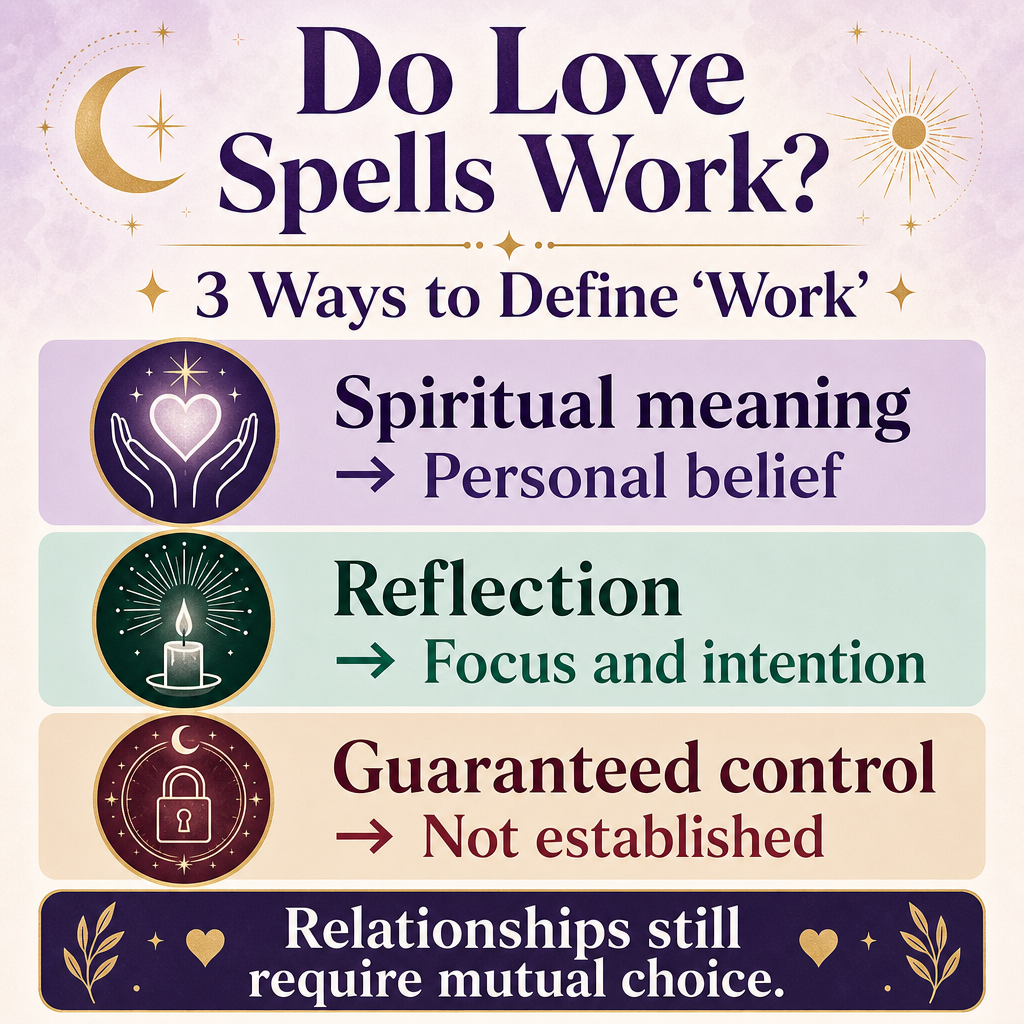
“Do love spells really work?” sounds like a yes-or-no question, but the answer depends on what “work” means. Some believers understand a love spell spiritually. Others experience a ritual as a symbolic practice that helps them focus, reflect, or act with more confidence.

There is no scientific evidence that love spells can force another person to fall in love, return, or change a decision. Claims of guaranteed supernatural results should be treated cautiously. A balanced view separates personal spiritual meaning from verified cause and effect.

Three Different Meanings of “Work”

1. A spiritual interpretation

A believer may feel that intention, prayer, ritual, or symbolic objects help align them with love, healing, or opportunity.

2. A reflective interpretation

A ritual can create a focused moment to identify what you want, calm down before making a decision, or reinforce a commitment to change your own behavior.

3. A guaranteed external result

This is the claim that a spell will definitely make a specific person love you, return, or behave differently. That claim is not scientifically established and conflicts with the reality of another person’s free will.

What Believers Commonly Focus On

  • Clear intention.
  • Emotional readiness.
  • Patience.
  • Personal growth.
  • Symbolic tools such as candles or journals.
  • Openness to unexpected outcomes.

For related perspectives, see Why a Love Spell Might Not Work and Are Love Spells Permanent?.

Free Will Is the Practical Boundary

Whatever your spiritual beliefs, another person’s decision still matters. A healthy practice does not use a ritual as permission to ignore rejection, violate a boundary, or assume that a coincidence proves consent.

What May Change After a Ritual

Sometimes the clearest change is in the person performing it. They may become calmer, more confident, more willing to meet people, more focused on communication, or more ready to let go. Those changes can affect a love life without proving supernatural causation.

How to Evaluate Results More Carefully

  1. Define the goal before the ritual.
  2. Separate internal changes from another person’s actions.
  3. Look for direct communication rather than signs alone.
  4. Notice whether your behavior has changed.
  5. Set a point when you will reassess instead of waiting indefinitely.

Red Flags Around Guaranteed Love Spell Claims

  • A promise of 100% guaranteed results.
  • Claims that only repeated payments can prevent disaster.
  • Pressure to keep the work secret from everyone.
  • Threats that stopping payment will cause harm.
  • Claims that another person’s consent is irrelevant.

Responsible spiritual guidance should leave room for uncertainty and personal choice.

Where Love Spells Fit Best

A balanced use is as an intention-setting practice alongside real-world actions. If your goal is new love, meet people. If your goal is reconciliation, communicate only when welcome. If your goal is a stronger relationship, work on trust and shared habits. If your goal is healing, allow yourself to release the relationship.

Infographic showing three ways people define whether a love spell works

Frequently Asked Questions

1. Do love spells always work?

No outcome can be guaranteed. Beliefs vary, and spiritual rituals are not scientifically established methods for controlling romantic events.

2. Is there scientific proof that love spells work?

No scientific evidence establishes that love spells can cause another person to fall in love or change their decisions.

3. Why do people believe love spells work?

Some people interpret rituals through spiritual belief, personal meaning, emotional focus, coincidence, or changes in their own behavior.

4. Can intention change another person’s feelings?

There is no reliable evidence that intention alone changes another person’s feelings. Their choices remain their own.

5. Can a ritual still be useful without supernatural proof?

Yes. It can function as a symbolic practice for reflection, confidence, closure, or clarifying goals.

6. How long should I wait for results?

There is no reliable spiritual timetable. Evaluate real-world progress instead of waiting indefinitely.

7. Are dreams or synchronicities proof?

No. They may feel meaningful but are not objective proof of cause or another person’s feelings.

8. Can love spells help existing relationships?

A shared ritual may provide a structured moment for connection, but communication and behavior are what strengthen the relationship.

9. Can love spells bring back an ex?

They cannot guarantee reconciliation. A reunion depends on mutual willingness and changes that address the reasons for the breakup.

10. Can love spells make someone love me?

There is no evidence that a ritual can create genuine love in another person. Mutual attraction and consent matter.

11. What makes a responsible love ritual?

Clear intention, free will, realistic expectations, safe practices, and willingness to accept an outcome you did not choose.

12. Should I pay someone who guarantees a result?

Be cautious of anyone guaranteeing a specific romantic outcome or using fear and pressure to demand more money.

13. Can I repeat a spell?

You can repeat a personal ritual, but repetition does not create a guarantee and should not become compulsive.

14. What should I do after a ritual?

Take practical steps that match the intention: communicate respectfully, meet people, strengthen boundaries, or focus on healing.

15. What is the most balanced way to view love spells?

Treat them as spiritual or symbolic practices that may help you focus, while recognizing that relationships depend on mutual human choices.

Final Thoughts

Love spells can be meaningful spiritual rituals for people who believe in them, and they can also serve as symbolic practices for reflection and intention. What they cannot responsibly be presented as is a guaranteed way to control another person. The healthiest approach combines spiritual meaning with realistic expectations, free will, and practical relationship choices.

Choosing the Right Love Spell for Your Heart’s Intent

10
Older woman choosing a love-spell intention with laptop and notes

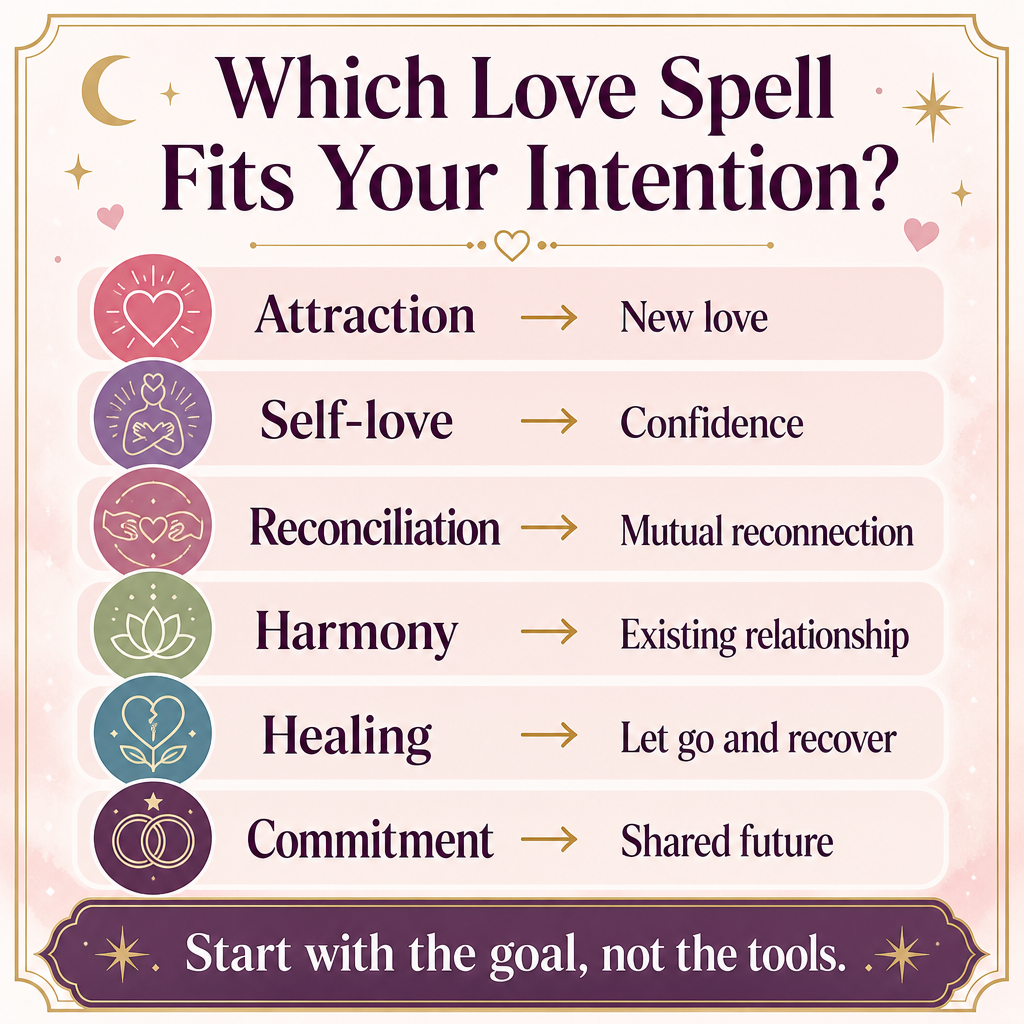
Choosing a love spell is easier when you stop asking which ritual is “most powerful” and start asking what you actually need. Attraction, reconciliation, self-love, healing, harmony, and commitment are different intentions, so they should not be treated as interchangeable.

Love spells are spiritual or symbolic practices. They are not scientifically proven methods for guaranteeing romantic outcomes, and any practice involving another person should respect free will, consent, and personal safety.

Start With the Intention, Not the Tools

Before choosing candles, herbs, crystals, moon phases, or written petitions, define the goal in one clear sentence. Choosing the right spell begins with self-awareness rather than chasing the “strongest” ritual.

  • New love: attraction.
  • Confidence and worth: self-love.
  • Past relationship: reconciliation or healing.
  • Existing relationship: harmony or commitment.
  • Heartbreak: release and healing.
  • Long-term bond: renewal or gratitude.

For basic techniques, see How to Cast Love Spells and Love Spells for Beginners.

Love Spell Types by Goal

Attraction spells

Best suited to opening yourself to compatible romantic opportunities rather than controlling one particular person.

Self-love spells

Useful when confidence, boundaries, or emotional readiness need attention before dating or reconciliation.

Reconciliation spells

Centered on healing, forgiveness, and renewed communication when both people may still want a relationship.

Harmony spells

Designed for couples who already have a relationship and want to focus on patience, gratitude, trust, or communication.

Commitment or renewal rituals

Often chosen around anniversaries or milestones to symbolize loyalty, shared goals, and continued partnership.

Healing and release rituals

Appropriate when moving forward is healthier than trying to restore the past.

A Quick Decision Method

  1. What is happening in my love life right now?
  2. What do I want to feel or change?
  3. Does this goal require another person’s willing participation?
  4. Would healing or self-love be more useful first?
  5. What real-world action will support the intention?

Choosing Tools Symbolically

Candles, crystals, flowers, journals, or moon phases can add structure and meaning, but the object itself should not be treated as a guaranteed source of power. Choose tools because they help you focus.

  • Pink candle: affection and kindness.
  • White candle: clarity or peace.
  • Journal: reflection and intention.
  • Rose: affection and gratitude.
  • Rose quartz: commonly used symbolically in love-centered spiritual practice.

When to Change Your Intention

If you discover that reconciliation is driven by loneliness, that an attraction is not mutual, or that an existing relationship is unhealthy, adjust the ritual. A good spiritual practice should be able to grow with new information.

For the opposite end of the process, see Can You Remove a Love Spell?

Infographic matching love spell types to relationship intentions

Frequently Asked Questions

1. How do I know which love spell is right for me?

Start with your actual goal: new love, self-love, healing, reconciliation, harmony, commitment, or closure.

2. Should I choose the strongest spell?

No. A ritual that matches your situation is more meaningful than one marketed as the most powerful.

3. What is an attraction spell for?

It is generally used to symbolize openness to new romantic opportunities and compatible partners.

4. What is a self-love spell for?

It focuses on confidence, self-worth, healing, and healthier relationship standards.

5. What is a reconciliation spell for?

It is associated with healing, communication, forgiveness, and the possibility of a mutual reunion.

6. What is a harmony spell for?

It focuses on an existing relationship and shared goals such as trust, patience, and communication.

7. What is a healing love spell for?

It is a symbolic practice for processing heartbreak, resentment, disappointment, or emotional closure.

8. Can I combine several intentions?

You can, but many practitioners prefer one clear primary intention at a time.

9. Does moon timing matter?

Some traditions assign meaning to moon phases, but timing does not guarantee a result.

10. Do I need special tools?

No. Candles, flowers, crystals, and journals can be symbolic, but they are not required.

11. How should I choose ritual tools?

Choose items that safely and personally represent your intention rather than assuming an object has guaranteed power.

12. What if my intention changes?

Change the practice. Personal growth can legitimately change what you want.

13. Can beginners choose simple rituals?

Yes. Journaling, meditation, affirmations, prayer, or a candle ritual can be enough.

14. Should a love spell target a specific person?

A broader intention centered on mutual, healthy love leaves more room for consent and compatibility.

15. What is the best first step?

Write one sentence describing the healthiest relationship outcome you want, then choose a ritual that supports that sentence.

Final Thoughts

The right love spell is the one that honestly matches your present situation and keeps room for mutual choice. Start with intention, choose simple symbols that support it, and pair the ritual with practical actions that help you build healthier relationships.

Can Love Spells Make Someone Love You? A Clear Guide

10
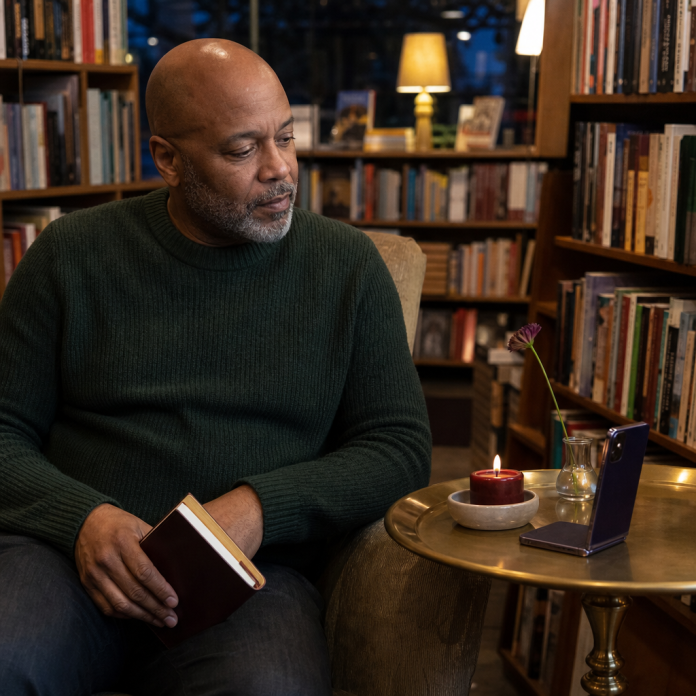
Man considering attraction and free will with foldable phone

The question “Can a love spell make someone love me?” sits at the center of many attraction traditions. The useful distinction is between a ritual that helps you focus on openness, confidence, and the kind of relationship you want, and a claim that a ritual can control another person’s heart.

Love spells are spiritual or symbolic practices, not scientifically established methods for changing another person’s emotions. Genuine love requires mutual choice, and a ritual should never be used to justify pressure, repeated unwanted contact, or ignoring a clear “no.”

What Love Spells Can Mean in a Respectful Practice

Many believers use love rituals as a way to clarify intention. That can mean becoming more open to meeting people, building confidence, healing after disappointment, or bringing more attention to an existing mutual connection.

  • Invite compatible romantic opportunities.
  • Strengthen confidence before expressing interest.
  • Encourage honest communication.
  • Reflect on the qualities you want in a partner.
  • Stay open to love without controlling a specific person.

For practical spell traditions, see how to cast love spells and the broader guide to love spells for beginners.

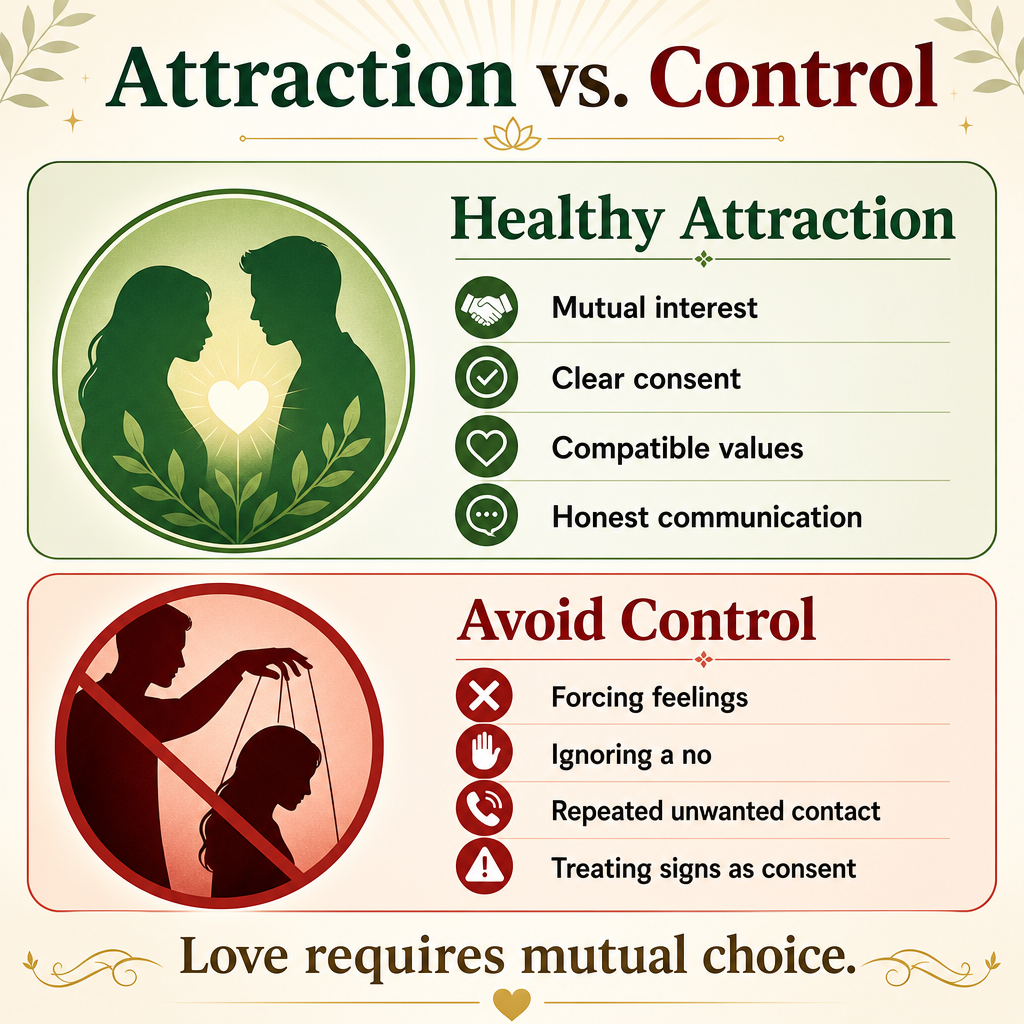
Attraction Is Not the Same as Control

An attraction ritual can be framed around your own readiness and the possibility of mutual connection. A control-based ritual is different because it assumes one person’s desire should override another person’s decision. Healthy relationships are built when both people keep choosing the connection.

Better intention

“May I be open to a compatible, loving relationship.”

Unhealthy intention

“Make this specific person love me regardless of what they want.”

What Actually Helps Feelings Grow

Romantic feelings usually develop through repeated positive experiences: conversation, trust, attraction, kindness, reliability, humor, vulnerability, and shared values. A spiritual ritual may be meaningful to you, but it does not replace those experiences.

If you are already in a mutual relationship, a harmony-focused approach is a better fit than trying to create feelings. RelationshipSpell.com’s guide to using magic to make love strong explores that existing-relationship intent.

Self-Love Before Attraction

Self-love rituals are often overlooked because they do not promise an immediate romantic result. Yet they can be among the most constructive practices: clarifying boundaries, strengthening confidence, and helping you recognize whether a connection is actually good for you.

  • Write down the qualities you value in yourself.
  • List the standards you want to keep in dating.
  • Notice where loneliness may be shaping your decisions.
  • Practice saying what you want clearly and respectfully.

A Simple Mutual-Love Intention Ritual

  1. Write five qualities you want in a healthy relationship.
  2. Write five qualities you can bring to a relationship.
  3. Light a candle only if you can do so safely, or simply sit quietly.
  4. Read your intention: “I welcome mutual, respectful, compatible love.”
  5. Choose one real-world action, such as meeting people, communicating honestly, or strengthening a boundary.

How to Read “Signs” Carefully

People sometimes interpret dreams, coincidences, repeated numbers, or sudden contact as signs. You can treat those experiences as personally meaningful without treating them as proof. The strongest evidence of romantic interest is direct: reciprocal conversation, consistent effort, and clear willingness to spend time together.

When to Let Go

If someone is unavailable, has declined your interest, asks for space, or repeatedly treats you poorly, letting go is more respectful and usually healthier than intensifying the ritual. A release or self-love practice can redirect attention toward a relationship that is mutual from the beginning.

Infographic comparing healthy attraction intentions with controlling behavior

Frequently Asked Questions

1. Can a love spell force someone to love me?

No reliable method can force genuine love. A respectful spiritual approach leaves another person free to choose.

2. What is the difference between attraction and control?

Attraction-focused practice centers on openness, confidence, and compatible opportunities; control attempts to override another person’s wishes.

3. Can a spell create feelings that are not there?

There is no scientific evidence that a ritual can create romantic feelings in another person. Genuine affection develops through mutual experience and choice.

4. What should I focus on instead of a specific person?

Focus on qualities such as mutual attraction, kindness, honesty, compatibility, emotional availability, and respect.

5. Are self-love rituals useful?

They can be meaningful as reflection practices that support confidence, self-respect, and clearer relationship standards.

6. Can a spell help me feel more confident?

Rituals, journaling, meditation, or affirmations may help some people focus their intentions and approach dating with more confidence.

7. Should I tell someone I performed a love ritual?

That is a personal choice, but the ritual does not create permission to cross boundaries or assume someone reciprocates your feelings.

8. How do I know if someone is interested?

Look for direct communication, consistent behavior, reciprocal effort, and clear consent rather than signs or coincidences alone.

9. What if the person says no?

Respect the answer. Redirect the ritual toward healing, self-love, or openness to a compatible relationship.

10. Can beginners practice attraction rituals?

Yes, many people start with simple journaling, meditation, prayer, or intention-setting that does not target another person’s will.

11. Do I need special tools?

No. Tools can be symbolic, but a quiet reflection practice can be enough.

12. Are dreams proof someone loves me?

No. Dreams may feel meaningful, but they do not establish another person’s feelings or consent.

13. Should I repeat a ritual until I get the result I want?

Repeated rituals cannot guarantee a result. If repetition is driven by anxiety, it may be healthier to step back and refocus.

14. What makes a relationship genuine?

Mutual choice, trust, kindness, communication, compatible goals, shared experiences, and respect.

15. What is the safest intention for a love spell?

An intention such as welcoming healthy, mutual love preserves room for consent and unexpected positive outcomes.

Final Thoughts

A love spell cannot guarantee that another person will fall in love with you. Its most constructive role is as a spiritual framework for clarifying what kind of love you want, strengthening your own readiness, and staying open to a relationship built on mutual attraction and free will.

Are Love Spells Permanent? Understanding Lasting Love

10
Are Love Spells Permanent?

When people are thinking about doing spells, they wonder if love spells are permanent. When someone performs a love spell, they hope that the positive feelings, connection, or the renewed relationship will stay strong for years. People naturally want to have lasting happiness, trust, and love.

This kind of answer isn’t yes or no. People believe that love spells aren’t something that replaces the everyday effort needed to build healthy relationships. They see spells as spiritual practices that encourage openness, love, healing, and connection while creating a positive foundation for the future of the relationship.

This guide looks at spiritual traditions and how to understand lasting love, and if spells are permanent and how couples can keep nurturing positive energy after the spell is complete.

What Does Permanent Mean?

The word “permanent” can mean different things depending on who’s asking. Some people want a love spell that creates romance that lasts forever and never changes, but others want positive effects that will support their relationship. Practitioners often define permanence as something different.

Instead of believing that one ritual will guarantee a relationship, they often believe that spiritual work creates opportunities that grow even stronger through everyday actions. When you look at things from this perspective, lasting love is built through spiritual intention and personal commitments.

Are Love Spells Permanent?

Spells aren’t usually said to be permanent in the sense that they take away the need for communication, common effort, or respect. Practitioners often explain that love spells create positive spiritual forces, and what happens afterward depends on how the relationship keeps growing. Some spiritual traditions teach that:

  • Love requires ongoing care.
  • Trust develops through actions.
  • Communication strengthens emotional connection.
  • Spiritual intention supports healthy relationships.
  • Personal growth continues throughout life.

The spell can start the journey, but it’s important for both partners to keep doing good things to shape the future of their relationship. The American Psychological Association similarly emphasizes open communication and continued attention as practical parts of maintaining a healthy relationship.

Understanding Spiritual Energy

Practitioners often believe that spiritual energy keeps influencing daily life even after the spell ends. Here are some examples that spells can show:

  • More confidence.
  • Stronger appreciation.
  • Increased patience.
  • Better communication.
  • Emotional healing.
  • Openness to love.

These things remain meaningful because they’re part of everyday habits, not just temporary things that go away. Focusing less on whether the spell will last forever and more on whether positive changes are there is what’s important when doing any kind of spell.

Kinds of Love Spells

No love spell is the same, but they all should have the same purpose. Here are some different kinds of love spells:

Attraction Spells

Attraction spells are meant to bring new romantic opportunities into your life. These spells focus on helping you become open to meeting someone who shares your goals and values.

Self-Love Spells

Some people feel that self-love helps to create a better foundation for future relationships. These kinds of spells encourage emotional healing, confidence, and self-acceptance.

Relationship Harmony Spells

Relationship harmony spells are intended to strengthen communication, forgiveness, patience, and emotional closeness between partners.

Healing Spells

Healing spells help people to let go of emotional pain after a breakup and encourage hope for the future.

Growth After a Love Spell

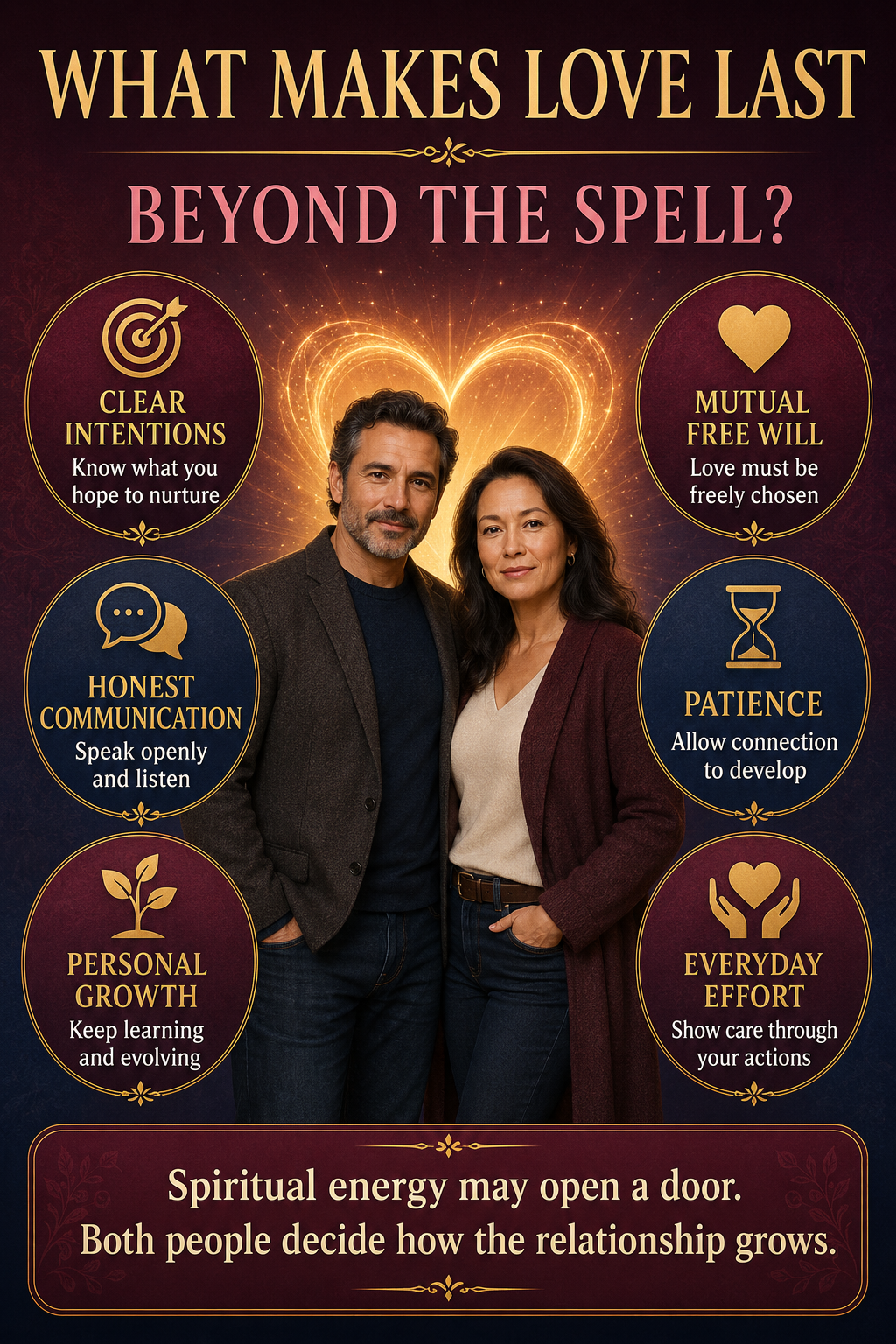
What Makes Love Last Beyond the Spell?
Love should never be a destination, but it should be an ongoing journey. Even after you do a meaningful spell, couples should keep learning things like:

  • How to communicate.
  • How to forgive.
  • How to support one another.
  • How to celebrate successes.
  • How to overcome challenges together.

These kinds of experiences strengthen the spiritual intentions that happened during the love spell.

Free Will and Love Spells

Throughout all modern love spell traditions, free will is seen as important. This is because healthy relationships should have mutual choice. Lasting love gets stronger when both people invest in the relationship, such as:

  • Listening carefully.
  • Showing appreciation.
  • Respecting each other’s goals.
  • Solving problems together.
  • Continuing emotional growth.

Rather than replacing these efforts, a love spell is commonly viewed as supporting them. A PubMed-indexed study identifies communication, honesty, trust, respect and understanding among the qualities people associate with healthy relationships.

Do Love Spells Fade?

Spiritual intentions stay meaningful, but relationships still need attention. Couples who stop communicating or appreciating each other, for example, will experience emotional distance as time goes on. Instead of saying that the spell faded, it’s important to say that the relationship needs more care.

This is one of the biggest reasons that couples pick symbolic renewal rituals during important life events or anniversaries. By doing these ceremonies, they celebrate continuing commitment instead of trying to just fix failure.

Keeping Positive Energy Going

Here are some things that can keep positive energy going:

Setting Clear Intentions

When you set a goal, this is important, and instead of asking for love, you should define the qualities that you want your partner to have.

Having Patience

One of the most important things in a spell is patience. Just like relationships should develop as time goes on, spiritual rituals should also unfold in their own time.

Positive Thinking

Some people think that you should look at rituals with hope instead of fear, and keeping emotional balance is an important part of spiritual work.

Personal Growth

Love spells are seen as working alongside personal development. As you improve communication, learn to be kind, have more confidence, and heal from past wounds, you can have healthier relationships.

Common Misunderstandings About Love Spells

Here are some common misunderstandings about love spells:

Myth: One Love Spell Guarantees a Perfect Relationship Forever

Many practitioners believe that even the strongest relationships need love, patience, and effort from both people. A ritual is often viewed as the beginning of the journey instead of the end.

Myth: Love Never Changes

Many spiritual traditions believe that love continues to grow as time goes on. Every relationship goes through different seasons, and many believers feel those experiences can make a relationship even stronger.

Myth: Permanent Love Means There Will Never Be Problems

Every relationship has challenges from time to time. Many practitioners believe that communication, understanding, patience, and forgiveness are still important parts of building a healthy relationship.

Myth: Your Spiritual Work Ends After the Ritual

Many believers continue supporting their intentions long after a ritual is finished. Practices like gratitude, meditation, journaling, and personal growth are often seen as meaningful ways to continue nurturing the relationship.

Frequently Asked Questions

Here are some frequently asked questions:

Are permanent love spells really forever?

Beliefs can be different from one tradition to another. Many practitioners believe love spells create lasting intentions, while the relationship itself continues growing through love, trust, and mutual effort.

Can couples perform renewal rituals?

Yes. Many spiritual traditions include anniversary blessings, gratitude rituals, and relationship ceremonies that celebrate and strengthen the bond between two people.

Do self-love spells have lasting benefits?

Many believers feel they do. Self-love rituals are often viewed as long-lasting because they encourage confidence, emotional healing, and continued personal growth.

Can the energy of a love spell continue after the ritual?

Many practitioners believe it can. They often feel that positive intentions continue growing when they’re supported by everyday actions and a healthy mindset.

What helps keep love strong over the years?

Many practitioners believe healthy relationships are built through communication, trust, kindness, gratitude, forgiveness, and spending meaningful time together.

Should I perform another love spell later?

Some believers choose to perform symbolic renewal rituals during anniversaries or other important milestones instead of repeating the same love spell over and over again.

Final Thoughts: Do Love Spells Last Forever?

Some people wonder if love spells last forever. The biggest strength isn’t in creating a permanent change that happens fast, but in inspiring lasting changes, such as emotional growth and gratitude, that create deeper relationships. A love spell is the start of a meaningful journey, not a one-time situation that replaces the work of loving a person the way they deserve to be loved.

The best relationships are built by combining spiritual intention, mutual respect, honest communication, gratitude, and patience. These things help turn a simple spell into something that keeps shaping the relationship after the ceremony has ended.

If you’re looking for new love, wanting to strengthen your present relationship, or celebrating being married for years, spiritual traditions can remind you that lasting love happens by creating thoughtful moments each day.

Why “Witchy Aesthetic” Dominates TikTok Fashion Feeds

10
Witchy Aesthetic

When TikTok Has Spell Casting

If you open TikTok at night, you will probably feel a certain mood. You might see skirts that are moving in slow motion, people with wide-brim hats and a moonlight filter, and crystal pendants lying on lace bodices. If this feels like witchy fashion has taken over social media, you aren’t just imagining it. These are called “witchy aesthetics,” and they aren’t new, but they are becoming big in TikTok’s fashion corners. This has inspired millions of viewers and subcultures like WitchTok and Whimsigoth.

But why has this become so popular as of late? Why are Gen Z creators, fashion influencers, and brands adding spell-casting chic? This is a way that fashion cycles and psychology are going deeper with the desires that people have for a spiritual connection. This isn’t just a trend or a fad, but the witchy look has roots that are based on old archetypes. It offers more than just a way for people to take selfies, but it promises empowerment, identity, and even psychic work.

Witchcore, Whimsigoth & Today’s Witchy Style Vocabulary
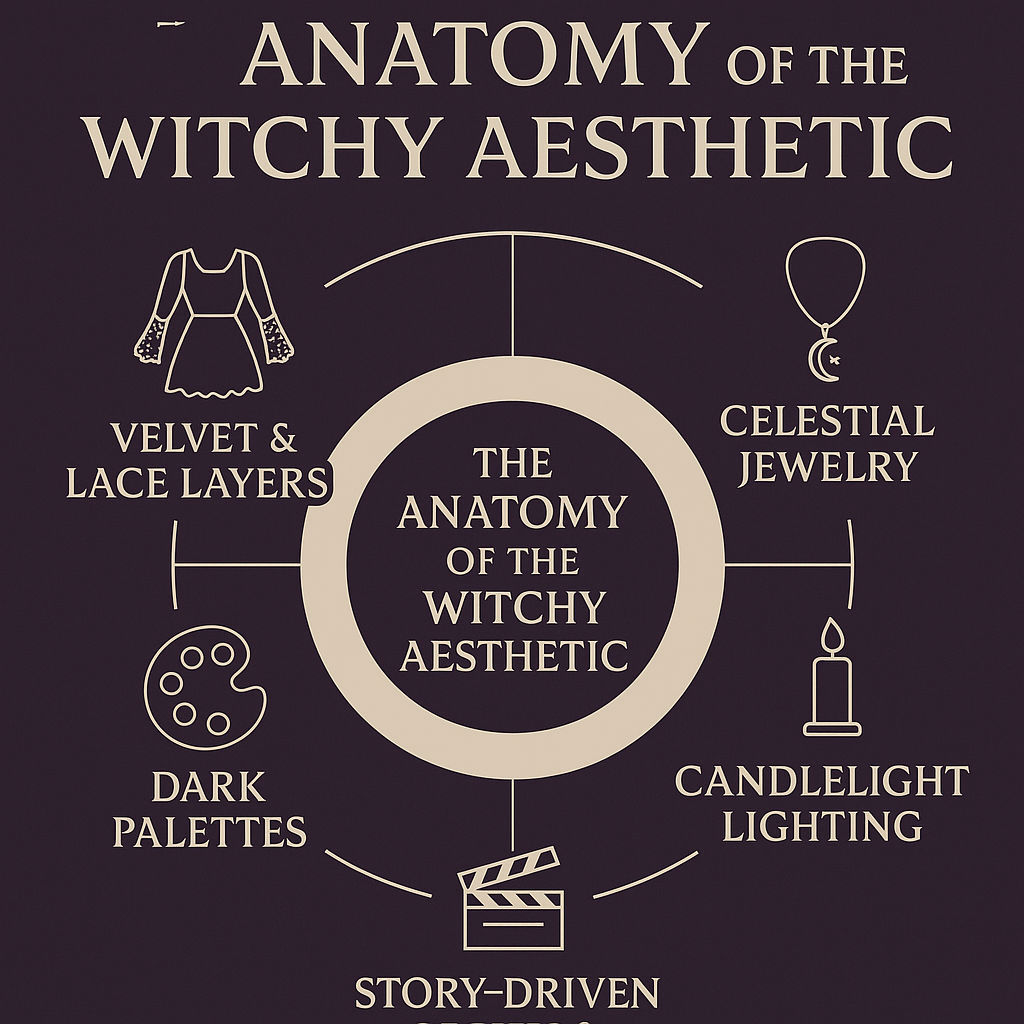
The Anatomy of the Witchy Aesthetic

The witchy look doesn’t fit into just one box, but it’s really a mix of overlapping styles. On one end, you’ll find cozy cottage-core witches stirring tea in embroidered skirts. On the other hand, whimsigoth creators glide across TikTok in velvet dresses printed with stars and moons.

Witchcore is the broadest branch of the trend. It celebrates natural magic like herbs hanging from shelves, crystals tucked into pockets, and secondhand treasures with a story. Picture earth-tone skirts trimmed in lace, a tarot deck hidden in a worn leather bag, or heavy boots grounding the whole look. It’s folklore meets fashion.

Whimsigoth, on the other hand, is the internet’s dramatic younger sister, which is a blend of whimsy and gothic mood. The term, revived on TikTok and Instagram, has pulled in millions of views under tags like #whimsigoth and #witchyaesthetic. As Glamour explains, it mixes flowing shapes, celestial fabrics, and romantic mystery, part Stevie Nicks, part digital daydream, according to Glamour.

Even professional trend watchers have noticed. WGSN, a global forecasting firm, called “witchy autumn” the natural follow-up to “brat summer,” signaling that fashion is shifting toward moodier, more mystical tones.

What keeps Witchcore and Whimsigoth alive isn’t only the clothes, but it’s the storytelling. Every outfit becomes a mini narrative: the city witch, the forest dreamer, the cosmic wanderer. On TikTok, where identity and imagination merge in seconds, that sense of story spreads faster than any designer label ever could.

The Psychology Behind Why People Want Spells

Fashion isn’t just about clothes; it’s about emotional climate and moments. The witchy aesthetic is popular now because it speaks to people about how they feel in a world of chaos, uncertainty, and change.

The witch is something that has always been a symbol of rebellion and isn’t part of tradition. In medieval Europe, witches made people afraid because they were about feminine independence. Today, that same archetype is relevant, especially for Gen Z and millennials. It brings up political problems, climate change, and the shifting of gender norms. When someone dresses like a witch, it’s a way to show resistance and to reclaim a place in society.

According to The Guardian, it said, “dressing like a witch is fashion finally catching up to magic,” and it shows it as more of a playful style instead of a fad or trend. It’s about aligning culture and self-empowerment.

There’s also something deeply psychological behind all this. When life feels uncertain, people look for symbols that bring a sense of safety or control. Centuries ago, knights went into battle with charms tucked beneath their armor. Today, TikTok creators wear moon pendants, lace shawls, and pentagram earrings for the very same reason. These details aren’t just decoration; they act like modern-day talismans, giving the wearer a quiet kind of strength.

Part of what makes this trend so exciting is that it balances identity but allows people to escape. It lets someone go into fantasy while still living a real life. When on TikTok, they are able to blend these two together. A creator can play the role of a stylish influencer and then a mystical character without losing authenticity. This is play and performance with self-expression.

In the end, the witchy aesthetic isn’t thriving just because velvet looks great by candlelight. It’s thriving because it meets an emotional need. It helps people feel grounded, powerful, and a little bit enchanted in a world that often feels unpredictable.

Signature Design Elements of Witchy Fashion
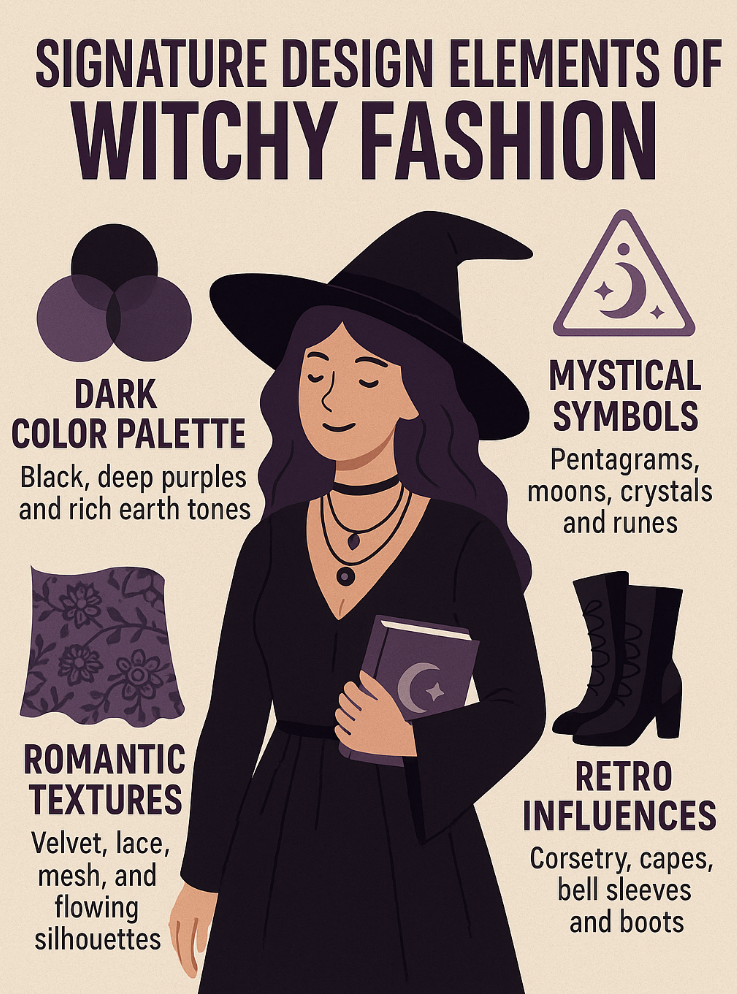
Signature Design Elements of Witchy Fashion

Witchy fashion isn’t just about looking mysterious, but it’s about telling a story through what you wear. On TikTok, people have turned it into a full creative ritual. Every layer, color, and texture adds to a mood that feels ancient and modern at the same time.

Color Palette

Black is always the anchor. It’s bold, protective, and timeless. The magic gets deeper when other shades besides black are used. Colors like forest green, deep purple, and rich reds help people feel connected to nature and to the sky. Using jewel tones can bring warmth, and colors like midnight blue or earthy browns look like something that is real.

Textures and Fabrics

Velvet and lace are two of the most loved materials in this style. Velvet brings mystery, and lace makes everything seem romantic. Creators also use leather, faux fur, and chunky knit clothing to make the outfits look soft and strong. They layer these different textures to make the look multi-dimensional, just like the spiritual world shows.

Silhouettes and Shapes

There’s movement in every witchy outfit.  Flowing skirts, dramatic sleeves, and long coats make it easy for fabric to move with the air. Fitted bodices, corsets, or chokers balance the flow by adding structure and edge. Many outfits include uneven hems or layered pieces like small details that give each look a touch of unpredictability, like magic in motion.

Symbols and Motifs

The witchy world runs on symbols. Moons, stars, and constellations show up everywhere, from jewelry to fabric prints. Snakes, ravens, and pentagrams also appear often, not as decoration, but as quiet nods to personal belief. Each charm, crystal, or pendant tells its own story about protection, transformation, or intuition.

Accessories and Details

Accessories are what seal the spell. Wide-brim hats instantly change the look from casual to mystical. Silver jewelry, often with crystals like amethyst or obsidian, gives off a grounding energy. Boots, especially lace-ups or platforms, root the outfit in confidence. Dark lipstick, smoky eyes, and intricate nail art finish the look, bringing a final touch of mystery.

On TikTok, these details come alive in seconds. One video might start with jeans and a T-shirt, then shift to layered skirts, lace gloves, and moon jewelry, all with a snap or a hand wave. The effect isn’t just fashion. It feels like a transformation. For many creators, these moments are a way to express power, confidence, and creativity all at once.

Algorithm on TikTok That Casts the Spell

Trends move fast on TikTok; one swipe is all it takes to fall into a whole new world. The witchy aesthetic is a perfect example. Its rise isn’t random; it’s powered by the way TikTok’s algorithm amplifies what people linger on, turning niche ideas into massive communities.

Watch one video of a crystal haul or a tarot reading, and suddenly your For You Page starts glowing with candlelight and velvet. Before long, you’re seeing creators twirl in black gowns, show off their moon jewelry, or share “witchy outfit inspo.” TikTok’s feedback loop gives these subcultures instant visibility, making them feel less like small corners of the internet and more like a global style wave.

The format helps, too. Creators love to do transformation videos where they’ll snap or wave their hand and it’ll turn their jeans into lace gloves and layered skirts. These are dramatic edits that are quick, but they help to build TikTok and work for those who have short attention spans. Each reel will feel like a ritual that has visual flair that keeps viewers watching.

Hashtags like #WitchTok, #Whimsigoth, and #WitchyAesthetic pull people deeper in. Once you interact with one, the platform keeps feeding you more of the same: spells, fashion hauls, crystal setups. What starts as curiosity soon becomes community. TikTok’s tools, like duets and stitches, make it easy for creators to connect, collaborate, and remix each other’s magic.

That’s what makes this trend different. It isn’t just about watching; it’s about joining in. People aren’t only liking witchy fashion, they’re trying it, personalizing it, and making it part of their daily style. The algorithm doesn’t just spread the aesthetic; it helps people live it.

When Witchy Aesthetic and Psychic Belief Work Together

What makes the witchy look stand out from other online trends is that it doesn’t end once the outfit is chosen. It stretches past fashion into spirituality, energy work, and how people see themselves. On TikTok, it’s not just about clothes, but it’s about showing what you believe in through what you wear.

You might even see an overlap in witchy fashion with tarot cards, astrology, or even crystals. Someone might be wearing a moon pendant (which is more than just an accessory, but it’s a way to acknowledge your intuition and your natural cycles). A velvet pouch might carry more than just makeup, and inside there could be tarot cards or small stones that are used for psychic readings. These pieces become an expression of someone’s faith in a visual way to show that they’re aligned with the spiritual world.

For many creators, dressing witchy isn’t just a look, but it’s part of who they are. Just as a doctor wears a coat or an artist carries a sketchbook, spiritually inclined TikTokers wear their spirituality. Their clothes say, “I read cards,” “I follow my intuition,” “I believe in energy.” The aesthetic becomes a kind of personal uniform for the spiritual path they walk.

This blend between fashion and practice shows up constantly online. One video might feature someone twirling in a layered black skirt, and the next shows them reading tarot or setting out a crystal grid. The shift feels seamless, like style and spirituality feeding off each other until they become one and the same.

That’s the real magic of this trend. People watching aren’t just scrolling past pretty outfits; they’re being drawn into a worldview, one that whispers, “You can be both stylish and spiritual.” It’s fashion used as spellwork, and self-expression turned into ritual. In a world craving both identity and meaning, that combination feels powerful, and it’s why the witchy aesthetic keeps spreading.

Real-Life Examples of Witchy Trends

In order to know why witchy aesthetics are big on TikTok, you have to look at the real-life examples that helped to shape this trend:

A lot of people talk about Whimsigoth, which is a term that adds whimsical and gothic together. It is a term from the 1990s, and it is often seen on TikTok. This is seen with velvet dresses, celestial prints, and flowing silhouettes. This became popular among style researchers and then became part of TikTok fashions and outfit changes, according to Glamour. Videos that use #Whimsigoth get millions of views and show how aesthetics and mysticism work together.

Those who forecast trends say that this is a trend on the rise. According to WGSN, “witchy autumn” is happening after brat summer, which means that there will be witch fashion as the seasons change. This means that summer’s playfulness will end up with fall’s magic, and creators will add dark palettes and dramatic sleeves to their layered looks.

According to The Amag, guides like “The Amag’s” and “How to Dress Like the New Witchy Style” show different designs that get the look going. This includes lace, dramatic sleeves, occult designs, and corsets. This starts conversations and has a witchy fashion. This gives creators a way to create content and to show videos of witchy outfits.

WWD shows the role of witches in social media and pop culture. This goes back to films like “The Craft,” and then the fashion leads to TikTok videos and feeds. This gives witchy aesthetics a place of importance and not just a fleeting trend. This is becoming part of the culture.

Witchy aesthetics is taking over TikTok because of the history behind it, versatility, and the community. Whether this is in Whimsigoth’s gowns, their moody layers, or the pop culture covens, this style feels like ancient times with a fresh perspective, reaching audiences with algorithms.

Critiques, Ethics & Boundaries

As beautiful and inspiring as the witchy aesthetic can be, it isn’t free from complications. When spirituality becomes a trend, the meaning behind certain symbols can get lost or even misused. On fast-moving platforms like TikTok, where visuals travel faster than explanations, it’s worth slowing down to look at the deeper side of what we wear.

Spiritual Trivialization

Many of the symbols we see in witchy fashion hold real spiritual power for different communities. Pentacles, sigils, herbs, and other sacred items carry layers of tradition in Wiccan, Pagan, and Indigenous paths. When these things are worn only for decoration, without care or knowledge, practitioners sometimes feel that their beliefs are being turned into costume pieces. It’s a similar issue that came up when yoga mantras and dreamcatchers were commercialized objects meant for reverence, becoming just another design.

Cultural Appropriation

Another concern that people might have is when there are spiritual items that come from specific cultures, and the user doesn’t know where they really come from. Smudging with white sage is a practice of the Indigenous people and not just a trendy way to do energy cleansing. When using TikTok, traditions might be left out in context, taken out of places they shouldn’t be. This should never be looked at as an accessory, but as a part of culture. The best way to do this is to make sure that you know what you’re wearing and where it’s rooted from, and that you credit the cultures behind these different symbols.

Exclusivity and Accessibility

There’s also the issue of representation. The witchy look often leans toward a narrow beauty ideal, thin bodies, Eurocentric features, and stylized perfection. While WitchTok is becoming more diverse and welcoming, it still has room to grow. True magic celebrates all forms, all genders, and all backgrounds. The movement becomes stronger when every person who feels drawn to it can see themselves reflected in it.

Performance Versus Practicing

Another thing that we see is the difference between aesthetics and spirituality. Wearing a crystal doesn’t mean someone is a witch, and posting about a tarot card reading doesn’t mean the person really practices it. Some see this as being a witch on the surface, like a performance, and not having the real spiritual or psychic roots that real witches have as a sacred bond with the universe.

But just because there is a difference, it doesn’t mean that it needs to be canceled. Instead, it can encourage people to be more thoughtful. TikTok creators who add this kind of content and then explain the symbols behind it, like the jewelry and the cultural origins, adding their looks with spiritual reflections, help to bring fashion and meaning together. The goal isn’t to stop it but to encourage more depth, respect, and authenticity.

When we use care with witchy aesthetics, it isn’t just looking powerful, but it becomes empowerment, adding style and spirit to something magical.

Tapping Into Witchy Aesthetics the Real Way

You don’t have to change everything in your wardrobe or pretend that you are part of a fantasy movie in order to enjoy witchy fashions. The style can change with you. Start with small things or go all in, but make sure that it is a reflection of who you are and not just a wardrobe change or costume.

Start with Meaningful Details

Add pieces to your collection that speak to your personality, like a moon charm necklace, a crystal ring, or dark nail polish. These aren’t just decorations but reminders of energy.

Experiment with Layers and Feel

Witchy fashion is all about texture and movement. Try layering lace over a dress or mixing velvet with something simple. A single statement piece can shift the whole mood of your outfit. The goal isn’t perfection, but it’s expression.

Blend Style and Spirit

The look feels most real when it connects to what matters to you. If you love tarot cards, keep your deck close. If you are inspired by astrology, wear your zodiac sign. When you have clothing that shows what you believe, it is no longer fashion but an extension of your spiritual self.

Flow with the Seasons

The witchy aesthetic changes beautifully with the time of year. When it’s fall, wear fabrics like long coats, dark tones, and boots. In the summer, try going barefoot in nature, wearing shell jewelry that channels ocean energy. Changing with the seasons helps your style and helps you to stay grounded in nature and fresh for what you’re showing.

Wear with Awareness

Understand the different symbols that you wear. If you’re drawn to a certain herb or to a pentagram, read about their meaning and where they came from. Being aware of these things helps to keep your expression full of depth and respectful to different cultures.

Witchy fashion isn’t about copying everything that you see online, but it’s about tuning into your own energy and seeing what feels real and powerful for you. When you dress like a witch with a purpose, your outfit is more than just clothes – it’s a place of magic and energy that will carry you wherever you go.

Final Thought: Why Witchy Aesthetics Isn’t Just a Costume

The fact that witchy aesthetics are on TikTok isn’t just a trend or a fashion statement; it’s about a cultural movement. It shows how there are generations that want meaning, to have self-expression, and to have empowerment. This is a language that speaks more than words and shows fashion and spirit working together. Moon pendant necklaces, velvet dresses, and lace gloves aren’t just pretty things to wear but the signal and invite quiet rebellion.

When there are millions of people who dress up as witches, they aren’t doing this as an algorithm, but they’re trying to share a real story. This is a story where intuition means something, and symbolism and style become a spell. This is why the trend isn’t just passing, but it is rooted in centuries of archetypes and psychic gifts. This comes from healers in the village to witches in pop culture, and it adapts to every platform.

Fashion isn’t always about identity, and witchy aesthetics takes it deeper. It makes psychic belief and spiritual longing work together. This is why it keeps moving forward. Unlike other trends that fade, this one isn’t just about wardrobe but about a new worldview.

Next time you look at TikTok and see moonlit areas and black lace, don’t just look at the fashion but see it as a way for people, maybe even yourself, to find your power, to find your presence, and to believe in the style that can summon magic.

FAQs:

1. What is the witchy aesthetic on TikTok?

A moody, mystical fashion vibe featuring dark palettes, velvet and lace, celestial prints, crystals, occult motifs, and storytelling edits that blend fashion with ritual-like ambiance.

2. Why does the witchy look perform so well in the algorithm?

It’s visually high-contrast and instantly recognizable. Strong hooks, ASMR textures, and repeatable formats drive watch time, saves, and remixing—signals the algorithm rewards.

3. Which fashion elements define witchy style?

Black layers, corsets, flowing skirts, capes, mesh, silver jewelry, moon and sigil charms, combat boots or pointy shoes, plus dramatic hats and gloves.

4. How do creators make witchy outfits feel fresh?

They blend subgenres (cottagecore, goth, boho), play with textures (velvet + mesh), add color accents (wine, forest green), and weave micro-stories into short videos.

5. What editing choices boost witchy vibe?

Low-key lighting, candle flicker overlays, grain, slow zooms, reverb audio, chime sounds, and timed cuts on beat drops to reveal outfit layers.

6. Which hashtags help discovery?

#witchyaesthetic #darkfashion #occultstyle #mooncore #witchtok #altstyle #gothicfashion. Mix broad + niche tags and rotate to avoid redundancy.

7. Are crystals and tarot props necessary?

No, but they telegraph the aesthetic quickly. Books, dried herbs, chalices, and antique mirrors create the mood just as well.

8. How can beginners try the look on a budget?

Thrift lace and velvet, DIY charms from wire, layer black basics, repurpose scarves as belts, and use safety pins for drape experiments.

9. What makeup trends fit witchy fashion?

Smoky eyes, graphic liner, berry or black lips, pale highlight with cool undertones, and nail art with moons, stars, or runes.

10. Is the witchy aesthetic the same as goth?

They overlap but differ in symbols, textures, and storytelling. Witchy leans mystical and nature-ritual; goth leans subcultural music history and stark silhouettes.

11. How do seasons influence witchy content?

Spikes at equinoxes, solstices, and October. Spring green witch looks and autumn sabbat styling offer timely hooks for series.

12. Are there cultural sensitivity concerns?

Yes. Avoid closed practices, sacred symbols without context, and stereotype tropes. Credit sources, focus on fashion, and use inclusive language.

13. What size-inclusive tips work for witchy styling?

Structured corsets with stretch panels, A-line skirts, adjustable belts, and layering sheer over opaque to shape lines without restricting movement.

14. How can men and masc-presenting folks wear witchy fashion?

Long coats, poet shirts, tailored vests, wide-brim hats, rings with onyx or moonstone, and boots. Focus on silhouette and symbolism, not gendered pieces.

15. How do brands collaborate with witchy creators?

Capsule drops, charm jewelry collabs, seasonal “ritual-ready” kits, and limited-print celestial fabrics; creators provide styling series and lore-based narratives.

16. Does sustainability fit the aesthetic?

Yes. Thrifting, upcycling, natural fibers, and slow-fashion jewelry align with nature-forward witchcraft themes and resonate with audiences.

17. What story formats convert best?

“Get ready for the ritual,” “Spellbound thrift haul,” “Herb lore outfit challenge,” and moon-phase lookbooks. Clear arcs keep viewers to the end.

18. How long should witchy fashion videos be?

7–20 seconds for reveals and transitions; 20–45 seconds for mini-stories or tutorials. Front-load the hook within 1–2 seconds.

19. Do captions matter for reach?

Yes. Use 1–2 keyword phrases early (e.g., “witchy corset styling”), add a prompt (“save for Samhain”), and consider accessibility with alt text.

20. What music and sounds work well?

Ambient chimes, dark pop, ethereal choirs, harp plucks, and trending sounds remixed with reverb. Always check rights within the platform.

21. How do creators monetize witchy fashion?

Affiliate links, pattern PDFs, charm kits, presets, Patreon lore drops, brand deals, and limited-run merch with sigil motifs.

22. Any safety guidelines when using candles or smoke?

Use LED candles or incense outside frame, keep fabrics away from flames, and disclose effects or overlays instead of real smoke indoors.

23. What metrics show a post will keep climbing?

High 3-second retention, saves > shares early, remix/duet activity, and comments asking for sources or tutorials.

24. How can boutiques adopt witchy aesthetics authentically?

Curate a focused palette, feature artisan jewelry, credit folklore inspirations, shoot with cohesive lighting, and tell product stories with seasonal lore.


Binding Spells for Different Purposes

9
Binding Spells for Different Purposes

Binding spells have been around for centuries, and there are different spells for different reasons. They can be easy to cast or hard to cast. They can be used to protect you from spirits or negative energies, or they can be used to stop someone from having a strong influence over you. No matter what you need, there are binding spells that can help you.

A Simple Binding Spell to Stop Someone’s Influence

This binding spell is a gentle way to protect yourself from someone’s energy or actions. It doesn’t hurt the other person, but it just sets a firm boundary between you and them.

What you need:

  • A small piece of paper (about 3×3 inches)
  • Black ink pen
  • Rubber band, string, or paperclip

Steps:

  1. Write Their Name
    On the paper, write the person’s full name. If you know their middle name, include that too. Use black ink.
  2. Draw a Pentagram
    After writing the name, draw a pentagram (five-pointed star) over it. This helps seal your intention.
  3. Fold and Secure
    Fold the paper twice. Use a rubber band, string, or a paperclip to hold it together.
  4. Say Your Words of Protection
    Hold the paper to your forehead and say this three times:
    “To be protected from you, this charm I will do. With these words, I bind thee. Let me be protected from your harm. I now seal this charm.”
  5. Tap Into Your Power
    Place the folded paper under or inside your right shoe. Now stomp your foot nine times. Each stomp sends your intention into motion.
  6. End the Spell
    Finish by saying: “So mote it be!”
    That’s your way of sealing the spell and sending it off with confidence.

Water Binding Spell to Help Someone Let Go

This version uses water to wash away someone’s negative actions or connection to you. It’s gentle, but strong. This won’t cause harm, but it’s meant to distance someone and protect your peace.

What you need:

  • An item that belongs to the person (something small they won’t notice missing)
  • A long piece of silk ribbon (or natural thread)
  • A stream, creek, or river with moving water

Steps:

  1. Choose the Right Item
    Find something that belongs to the person, something personal but small. A button, pencil, or small cloth works great. Avoid anything plastic that could harm the environment.
  2. Wrap It Up with Care
    Take your ribbon and slowly wrap it around the item. As you wrap, say:
    “(Name), I bind you from causing harm to me, to others, and to yourself.”
    Keep repeating it as you go until the item is fully covered.
  3. Find Moving Water
    Go to a river, creek, or any natural stream where the water flows away from you. Face away from the water so your back is toward the current.
  4. Let It Go, Don’t Look Back
    Toss the wrapped item over your shoulder into the stream. As soon as you release it, walk away without turning around. That shows the universe you’ve let it go.
  5. Reflect
    As you walk, take a deep breath. Know that you’ve done your part. The energy has been sent. You’ve created space for peace to return to your life.

Binding Spell for Protection from Someone’s Magic

If you feel like someone is sending negative energy your way, whether it’s a spell, gossip, or just bad vibes, this protective binding spell is a strong way to stop it from affecting you. It won’t hurt the other person, but it will block their influence and keep your energy clean.

What You’ll Need:

  • A red candle (white works too if that’s all you have).
  • A piece of rope, string, or yarn (something you can tie knots in).
  • A quiet space where you can focus.

Get Focused First

Before you do anything, take a few moments to clear your head. Let your breath settle, let your thoughts slow down. You want to be clear about why you’re doing this. You’re not trying to hurt anyone, but you’re protecting yourself and reclaiming your peace.

Light the Candle

Once you’re centered, light your red (or white) candle. As the flame rises, say:
“I bind you, [name]. Your voice, your work, your energy. What you sent will not reach me.”

Feel your power returning as you speak those words.

Use the Rope to Seal the Binding

Hold your piece of rope. Each knot you tie is like sealing a doorway shut.

  • Tie the first knot and say: “I bind you. I stop your spell.”
  • Tie the second knot and say: “I stop your work.”
  • Tie a final knot and say: “Your spell is gone. Your work is destroyed.”

Blow Out the Candle

When you’re done, gently blow out the candle. Watch the smoke rise. As it fades, imagine all the energy that was sent your way dissolving with it. It no longer touches you. It’s finished.

Trust the Process

You don’t have to repeat this unless you feel called to. This is a powerful protective spell. You’ve closed the door and blocked out what was never meant to enter your space.