

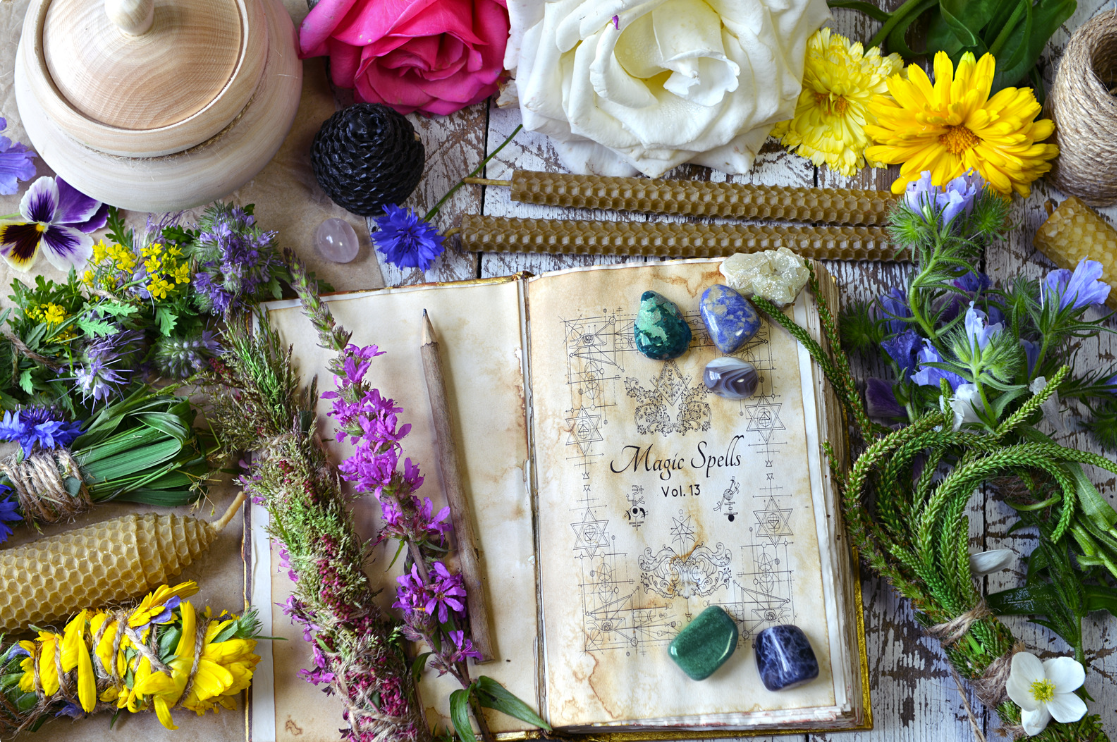
Herbs can be part of a personal ritual through their names, appearance, scent or meanings within a tradition. Choosing one begins with two different questions: what does it represent in the practice, and what is the actual plant or product in front of you?
A correspondence such as “love,” “protection” or “clarity” describes an association. It does not tell you whether a plant belongs in a drink, on skin, near a flame or in a household with children or pets. You can explore the symbolism with a drawing or written name while learning more about the material.
Read a correspondence as an idea to understand
Herbal correspondence lists may assign an element, planet, gender or purpose to a plant. These systems depend on the writer and tradition; a long list is not proof that every community shares the same meanings. Keep the source and context with any association you want to learn.
Before using a correspondence, explain it in ordinary words. Does “protection” mean reminding yourself to secure a door, keep a boundary or prepare for a task? Does “love” mean appreciation, friendship or a conversation both people want? The plant name does not guarantee those results or replace the action involved.
Some religious practices have their own teachers, histories and requirements. Learn in that context rather than treating unrelated traditions as interchangeable recipes. If you are creating a personal exercise, describe it as your own choice instead of assigning it an undocumented ancient origin.
Identify the material before choosing a use
| Question | Why it matters | What to do next |
|---|---|---|
| What is the plant? | A familiar common name or an online photograph may leave the identity uncertain. | Keep the supplier’s identification and label. Leave an uncertain plant unused rather than identifying it by a magical association. |
| Which part is it? | A leaf, root, seed, flower and an extracted product are different materials. | Record the actual part and product information. Do not substitute one because a list gives only the plant name. |
| What form is it in? | A whole plant, dried craft material, food product, oil and supplement are not interchangeable. | Use the directions for that exact product. Do not turn a craft purchase into a tea, skin mixture or medicine. |
| What use was it sold for? | “Ritual” or “natural” does not provide handling instructions. | Ask for the intended use and complete contents. Keep an inadequately labeled mixture unused. |
| Who else could encounter it? | Loose materials can be reached, spilled, shared or mistaken for food. | Keep labels and store materials separately from food and away from children and pets. Ask before involving another person. |
| Would a picture serve the purpose? | A symbolic exercise does not always need a physical ingredient. | Use a drawing, plant name or written association if that fits your own practice. You can learn without collecting or mixing anything. |
A magical plant list is not a food or medicine list
Poison Control’s illustrated plant guide identifies foxglove and lily-of-the-valley as poisonous. Their appearance in an occult list does not make them suitable ingredients. Do not gather them for a beginner ritual, tea or skin preparation because a list associates them with knowledge, sexuality or another desired effect.
The same guide explains that plant hazards depend on the plant and sometimes its parts. An unidentified leaf, a pleasant smell or the word “herb” does not establish suitability. If someone has eaten a poisonous or uncertain plant, contact a poison service promptly and keep identification information available. In the United States, call 1-800-222-1222; elsewhere use your local poison service.
This article’s personal exercise uses written plant names or drawings, with no swallowing, skin application, heating or foraging. For a separate food, cosmetic or supplement decision, use reliable information about the exact product and ask a qualified professional when personal health questions are involved. A spiritual correspondence does not answer those questions.
Four plant names as optional reflection prompts
Here are personal examples you can use on paper. They are suggestions for connecting a symbol to an action, not a universal correspondence chart or claims that these plants produce the result.
A rose: express appreciation
Draw a rose beside the name of a quality you value in a friendship. Choose a welcome way to express appreciation, such as thanking the person for a specific act. The drawing does not create affection or require a reply.
Rosemary: make room for remembrance
Write the plant’s name beside a memory you want to keep. Add the actual event and why it matters to you. This is a record of a memory, not a claim that carrying an herb improves memory or communicates with someone who has died.
Basil: notice what you already care for
Sketch a plant beside one ordinary responsibility you want to tend. Name the next task and when you can do it. Your action might be organizing a shelf or looking after an existing plant; no purchased ingredient is necessary.
Mint: define a fresh start
Use a written word or drawing to mark one thing you want to begin again. Make the start specific: open the unfinished document, prepare a question or clear a place to work. A symbol does not predict luck or financial gain.
A five-step herb-symbol exercise
- Choose one purpose. Use a plain word such as gratitude, remembrance or a new beginning.
- Choose a plant name or drawing. Keep the physical plant out of the exercise while you learn its identity and context.
- Write the association and its source. Separate a tradition you are studying from a personal meaning you chose.
- Name an action you can take. Choose an ordinary next step within your control, rather than a demand for someone else’s feelings or a promised result.
- Close and keep the note if useful. Put it in a notebook or finish the exercise. You do not have to burn, bury, drink or scatter anything.
A filled-in example: Ellis makes a rosemary memory card
In this fictional example, Ellis wants to preserve a memory of a family meal. The exercise uses paper, not a recipe for an herbal product.
- The purpose
- Record one detail of a meal with a relative so it can be remembered later.
- The chosen symbol
- A drawing labeled “rosemary.” Ellis chooses it as a personal reminder of the kitchen rather than as a claim about the plant’s effects.
- The written observation
- The relative explained how they learned a familiar recipe. Ellis writes that actual story and leaves uncertain details open.
- The practical next step
- Ask the relative whether they would like to share the recipe, and keep the card in a notebook. No plant material, flame or promised message is involved.
Keep smoke, oils and mixtures out of an automatic next step
Learning a plant’s name does not mean the next step must be burning it or adding it to a candle. The U.S. Fire Administration’s candle guidance recommends keeping things that burn away from a lit candle and extinguishing flames before leaving or sleeping. Dried plants and paper still need to stay clear of flame.
Do not grind unknown materials together, mix an unlabeled “love potion” or add a hidden ingredient to someone else’s food, drink or belongings. Informed agreement concerns the actual substance and use, not just a general interest in spirituality.
A dried herb is also different from an essential oil or a finished fragrance product. See ritual-oil labels and intended use before choosing an oil. For the distinct question of a themed drink or invitation, see potions for love and lust; a name does not establish a product’s contents or suitability.
Let the practice remain small
You do not need a cupboard of rare plants to learn. A page of carefully distinguished meanings can be more useful than a collection of ingredients you cannot identify. Keep supplier information for anything you already own, avoid taking plants from places where you lack permission and learn local collection rules before considering a harvest.
Store actual materials according to their directions. The ritual-material aftercare guide covers the separate questions of reuse and disposal. Neither finishing a ritual nor changing your mind requires leaving a bundle in a river, burning leftovers or burying an unknown mixture.
Questions about herbs in spells
1. Which herb makes a spell the strongest?
There is no established ranking that shows one herb produces a stronger supernatural outcome. Begin with the practice and the meaning you are studying. For the paper exercise here, a plant name or drawing is enough; no purchase or ingredient is required.
2. Are magical correspondences the same as plant-use instructions?
No. A correspondence describes a spiritual or symbolic association. It does not establish identity, toxicity, a preparation method or suitability for food, skin, smoke or medicine. Keep those practical questions separate.
3. Can I use a drawing instead of the plant?
Yes, for the optional personal exercise in this guide. Write what the symbol means to you and connect it to an ordinary action. This is not a claim that every tradition accepts the same substitution; learn a community’s practices in their own context.
4. Are foxglove and lily-of-the-valley suitable beginner herbs?
Do not collect them as ingredients for the beginner exercise here. Poison Control lists both as poisonous. A place in an occult correspondence list does not make a plant suitable for eating, skin preparations or improvised ritual mixtures.
5. Can I make tea from an herb sold for spells?
Do not turn a craft or ritual purchase into a drink because its name appears familiar. Identify the exact product, its contents and intended use. This exercise involves no ingestion, and a spiritual purpose is not a food-suitability instruction.
6. Is an essential oil the same as the dried herb?
No. An extracted oil, a dried plant, a food product and a finished cosmetic have different contents and uses. Read the exact product’s directions rather than substituting one for another based on a shared plant name.
7. Should I burn herbs to release an intention?
Burning is unnecessary for this exercise. You can write a closing sentence or put your note away. Do not add loose herbs to a candle or burn unidentified materials because a ritual describes them as cleansing or protective.
8. What if someone has eaten a poisonous or uncertain plant?
Contact a poison service promptly and keep the plant’s identification or product information available. In the United States, call 1-800-222-1222; elsewhere use your local poison service. Do not wait for a ritual sign to decide whether to ask for help.
I appreciate the detailed list of herbs and their uses, but I’m curious about the safety precautions, particularly concerning toxic plants like Foxglove and Lilly of the Valley. There should be more emphasis on safe handling.
Good point Gator, safety is paramount when dealng with potentnally toxic plants. A section on how to safely use these herbs without harm would be indeed beneficial.
The article’s detailed description of herbs and their uses in magic is quite comprehensive. However, it would be interesting to know if there are any scientific studies backing up these claims, especially concerning the energy properties assigned to these plants.
The article mentions specific plants like Aloe Vera and Anise. How do the elemntal and astrlogical associatons impact thier effectiveness in magic? More clarity on that could be helpful.
Agree with you Shorty, it would be interesting to know if these associations are based on traditional belefs or modern interpretations. Maybe some historical context will help.
This article has a lot of information on the topic, but it lacks a scientific perspective. It would be beneficial to include some references to historical and cultural contexts in which these herbs were used. Additionally, some part seem a bit repetitive.
While the article is informative, the structure could be improved for better readability. The list of herbs and their properties is useful, but the transitions between sections are somewhat abrupt.