

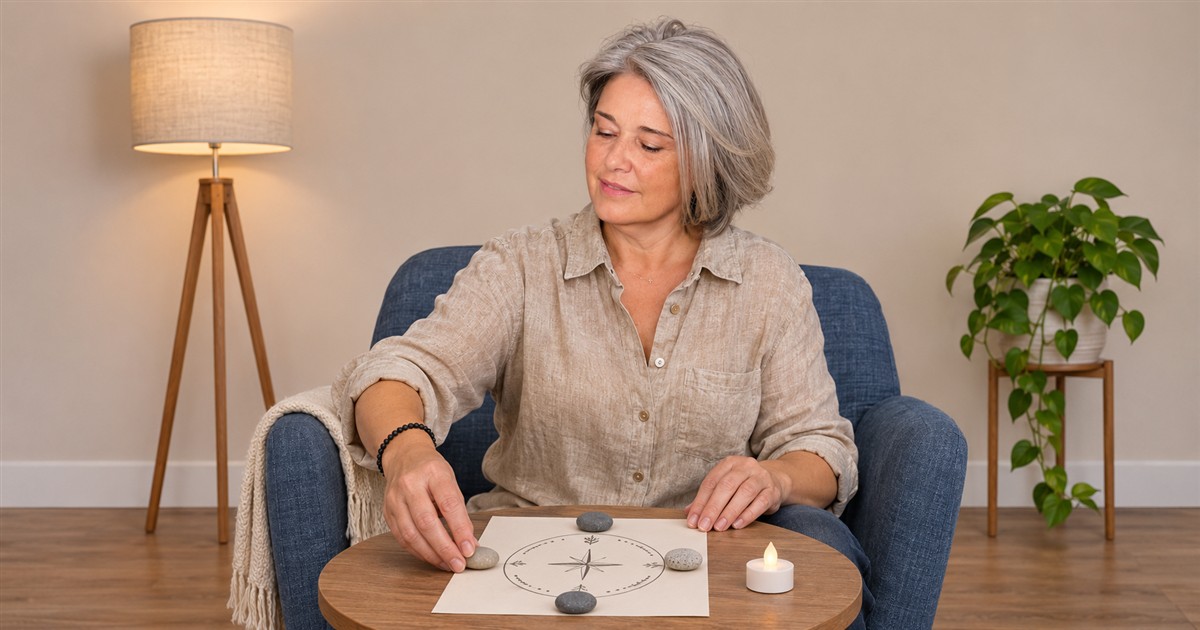
Casting a magic circle marks a space and a period of time for a ritual. Some practitioners understand that boundary as spiritually protective; others use it to distinguish focused practice from everyday activity. The useful starting point is knowing what you are setting apart, how people can move comfortably and how the activity will end.
You do not need a sword, a ring of candles or a line of salt across the floor. The simple practice below uses a clear space, an optional drawn circle on paper and words you understand. It gives you an opening and a closing without asking you to test for unseen threats.
Eight checks before a protection-circle ritual
1. Clarify your values
Choose a practice that fits your own path. The Wiccan Rede is meaningful within particular Wiccan contexts; it is not a rule shared by every witch.
2. Keep the intention protective
Focus on the space, attention and choices in your care. Avoid demands for revenge or control over another person.
3. Ask participants
Explain what you plan and invite rather than assume agreement. Anyone may leave or stop without needing spiritual permission.
4. Choose privacy without isolation
Keep your notes private if you wish. A teacher’s demand for secrecy should never prevent asking for help or checking a concerning instruction.
5. Leave the place cared for
Avoid scattering salt, herbs, cords or objects outdoors. Clear away materials and leave exits usable.
6. Choose no flame
A battery light, ordinary lamp or drawn symbol can mark the circle. Never leave a real candle burning while absent or asleep.
7. Make grounding ordinary
Notice your feet, the chair and the room. Use words or a comfortable gesture; smoke and a bath mixture are unnecessary.
8. Listen to your body
Stop if you feel unwell or distressed and respond to the actual concern. A ritual boundary does not replace care, practical protection or support.
Understand the circle in its particular tradition
A circle can represent a sacred boundary, a gathering place or a container for ritual attention. Its meaning depends on the practice. The Pagan Federation’s introduction to Witchcraft and Wicca describes several paths and differing uses of those names. A personal exercise should not be presented as the required ceremony for every witch or Pagan.
If you are learning with a named tradition, ask its teacher how the circle is understood and which parts are public to share. In your own reflection, say what you actually mean. “I am setting aside this place for quiet writing” is clearer than claiming you have proved a barrier against harmful spirits.
A pentagram is a five-pointed star; a circle has no corners. Some rituals acknowledge four directions, while other systems include different symbols or positions. There is no reason to invent five corners for a circle or combine several systems just because their instructions appear together online.
Choose how to represent the boundary
| Approach | What you do | What to keep practical |
|---|---|---|
| Words only | Name the place and activity you are setting apart. | Use words you understand; a memorized formula is optional. |
| A circle on paper | Draw a small circle in a notebook as a symbol of the session. | The drawing does not need to be large enough to sit inside. |
| A seated gesture | Indicate the space around your chair with a comfortable hand movement. | Stay within a comfortable reach; no turning or standing is required. |
| A walk around the space | Walk a clear route if walking suits you and the room. | Keep doors and exits usable; leave blades, cords and floor candles out of the route. |
| A shared arrangement | Agree where participants will sit and what the boundary means. | Anyone can decline a role, move, leave or end their participation. |
Visualization is optional. If imagining light or a sphere is difficult, use the drawn circle or a spoken description. A lack of vivid mental pictures does not mean you must repeat the opening until it feels different. For help deciding which objects serve a purpose, see using ritual tools on an altar.
A six-step opening and closing practice
- Choose the actual activity. Decide whether you are writing, meditating, reading cards or sharing a quiet reflection. Give it a manageable stopping point, such as finishing one journal question.
- Make the space usable. Put everyday items aside, keep normal lighting available and leave a clear path out. Gather what you need so the session does not become a search for supplies.
- Name the boundary. Draw a circle, make a comfortable gesture or simply describe the place. You might say, in your own words, that this is time for the chosen activity and that you will return to ordinary tasks afterward.
- Begin in language that fits your beliefs. A personal practice can include silence, an intention or a greeting meaningful to you. Invitations to deities, spirits or directions are not required for this exercise. Do not assign another participant a belief they have not agreed to express.
- Do the chosen activity. Keep attention on the question or practice you selected. Pause for comfort, practical needs or an interruption. You can leave the space without treating the movement as a dangerous breach.
- Close deliberately and put things away. State that the activity is finished. If you included a greeting or thanks, conclude it in a way consistent with your own practice. Close the notebook, clear the working surface and choose the ordinary task you will do next.
This is an optional personal structure, not an initiation or a claim to reproduce a community’s private rite. You can shorten it to an opening sentence, one activity and a closing sentence. If you want broader context before practising, the guide to beginner witchcraft explains how interests, study methods and traditions differ.
Let the closing have a clear endpoint
Some practitioners use a reverse direction or sequence when concluding a circle. Follow the context of a tradition you actually practise rather than treating one direction as a universal rule. In the simple exercise above, a plain statement that you are finished is enough.
You do not need a pendulum, dowsing rods or a particular bodily sensation to certify that the circle has closed. An unexpected noise, distraction or ordinary uneasy feeling does not demonstrate that a portal remains open. You can stop, turn on the lights, leave the room or speak to someone you trust if that would help you settle.
Keep spiritual meaning separate from practical protection. A circle does not establish that a room is physically secure, prevent a fire or make an unsafe situation safe. Attend to the actual condition that needs attention instead of testing the boundary repeatedly.
A filled-in example: Arden plans a short shared reflection
In this fictional example, Arden and a friend want to write about a seasonal change. They use a table and ordinary lighting, with no floor markings or flame.
- Purpose
- Each person writes one thing they want to make time for in the coming week.
- Boundary
- A small circle drawn at the top of each notebook marks the activity. Both people can move or leave whenever they need.
- Opening
- Arden explains the question and asks whether the friend wants quiet writing or conversation. The friend chooses quiet.
- Closing and next step
- They close their notebooks when each has finished the question, say that the reflection is complete and put the pens away. Sharing an answer remains optional.
Leave unnecessary materials out
This practice needs no smoke, scattered powder, saltwater or sharp tool. Avoid making lines across an exit or placing objects where people could trip. Outdoors, you can keep the boundary symbolic without collecting plants, marking surfaces or leaving materials behind.
If you choose a candle for another version, the U.S. Fire Administration’s candle guidance calls for a stable holder and at least 12 inches, about 30 centimetres, of clearance from things that can burn. Put the flame out before leaving the room or going to bed. A battery-operated light avoids the open flame.
An altar can hold the objects you actually use without filling the walking space. The guide to creating a meaningful altar space develops that choice. The circle’s value in your practice can rest in the attention, context and clear ending you give it, rather than in a promise that it blocks every possible harm.
Questions about casting and closing a circle
1. What does casting a magic circle mean?
It usually means setting apart a space for a spiritual or symbolic activity. Practitioners may understand it as sacred or protective, but meanings and methods vary. Identify the tradition or personal purpose before treating its instructions as a universal rule.
2. Do I need a wand, sword or candles?
No. The optional practice here can use words and a small drawing on paper. A comfortable hand gesture is another choice. Sharp tools, flames, smoke and a physical line around the floor are unnecessary.
3. Must I walk clockwise and close counterclockwise?
Some practices use those directions; others use different arrangements. Follow the context of a tradition you actually practise. For this personal exercise, an opening statement and a clear closing statement are enough, and walking is optional.
4. Can I leave the circle before the activity ends?
Yes. Attend to comfort, practical needs and interruptions. A symbolic boundary does not trap participants or make ordinary movement a dangerous breach. Anyone joining a shared practice should be free to pause or leave.
5. Does a circle have five corners?
No. A circle has no corners. A pentagram has five points, and some rituals acknowledge four directions. These are different arrangements; do not combine their instructions without understanding the context.
6. How can I tell that the circle is closed?
For the simple practice here, state that the activity is finished and put the materials away. A pendulum, unusual sensation or perfect mental picture is not required to certify an ending. You can return to an ordinary task.
7. Does a magic circle guarantee protection?
No. Spiritual protection is a belief or interpretation, not proof that practical hazards have been removed. Keep exits usable, manage actual risks and seek ordinary help for a situation that needs it.
8. What if I cannot visualize a circle of light?
Use a spoken description, a small drawing or a comfortable gesture instead. Mental imagery is optional. You do not need to repeat the opening until you feel a particular sensation.
It’s interesting how the article touches on the importance of cleanliness and setting up an altar. These steps seem crucial for ensuring the magic circle’s effectiveness.
Therre’s a lot of specific information here, althouh some parts are a bit confusing. For example, the section on closing the circle could be more clear.
The article provides a good overview of the topic but there are some syntax errors that make it dificult to follow in certain sections. Overall, it’s insightful for those new to witchcraft.
The idea of using a circle as a boundary agaisnt harmful energies is intriguing. However, I wonder how one verify if the circle is effectively active or not.
I found this article to be very detailed in explaining the different uses of a magic circle. It covers both the practical steps and the underlying principles.