

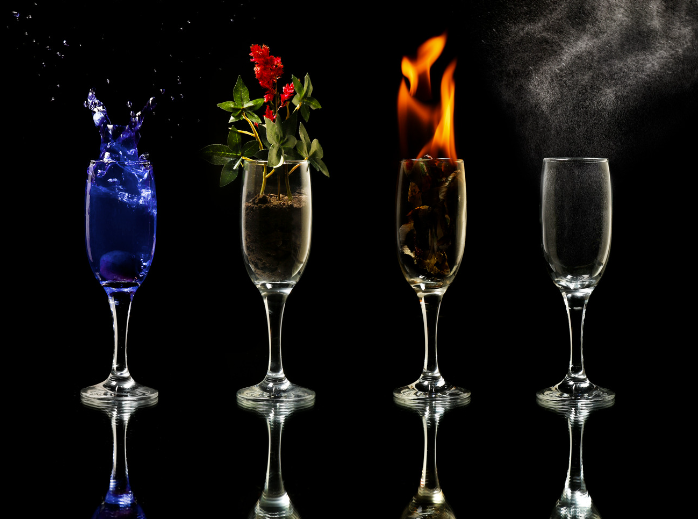
Earth, air, fire and water give many magical practices a language for describing qualities: steadiness, thought, change and feeling, for example. Some systems add spirit as a fifth element. The most useful way to read those associations is as part of a particular symbolic framework, with a source and a context.
A correspondence table is not a set of measurements about your personality, a guarantee that a spell will work or a complete description of nature. You can understand the framework without believing that every object has one fixed magical category.
Know which meaning of “element” a source uses
In a ritual guide, “element” may mean a spiritual principle, a symbol or a group of associations. In chemistry, it refers to a different system, represented by the Royal Society of Chemistry’s periodic table. Do not use a magical correspondence to decide how a physical substance behaves.
The Harvard Pluralism Project’s account of Pagan practice describes varied rituals and the use of elemental representations. It is useful context for learning about those practices; it does not make one correspondence chart a rule for every Pagan or witch.
Read the four elements as a framework
The examples here introduce common themes in contemporary elemental writing. The questions and paper symbols are suggestions for a personal reflection, not a claim that every tradition assigns the same qualities or accepts the same substitutions.
| Element | A symbolic theme to explore | A question and simple representation |
|---|---|---|
| Earth | Stability, material needs and steady attention. | What needs practical care? Draw a stone or write the task instead of collecting soil or plants. |
| Air | Thought, language, ideas and communication. | What needs to be said clearly? Write a sentence or draw a moving line; incense is unnecessary. |
| Fire | Initiative, determination and change. | What can I begin or change through my own action? Use a drawn flame, colored card or ordinary light without an open flame. |
| Water | Feeling, receptivity and responding to change. | What am I feeling, and what do I still need to ask? Draw a wave rather than treating an emotion as knowledge of someone else. |
| Spirit, when included | Connection, integration or a spiritual understanding of the whole. | How do the parts of this reflection fit together? Write a closing sentence in language consistent with your own beliefs. |
These themes can overlap. A letter involves the physical page, the ideas expressed and the feelings behind it. You do not have to decide that it belongs exclusively to one element before writing it. The symbol can help you notice a question rather than settle an argument about the object.
Why correspondence lists sometimes disagree
One list may combine directions, colors, seasons, tarot suits, planets, runes and chakras. Those categories come from different systems. Placing them in one table does not show that they share a single origin or that every assignment is interchangeable.
Check the author’s context before combining charts. Does the writer name a tradition, a deck, a teacher or a personal interpretation? If two lists assign a tool differently, record the difference rather than deciding that one must make your practice fail. A list with more entries is not automatically better supported.
Directions and seasonal associations also need context. Do not assume that a chart was written for your location or landscape. If you are learning a named practice, ask how its community uses the system. In a personal exercise, explain your own choice instead of claiming it is required everywhere.
Some older tables label qualities masculine or feminine. Those are terms used within a symbolic scheme, not instructions for what people of a particular gender may feel, think or practise. You can describe an idea more directly as active, receptive, changing or stable when that fits what you mean.
Keep spirit in its own context
Some practitioners include spirit alongside the other four elements, while others use a different arrangement or none at all. Describe the specific system you are studying. Do not assume that the words spirit, aether and akasha have identical meanings in every tradition that uses them.
A spiritual account of connection is different from a demonstrated physical force. You can express a belief honestly without saying that it is a measured energy running through every object. Nor does a pentagram by itself tell you the full meaning someone assigns to its points.
A five-step way to study a correspondence chart
- Name the source. Record the author, title and the tradition or perspective the writer actually identifies.
- Choose one association. Begin with a single pairing, such as earth and steadiness, instead of copying every row into a shopping list.
- Explain it in ordinary words. Write why that association makes sense in its context and what remains uncertain.
- Connect it to a question you can act on. Ask about your own preparation, communication or next task. Leave other people’s choices open.
- Review the action separately. Notice what you did and learned. A symbol, coincidence or strong sensation does not prove a supernatural result.
A filled-in example: Kei prepares for a conversation
In this fictional example, Kei wants to ask a friend about a changed plan. Four elemental prompts help organize the question without predicting the friend’s answer.
- Earth: the practical detail
- Kei checks the agreed date and the actual message rather than relying on a memory of the plan.
- Air: the words
- Kei writes, “Are we still meeting on Saturday, or would another day work better?”
- Fire: the chosen action
- Kei sends one appropriate message instead of repeatedly checking for a sign.
- Water: the feeling and uncertainty
- Kei notices disappointment but leaves the reason for the changed plan open until the friend replies.
If Kei wants a closing thought, it can simply connect the four parts: check the detail, ask clearly, act once and listen. No elemental score or judgment about the friend’s character is produced.
Use representations without adding unnecessary hazards
You can put four words on a page or choose one symbol at a time. Representing fire does not require lighting it; representing air does not require smoke or breath-holding; representing water does not require drinking a mixture or going near open water. A personal exercise can stay small and comfortable.
If you choose a real candle elsewhere, follow the U.S. Fire Administration’s candle guidance: use a stable holder, keep it at least 12 inches, about 30 centimetres, from things that can burn and extinguish it before leaving or sleeping. Symbolic protection does not replace those practical precautions.
For the distinct question of arranging objects, see using ritual tools on an altar. For opening and ending an activity in a chosen space, see casting and closing a magic circle. Learning the elemental vocabulary can help you read those guides while keeping their purpose and practical limits clear.
Questions about the elements of magic
1. What are the four elements in this magical framework?
Earth, air, fire and water are used as symbolic or spiritual categories in many contemporary magical writings. Their meanings depend on the system and source. They are different from the chemical elements represented in a periodic table.
2. Is spirit always a fifth element?
No. Some systems include spirit, and others use a different arrangement. Identify the particular source before assuming what a fifth point or word means. Spirit, aether and akasha should not automatically be treated as identical terms in every tradition.
3. Why do two correspondence charts disagree?
They may describe different traditions, decks, locations or personal interpretations. Check the context and record the difference. A disagreement does not by itself show that one chart makes a ritual fail.
4. Do colors or gender labels tell me what kind of person I am?
A symbolic category does not establish a person’s character, abilities or role. Gendered language in a correspondence table is not a rule about what people may think, feel or practise. Use more specific descriptions when they clarify your meaning.
5. Do I need to collect tools for every element?
No. For the optional reflection here, written words, drawings or ordinary objects can represent an idea. A spiritual association does not require fire, smoke, plant materials, mixtures or a purchase.
6. Can I use one element without all the others?
You can focus on one idea in a personal study or reflection. If you are learning a particular community’s practice, ask how that system is used rather than assuming that a personal adaptation represents its ceremony.
7. How can I use an elemental prompt without making a prediction?
Connect the symbol to a question about your own action: check a detail, choose words, begin a task or name a feeling. Review what you actually did. The exercise does not reveal someone else’s thoughts or calculate a magical outcome.
Interesting read about the different elements and their role in magic. The association of colors and tools with each element is particularly enlightening. Though, there are some grammatical issues that need attention.
Detailing the elements and their influences is quite informative. The Fire element described as an ‘outsider’ becaus has no real control intrigued me. It’s a fresh perspective, albeit the article could benefit from some syntactical improvements.
The breakdown of elements and their corresponding characteristics is quite insightful. The linkage between Air, logic and theory offers a fascinating perspective. Some sentences, though, are hard to follow due to syntaxic errors.
This article provides a comprehensive overview of the elemental forces in various magical practices. The distinction between each element and its associated attributes is well laid out. However, the syntax could be refined for better readability.
An engaging overview of elemental magic. The Spirit element being described as a binding force that transcends physical form is captivating. Nevertheless, the text could use a more polished syntax for clarity.