

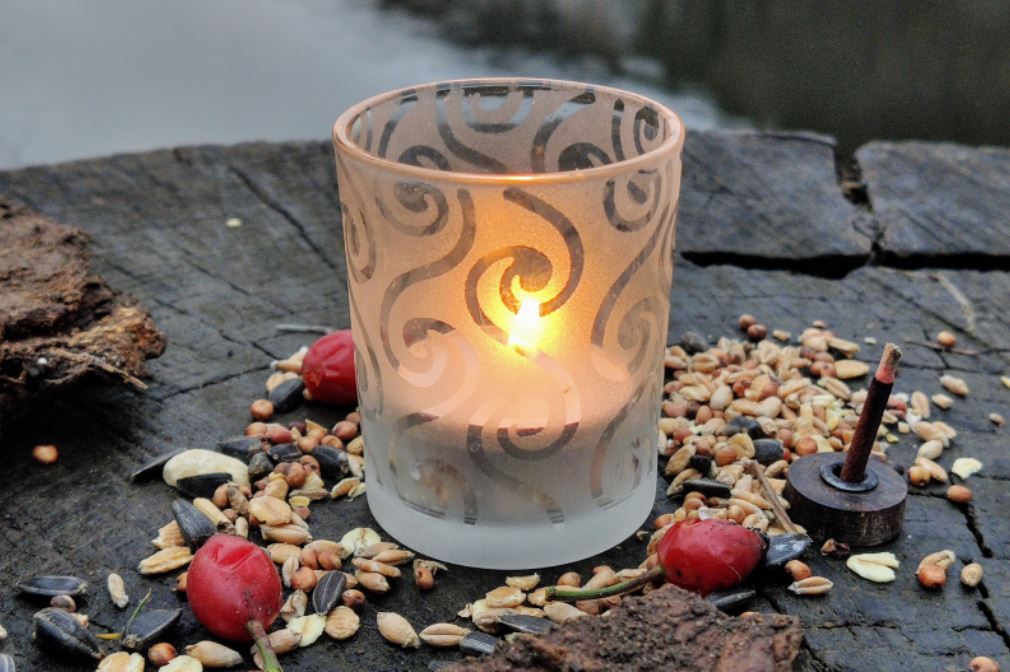
A seed can be a useful image for something you want to give time and attention: honest conversation, curiosity or making room to meet people. Love folklore also gives seeds another role, as objects used in attempts to glimpse a future partner. Enjoying that symbolism does not mean a seed can identify someone you are destined to love.
Start by deciding whether you want to learn about a historical custom or create a personal reflection. This guide separates those purposes and offers a simple paper exercise. You need no special seed, late-night outing or promise that a dream will bring you an answer.
What the seed-sowing stories describe
In Robert Burns’s poem “Halloween,” preserved by the Scottish Poetry Library, a character tries a hemp-seed custom connected with seeing a future sweetheart. The episode turns comic when the frightening presence proves to be a pig. This is a literary depiction of divination, not a demonstration that sowing seed predicts a relationship.
Folklore collector Roy Vickery’s account of hemp-seed love divination brings together records from different places and occasions. Some involve looking back after sowing, and the dates vary. His examples include Valentine’s Eve in Derbyshire and Devon as well as other calendar customs. They do not establish a universal instruction for every spiritual tradition.
These accounts are about particular recorded beliefs. They are not a reason to replace the named seed with birdseed, enter a garden at midnight or treat any figure you see as a future spouse. You can learn about a custom without reproducing its setting or accepting its prediction.
Keep three kinds of meaning separate
| What you encounter | What it means here | A useful next step |
|---|---|---|
| A historical account of seed divination. | Evidence that a belief or custom was recorded, with a particular source and setting. | Read the account in context rather than treating it as a tested method. |
| A seed used as your own symbol. | A reminder of a quality or action you want to practice. | Write the action in ordinary language and decide when to try it. |
| A plant grows, a message arrives or you have a vivid dream. | An event you can notice; it does not identify a destined partner or prove a ritual caused it. | Keep observations separate from conclusions about another person’s interest. |
A modern seed-symbol practice, without scattering anything
This optional exercise is a new personal reflection, not a reconstruction of the folklore above. Use paper and a pen. Draw a small seed, or simply write the word “seed.” Its shape, color and accuracy do not determine an outcome.
- Choose a quality. Write something you want to practice, such as honesty about your interests. Avoid making a specific person’s attraction your assigned task.
- Name a small action. Beneath the drawing, write what that quality would look like in an actual situation: answering a question honestly, for example.
- Leave room for a different response. Add what you will respect, including a declined invitation, a difference in preference or someone being unavailable.
- Put the card somewhere appropriate. Keep it in your own notebook or another private place. Do not leave it in someone’s belongings or use it to involve them secretly.
- Review the action, then close the activity. After the situation you chose, record what you did. You may keep, revise or recycle the card. You do not need to burn it or repeat the exercise until someone changes their mind.
A filled-in example: growing room for honesty
In this fictional example, Mira is going to a local book group and often agrees with other people’s opinions to seem appealing. Mira uses a drawn seed as a reminder to contribute honestly, whether or not anyone there becomes a romantic interest.
- The quality
- Be curious without hiding my own preferences.
- The symbol
- A seed drawn on an index card in my notebook.
- The action
- Offer one honest observation about the book when there is a suitable chance to join the discussion.
- The boundary
- No participant owes me agreement, attention outside the group or a date.
- The observation
- Did I share the thought I actually had and listen to someone else’s response?
- The next step
- Keep attending if I enjoy the group. Change my own plan if it does not suit me, rather than reading the evening as a prediction.
If you want to use an actual seed
Choose an ordinary gardening activity separately from the love symbolism. Use a place you own or have permission to plant, identify the seed and follow its packet and suitable local growing advice. Do not scatter unknown seeds, mixed bird food or seeds collected from someone else’s property as part of this exercise.
A drawing avoids buying or growing anything. You also do not need to eat a seed, put it under a pillow or keep loose materials near children or pets. If you choose a plant, whether it sprouts is a gardening observation, not a verdict on your capacity to love or be loved.
Choose a convenient time, not a romantic deadline
For this personal practice, choose a comfortable time that fits your day. Valentine’s Eve is February 13; Valentine’s Day is February 14. Neither is a required appointment for the exercise, and changing the time does not create a spiritual penalty.
There is no need to enter a churchyard, private garden or unfamiliar outdoor place after dark. You can read the historical accounts at home and keep your own practice entirely indoors. Nor do you need to wait until summer to find a person imagined during the activity.
Let real relationships provide real information
A dream or coincidence can be something you reflect on without making it evidence of a stranger’s identity or wishes. If you later meet someone, learn about them through actual conversation and freely expressed interest. Accept a clear refusal rather than interpreting it as a challenge from the ritual.
The beginner love-practice guide gives more examples of turning an intention into a respectful action. For another way to read historical objects and claims, see love charms and their recorded context. Neither a custom nor a symbol can supply another person’s agreement.
Questions about seed rituals
1. What is a seed ritual for love?
The phrase can describe a folk divination custom or a modern symbolic activity about hopes for a relationship. These are different uses. A record of a custom tells us what people believed or did; it does not establish that the activity reveals a future partner.
2. Must I do it on Valentine’s Eve?
No date is required for the personal exercise here. Historical accounts describe different occasions. Valentine’s Eve means February 13, the evening before Valentine’s Day, rather than a two-day window that guarantees an effect.
3. Do I need hemp seed, birdseed or sunflower seeds?
No. Draw a seed on paper for the exercise below. You do not need to buy, grow, eat or scatter any seed. The symbol stands for a quality you want to practice, not an ingredient that controls attraction.
4. Should I look over my shoulder for my future partner?
That action appears in some accounts of love divination. You do not need to reenact it. Seeing a person, a shadow or an animal does not identify a destined partner or give you permission to approach someone who does not want contact.
5. Will a dream afterwards show my soulmate?
A dream may feel meaningful, but its occurrence or vividness cannot confirm that it depicts a future partner. You can write down what you remember without searching for someone to match it or treating the dream as their consent.
6. Can I plant a real seed instead of drawing one?
You may choose an ordinary gardening project if you have permission for the place and know what you are planting. Follow the seed packet and appropriate local planting advice. Germination and plant growth are not measures of romantic worth, compatibility or another person’s feelings.
7. What if no relationship follows the ritual?
The exercise promises no romantic outcome. Review only the action you chose, such as expressing an honest preference or making time for an activity you enjoy. You have not failed spiritually because another person is unavailable or uninterested.
8. Can two people try it together?
Yes, if both understand the activity and want to join. Each person can choose their own quality and action, and either may stop. Sharing a symbol does not create a promise to date, remain together or adopt the same beliefs.
Interesting read. But, does it has scientific proof that these rituals work? I wonder how many people found love useing these methods.
A thought provoking article. While it seems somewhat whimsical, the practice of using seeds and spells for love is intriguing. However, I would like to see more empirical evidence or testimonials to support its efficacy.
Hmm, the idea of using seeds to find love is quite fascinating. I wonder if it varies based on geographical location or cultural beliefs. Also, is there any historical context to this practice?
The concept is unique, but is there any evidence that scattering seeds has a direct correlation to finding love? Does it tie in with any ancient traditions or is it more of a modern-day ritual?
This is a very specific ritual. The timing, the method, the seeds—it seems like there is alot of detail that needs attention. I’m curious about the origin of this ritual, though. Who came up with this idea?