

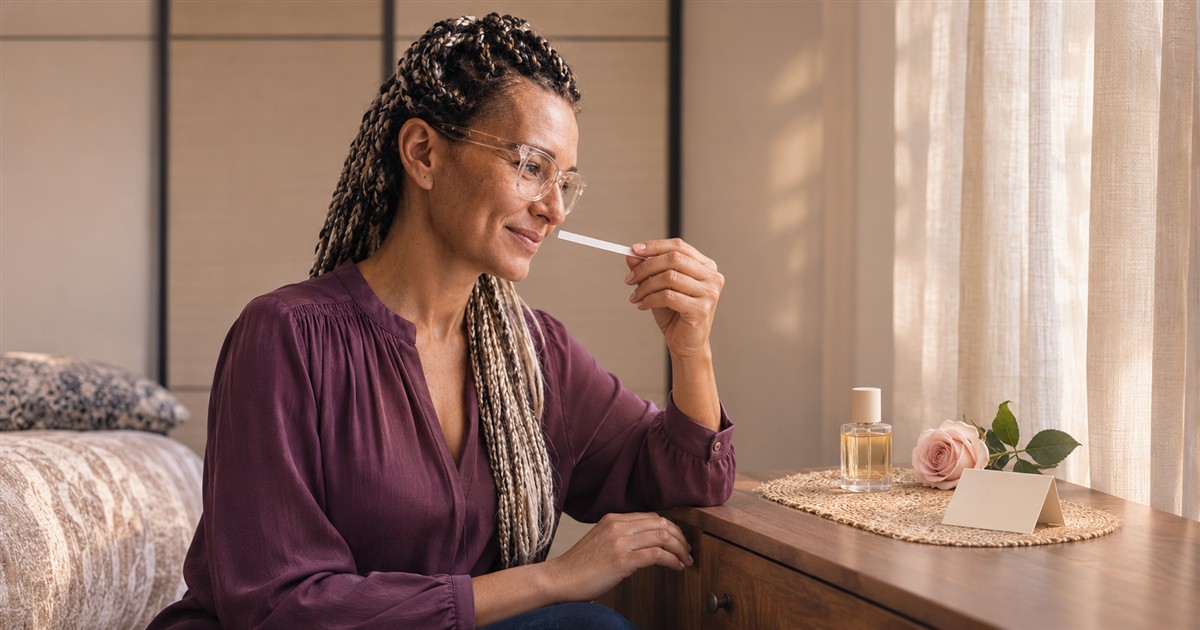
A familiar perfume can make a moment feel intimate before you have words for it. In love magic, fragrance can become a personal symbol of warmth, confidence or welcome. The best starting point is a scent you genuinely enjoy—or no scent at all if that suits you better.
This ritual uses an identified, finished fragrance according to its label, with a paper card as a scent-free alternative. It asks you to set an intention for how you want to show up, rather than trying to change someone’s feelings without their knowledge.
Choose meaning before choosing a bottle
Rose or a floral theme
You might associate it with tenderness, a garden or a particular memory. Ask: what does care look like in my actions?
Vanilla or a warm theme
It may suggest comfort to you and feel too sweet to someone else. Ask: what helps me feel at ease without assuming a shared preference?
Citrus or a bright theme
You may choose it as a fresh-start symbol. Ask: what small invitation or new possibility am I open to?
An unscented symbol
A colored card, flower drawing or familiar stone can hold the intention without exposing anyone to fragrance.
Scent, memory and attraction are different questions
A smell may remind you of a person or place and influence how you experience a setting. That personal association does not make it a reliable signal of another person’s attraction, availability or consent. Someone may enjoy a scent, dislike it or need to avoid it.
A commercial “love potion” name describes a theme, not proof of a guaranteed response. Nor does adding more fragrance make a ritual stronger. Keep spiritual associations personal and ask the other person what they actually prefer.
A five-step scent ritual for a welcome connection
- Name your own intention. Choose a quality such as warmth, honesty or confidence. Avoid “they will desire me.”
- Check the setting. For shared space, ask whether fragrance is welcome. If anyone prefers none, use the unscented card version.
- Choose an identified finished product. Use it only in the way its label permits. A perfume intended for skin, a room fragrance and a concentrated oil are different products.
- Mark the moment. Place your intention card nearby. If suitable, use the fragrance as directed; otherwise imagine or draw the scent’s symbol. Say, “May I meet this moment with warmth and respect.”
- Close with an invitation. Put the materials away. Choose a clear, welcome action, such as asking whether someone would enjoy meeting for coffee. Their answer remains open.
Leave concentrated perfume recipes to suitable product guidance
Do not mix arbitrary essential oils and apply the concentrate to pulse points. A pleasant smell, a “natural” label or several days in a dark bottle does not establish skin suitability. Poison Control explains that misuse of essential oils can cause poisoning and skin reactions. Keep products labeled and out of reach of children and pets.
Do not add fragrance or ritual oil to anyone’s drink, food, belongings or body without their knowledge and agreement. Never add arbitrary oils, powders or herbs to a lit candle. A card ritual can express the same intention without these exposures.
The guide to magical oils explains product labels and uses in more detail. If someone feels unwell after exposure, respond to the symptoms and seek appropriate advice rather than interpreting them as proof of spiritual cleansing.
Keep a useful personal scent note
Record the product name, the setting, whether fragrance was welcome and how you experienced it. Keep the observation “I felt comfortable wearing it” separate from “it made them interested.” You cannot establish someone else’s feelings from a perfume or a coincidence.
For a broader practice, see love affirmations and the beginner love-spell guide. Let fragrance be one optional part of your practice, with room for ordinary conversation and different preferences.
Questions about this practice
1. Can scent be part of a love spell?
Yes, if it is meaningful and suitable for your setting. You can use it as a personal symbol without claiming it controls attraction.
2. Which scent attracts everyone?
There is no universal preference. Ask rather than assuming a floral, warm or spicy scent will appeal to another person.
3. Can fragrance reveal that someone is single?
No. Do not infer relationship status, interest or consent from a person’s scent.
4. Do I need a love-potion perfume?
No. An ordinary identified product you like, used according to its label, is sufficient if fragrance is wanted at all.
5. Can I use a scent-free version?
Yes. Draw a flower or choose a colored card to represent the quality you want to bring to the moment.
6. Can I use essential oil directly on skin?
Do not apply an arbitrary concentrate or unknown ritual blend. Follow appropriate directions for an identified finished product.
7. Does a dark bottle make a homemade blend safe?
No. A container or waiting period does not establish the ingredients, concentration, stability or suitability of a mixture.
8. Can I add perfume to a drink?
No. Keep fragrance and ritual oils out of food and drink, and never add an undisclosed substance for someone else to consume.
9. Can I anoint someone’s belongings?
Ask before applying anything to another person’s body, clothes or property. A symbolic purpose does not supply permission.
10. Should I use a diffuser for a shared ritual?
Only if the product, setting and everyone affected make that appropriate. An unscented option is simpler when there is uncertainty.
11. Does more scent mean stronger magic?
A stronger smell is not an established measure of spiritual power and can make a shared setting unpleasant or unsuitable.
12. Can I add oils to a candle?
Do not add arbitrary fragrance oils, powders or herbs to candles. Follow the exact product’s directions or choose a battery light.
13. What if my partner dislikes my favorite scent?
Respect the preference and choose a different or unscented shared practice. Disliking a fragrance is not rejection of you.
14. How should I store products?
Keep them labeled, follow product storage instructions and keep them out of the reach of children and pets.
15. How can I review the ritual?
Record your own comfort, choices and actions. Ask about another person’s preferences instead of reading them from signs.