
Love magic has a real documented history, but that history is more complex than the idea that every civilization practiced the same kind of “love spell.” The supplied draft covered many cultures in a broad sweep. This revised version narrows claims to what surviving evidence can support and separates documented history from modern spiritual inspiration.
Ancient and medieval sources show people using rituals, prayers, amulets, figurines, written formulas, herbs, perfumes, knots, and other symbolic tools for attraction, marriage, affection, fertility, reconciliation, or control. The meaning of those practices changed from place to place.
What Counts as Evidence for Ancient Love Magic?
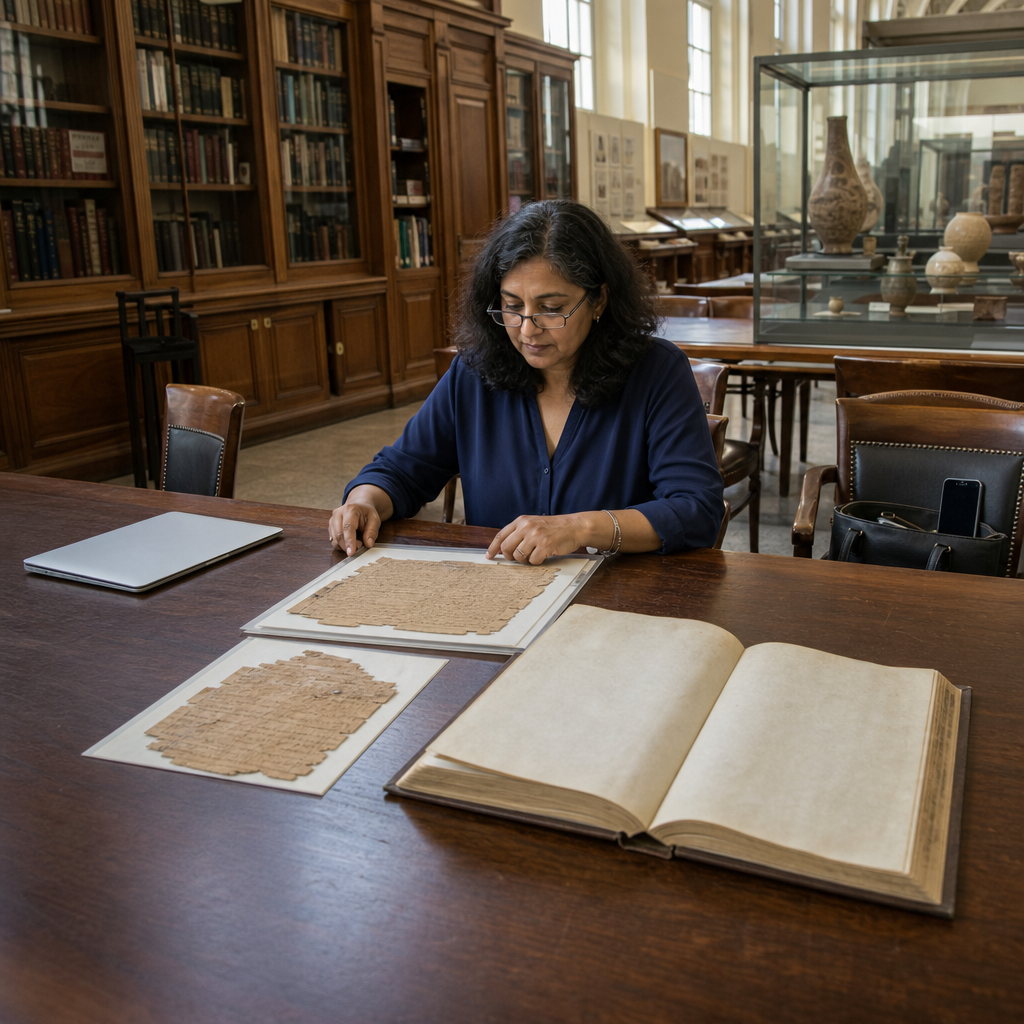
Historians rely on surviving objects and texts: papyri, tablets, inscriptions, figurines, amulets, recipe books, court records, religious texts, and literary references. For example, the British Museum’s London Magical Papyrus includes a catalogued love spell among many other ritual texts. The British Library also preserves Greek magical papyri containing love spells from Late Antique Egypt.
These sources are especially useful because they let us discuss a specific object, language, date, and context instead of making vague claims about an entire civilization.
Greco-Roman Egypt and the Magical Papyri
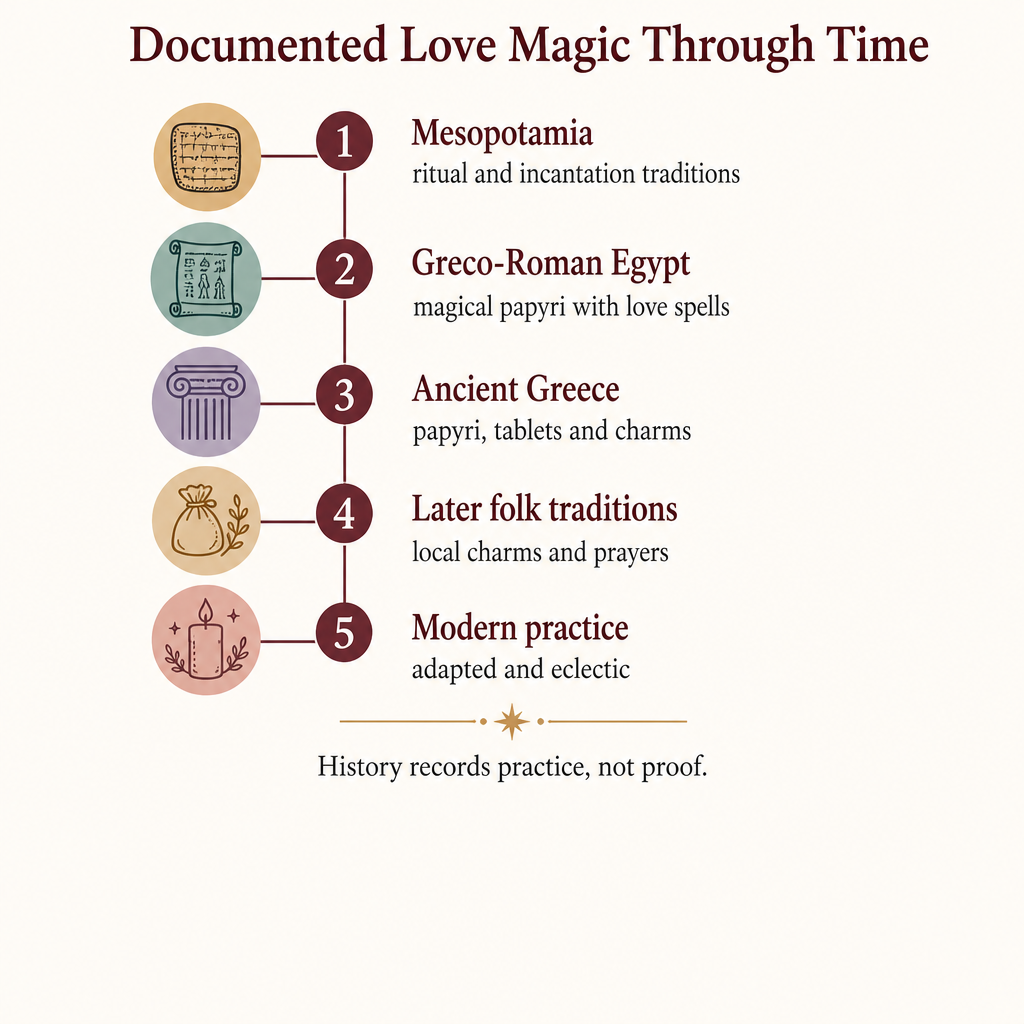
Some of the clearest surviving love-spell texts come from Egypt during the Greco-Roman and Late Antique periods. They may be written in Greek, Demotic Egyptian, or mixed linguistic traditions. They include attraction spells, binding rituals, love charms, and instructions involving objects or spoken formulas.
Many of these historical texts are coercive by modern standards. A modern consent-centered article should not romanticize that feature. Studying an ancient practice and recommending it are two different things.
Ancient Greek Love Magic
Greek evidence includes magical papyri, curse tablets, gemstones, figurines, and references in literature. Scholars distinguish different types of attraction and affection magic rather than treating “Greek love spells” as one uniform practice.
This is one place where the modern idea that ancient love magic was mainly about gentle harmony breaks down. Some historical spells explicitly attempted to compel or bind another person.
Mesopotamian Ritual Traditions
Mesopotamia preserves a large body of incantations and ritual literature. It is safer to say that magic and ritual were well documented there than to turn every marriage, fertility, or relationship custom into a “love spell.” The category itself is often a modern label applied to varied ancient practices.
Ancient Egypt Beyond the Simplified Story
Popular spiritual writing often says “Ancient Egyptians used love spells” without a date or source. A more accurate statement is that magical texts from Egypt, especially later periods with Greek and Demotic material, include love spells and related rituals. This distinction matters because Egyptian history spans thousands of years and many changing religious contexts.
For a site-specific companion piece, see What Are Egyptian Love Spells?.
Europe, Folk Practice, and Household Ritual
Across later European history, people used charms, prayers, herbs, written formulas, divination, and household customs connected with courtship, marriage, fertility, and affection. These practices varied by region and religious environment. It is better to discuss a particular folk custom than to claim there was one medieval European love-magic system.
Africa, Asia, and Indigenous Traditions: Avoiding Overgeneralization
The supplied draft treated Africa, India, China, Japan, and Indigenous cultures as large single traditions. That is too broad. Each region contains many religions, languages, ethnic groups, and local practices. Some have relationship blessings, marriage rituals, divination, ancestor traditions, shrine practices, charms, or folk magic, but they should be studied on their own terms.
A respectful history does not automatically relabel every relationship ceremony as a love spell.
How Modern Love Magic Developed
Modern witchcraft and eclectic spirituality often combine older folk practices with ceremonial magic, astrology, modern crystal culture, candle rituals, manifestation language, and internet-era interpretations. This means a modern ritual may be inspired by older symbols without being an unchanged ancient practice.
For the site’s wider background material, History of Magic provides another entry point, while Understanding Wicca covers one modern religious context that is often incorrectly treated as identical to all witchcraft.
Consent: A Major Difference Between Historical Study and Modern Practice
Historical love magic often reflects social values very different from modern relationship ethics. Some texts tried to compel desire, restrict a partner, or override resistance. A modern article can document that history without endorsing it.
Today, a safer framing focuses on self-love, openness to compatible partners, mutual reconciliation, relationship harmony, and personal reflection.
Frequently Asked Questions
1. How old is documented love magic?
Written evidence survives from antiquity, including magical papyri from Greco-Roman Egypt. This shows that love-related ritual texts are at least many centuries old, though practices and purposes differed widely.
2. Did ancient Egyptians use love spells?
Love spells appear in magical papyri from Egypt, especially from the Greco-Roman and Late Antique periods. It is more accurate to discuss specific surviving texts than to claim that all ancient Egyptians practiced the same rituals.
3. Did ancient Greeks practice love magic?
Yes, surviving Greek magical texts, curse tablets, amulets, and literary references document several forms of love magic. Some were coercive by modern standards.
4. Were ancient love spells always positive?
No. Historical evidence includes attraction, binding, compulsion, and other practices that would conflict with modern consent-centered ethics.
5. Did Mesopotamia have magic?
Mesopotamian sources preserve extensive ritual and incantation traditions. Claims about specific love rituals should be tied to documented texts rather than generalized from magic as a whole.
6. Were candles used in all ancient love rituals?
No. Depending on place and period, rituals could involve lamps, figurines, tablets, papyrus, amulets, incense, oils, knots, spoken formulas, or other materials.
7. Did every culture have love spells?
Many societies developed rituals around love, marriage, fertility, family, or attraction, but it is too broad to say that every culture had the same thing called a love spell.
8. What are the Greek Magical Papyri?
They are a modern scholarly name for a collection of magical texts, mainly from Greco-Roman Egypt, containing rituals for many purposes including love, protection, divination, and healing.
9. What is a love-binding spell in history?
Some ancient texts sought to bind, compel, attract, or restrain a desired person. These historical practices should be described accurately without presenting coercion as a model for modern relationships.
10. How did folk traditions change over time?
Rituals changed as religions, languages, trade, migration, family customs, and local beliefs changed. Modern practice often combines inherited traditions with newer eclectic spirituality.
11. Are modern love spells direct copies of ancient spells?
Usually not. Some modern practitioners borrow symbols or ideas from older material, but modern rituals are often simplified, adapted, or newly created.
12. Why is cultural context important?
A ritual can have a specific religious, ethnic, or historical meaning. Removing it from that context can lead to inaccurate claims or disrespectful borrowing.
13. Can historical sources prove magic works?
Historical sources can show that people practiced and believed in magic. They do not by themselves prove that a ritual caused the desired supernatural outcome.
14. Where can I see documented ancient love magic?
Major libraries, museums, and academic collections preserve magical papyri and related objects. The British Museum and British Library, for example, catalogue texts that explicitly include love spells.
15. What is the best way to study love-spell history?
Use museum catalogues, academic publications, primary-text translations, and scholarship that identifies the date, language, place, and cultural setting of each source.
Final Thoughts on the History of Love Spells
Love magic has a long and fascinating documentary record, especially in ancient Mediterranean material. But the strongest history is specific: it names the text, object, place, language, and period whenever possible.
That approach is more respectful to the cultures involved and more useful for readers than a single story claiming that all societies shared the same beliefs. Modern practitioners can be inspired by history while still recognizing how much spiritual practice has changed.
I realy appreciate the care on specificity here, the draft was broad but this revision show more attencion to date place and object which make the historry more trustable, some sentance are long and slipp in punctuation yet the meaning remain clear and hopeful about learning not endorsing coercion, very respecful and usefull for readers seeking facts
This is a richly texted overview that, even with a fewe typo and odd phrasing, signal the imporance of context and evidence; i like how it separes belief from proof and it encouragess respectful use of source material, it make me think about continuities and changes across time and also about ethics in modern practice, very inspirring and bright ✨
Nice clear work that dont oversimplify, i like the FAQ style and the way it say where to look for original texts, sometimes lines run together and grammer slip but the core message come through: study the object not the myth, be respectful, and dont romanticize coercion, that advice feel wise and caring to me
Thoughtful revision that privilegess primary objects and proper dating, i apreciate the nuance about regional diversity and dangers of overgeneralizing; the prose sometimes contain segmentation and logographic slips yet the analytic frame remain intact and constructive, it invites furthur research while advising ethical modern adaptation, very encouraging for students and practitioners alike 🙂
Such a gentle and usefull walkthru of olde texts and objects, i like how it say name place and date even when some thing is missing it still feel respectfull to the cultura, many words is a bit tangled but i was smiling reading about papyri and charms, its helpful and warm and gives me idea for study 😊
this piece is very good it show many thing but not one story ok i like that, the author put many names and places but i get confuse some time, still it shows peoples hope and ritual and it make me feel kind and happy to think about old love things, good job folks 👍
wow this old writting is so fun to read i like it alot it feels like magik and papers with little picture and words run together i cant read all but i feel warm and curiouse, people was tryna love yes 😊 its nice to learn about how they did it and why it was importent, makes me smile and want to know morre
Im happy this talk about consent and history not glamorize bad thing, it keep a kind and safe tone while still be curious about old spell papers and amulets, some words get mashed together or verb dont match but it still read friendly and warm, i feel safer reading this and learn alot about place and time